What Is Answer Engine Optimization: A Shopify Guide 2026
You open Shopify analytics, see product page traffic holding up, and then notice your blog and educational pages aren't pulling the same weight they used to. Impressions may still look respectable. A few rankings are still there. But clicks feel softer, especially on informational searches.
At the same time, customers say things like, “I found your brand in ChatGPT,” or “Google showed me the answer right on the results page.” Useful visibility, yes. Obvious traffic, not always.
That's where Answer Engine Optimization, or AEO, matters. For Shopify stores, this isn't just another acronym beside SEO. It's a change in how shoppers discover products, compare options, and narrow choices before they ever land on a collection page. In practice, AEO has become the new long-tail for product discovery. Smaller, sharper brands can use it to win question-based demand that bigger retailers often ignore or answer too slowly.
Table of Contents
- Why Your Shopify Traffic Is Changing and What to Do About It
- From Search Engines to Answer Engines The New Reality
- AEO vs SEO Understanding the Strategic Difference
- The AEO Playbook A Tactical Guide for Shopify Stores
- How to Measure AEO Success Beyond Clicks and Rankings
- An AEO Checklist for Your Shopify Product Pages
- Integrating AEO into Your Workflow with wRanks
Why Your Shopify Traffic Is Changing and What to Do About It
For many Shopify owners, the weirdest part of modern search is that visibility and traffic no longer move together. You can show up more often in the market, influence more buying decisions, and still see fewer clicks from top-of-funnel content.
That isn't a tracking problem. It's a search behavior problem.
People now ask product questions in places that behave less like search engines and more like answer systems. They ask for comparisons, gift ideas, ingredient explanations, sizing help, setup tips, and “best for” recommendations. Then they get a condensed answer without needing to visit ten websites. If your content helps form that answer, your brand gains exposure even when the click never arrives.
For Shopify stores, this shift changes how long-tail discovery works. The old play was to publish a blog post for every niche question and hope the query produced a click. The new play is to make your best product and content pages easy to extract, quote, and trust.
That's what AEO is. It's the practice of shaping content so AI systems and search features can pull a clear answer from your site.
For a smaller store, this is good news. Big retailers usually have scale, but they often move slowly on niche questions, product education, and clear explanations.
If your organic traffic has flattened, it's worth treating AEO as an adjustment to your SEO program, not a replacement for it. Classic search still matters. Transactional rankings still matter. But if you want more from your educational content, your pages need to do more than rank. They need to answer cleanly.
A practical starting point is to review your informational content through the lens of improving organic search traffic for a changing SERP. Stores that adapt fastest usually tighten page structure before they publish more content.
From Search Engines to Answer Engines The New Reality
A shopper asks ChatGPT which blanket works best for hot sleepers with sensitive skin. Another asks Google for the best resistance band for knee rehab at home. In both cases, they may get a usable answer before they ever reach a results page full of blue links.
That is the shift.
Search used to send shoppers to sources. Answer engines often read the sources first, then return a distilled response. For a Shopify store, that changes what your content is competing for. You are no longer only trying to win the click. You are trying to become the passage an AI system trusts enough to quote.
What changed in plain English
For detailed product questions, the system often retrieves a few relevant passages, checks which ones are clear, specific, and credible, and builds a response from there. A page can influence the buying journey without ranking first in the old sense.
That is why what is Answer Engine Optimization is now a practical question, not a niche SEO term. If you want a solid primer on the category itself, Algomizer's guide to answer engine optimization is a useful outside reference.
The behavior shift is large enough to affect how stores plan content. CXL's guide to AEO notes the rise of zero-click searches and growing usage of AI answer platforms. For a merchant, the takeaway is straightforward. More product research now happens inside the answer itself.
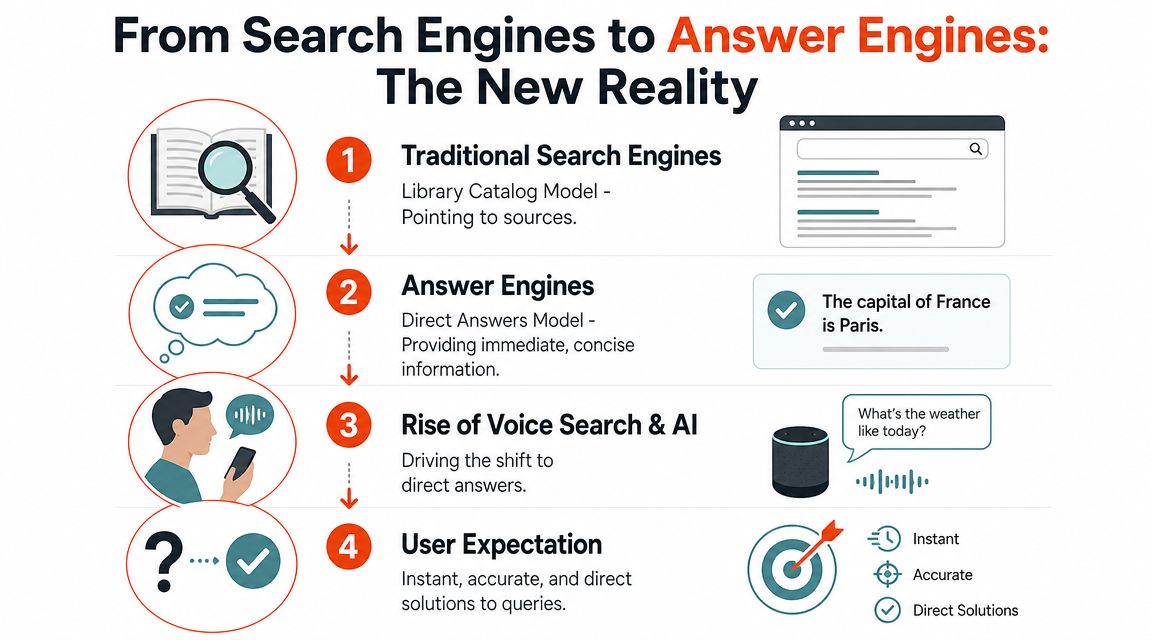
A useful way to frame it:
| Model | What the system does | What your page must do |
|---|---|---|
| Traditional search | Lists possible sources | Rank well and earn the click |
| Answer engine | Synthesizes a direct response | Provide a passage that can be extracted and cited |
This creates a real opening for smaller Shopify brands.
Why this matters for product discovery
Answer engines are becoming the new long-tail for eCommerce discovery. The old version of long-tail SEO was building a page that matched a very specific query and waiting for the click. The new version is giving the system a clean, trustworthy answer for a narrow buying question such as “best yoga mat for hardwood floors and sweaty hands” or “compact coffee gift for a small apartment.”
Big retailers still have scale. Smaller stores often have better odds on specificity. They can explain fit, use case, trade-offs, and edge cases faster, and those details are exactly what answer systems need.
Pages built for extraction often overlap with pages built for featured snippets, so it helps to review how to optimize for featured snippets. The mechanics are not identical, but the writing discipline is similar. Clear headings, direct answers, and tight supporting detail all make your content easier to cite.
Practical rule: Write so a system can lift two clean sentences from the page and a shopper still gets the right meaning.
AEO vs SEO Understanding the Strategic Difference
A Shopify store can rank well, publish useful content, and still lose visibility at the moment a shopper asks an AI tool for a recommendation. That is the strategic difference. SEO helps your pages win the visit. AEO helps your brand show up before the visit happens, inside the answer itself.
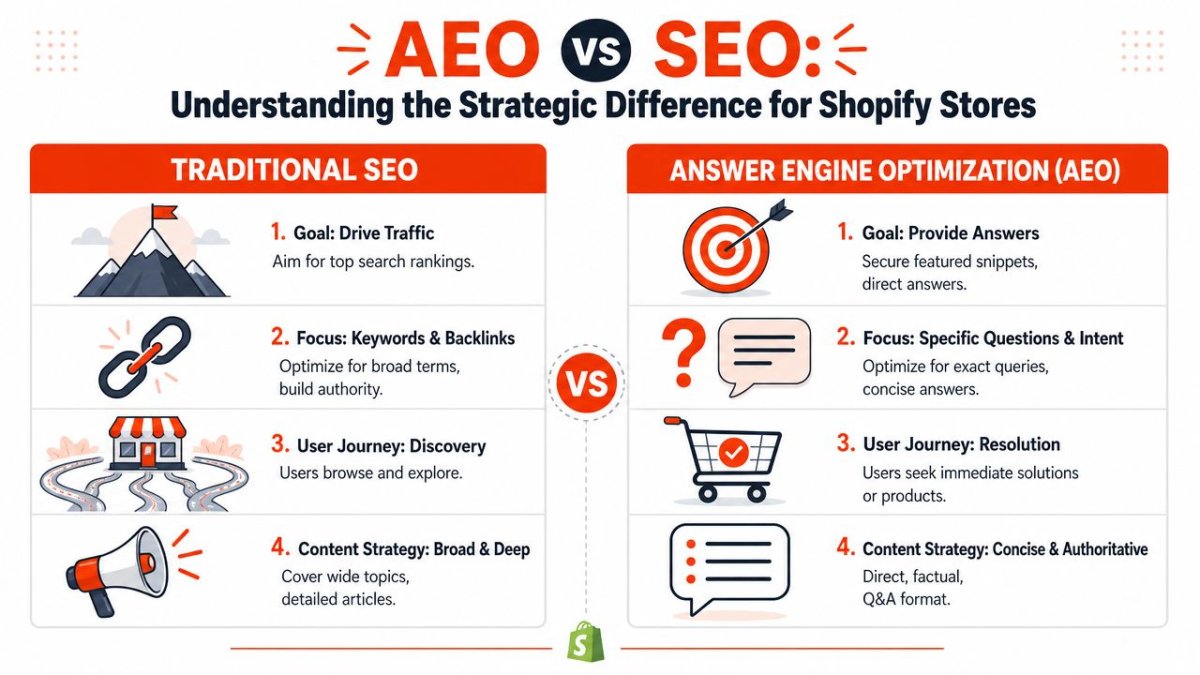
They solve different business problems
The split is easier to manage when you tie each channel to a business outcome, not a tactic.
| Channel | Primary goal | Best fit for |
|---|---|---|
| SEO | Earn clicks and sessions | Product terms, collection terms, buying-intent pages |
| AEO | Earn citations, mentions, and answer visibility | Questions, comparisons, education, pre-purchase reassurance |
For eCommerce, this changes how you value content. A buying query still needs a page that ranks and converts. A question-led query can create value even when the shopper never clicks, because your brand gets named, cited, or remembered during research. Meltwater notes that answer engines can reuse publisher content inside generated responses without sending the user onward, which can strengthen visibility while reducing referral traffic from informational searches.
That trade-off is real.
I would treat AEO as a distribution channel for expertise, while SEO remains the channel that captures demand and turns it into sessions, email signups, and sales.
Where Shopify stores should use each one
The cleanest way to apply this is by page type and search intent.
- Use SEO for transactional pages: Product pages, collection pages, and comparison pages where the shopper is already close to purchase.
- Use AEO for discovery and reassurance: FAQs, care guides, sizing help, ingredient or material explainers, gifting guides, and use-case content.
- Use both on high-value hybrid pages: Product pages that answer objections clearly can still rank, and they can also feed answer engines with extractable passages.
Smaller Shopify brands have an opening against larger retailers. Big catalogs help on broad head terms. Smaller stores often move faster on narrow buying questions, edge cases, and product-fit details. That makes AEO the new long-tail for product discovery. Instead of waiting to rank for every variant query, you can publish the exact explanation an answer engine needs for questions like fit, compatibility, skin sensitivity, room size, storage limits, or cleaning method.
A lot of stores miss that middle layer. They either stop at basic product copy or publish blog content that delays the answer. Both choices make the page harder to extract and easier to replace.
If you need to tighten the click-driving side first, start with these eCommerce SEO best practices for Shopify stores. Then sort your existing pages into two buckets. Pages that should win the click. Pages that should shape the answer.
If a page only becomes useful after five paragraphs, it is weak AEO content.
The AEO Playbook A Tactical Guide for Shopify Stores
A shopper asks ChatGPT whether your protein powder is safe for sensitive stomachs, whether your linen sheets shrink, or whether your laptop sleeve fits a 15-inch MacBook Air. If your store has the clearest answer, you have a shot at shaping that buying decision before the shopper ever compares ten tabs.
That is the practical shift. AEO gives Shopify brands a new way to win long-tail product discovery. Bigger retailers still have advantages on broad category terms, but smaller stores can move faster on the exact questions customers ask before they buy.
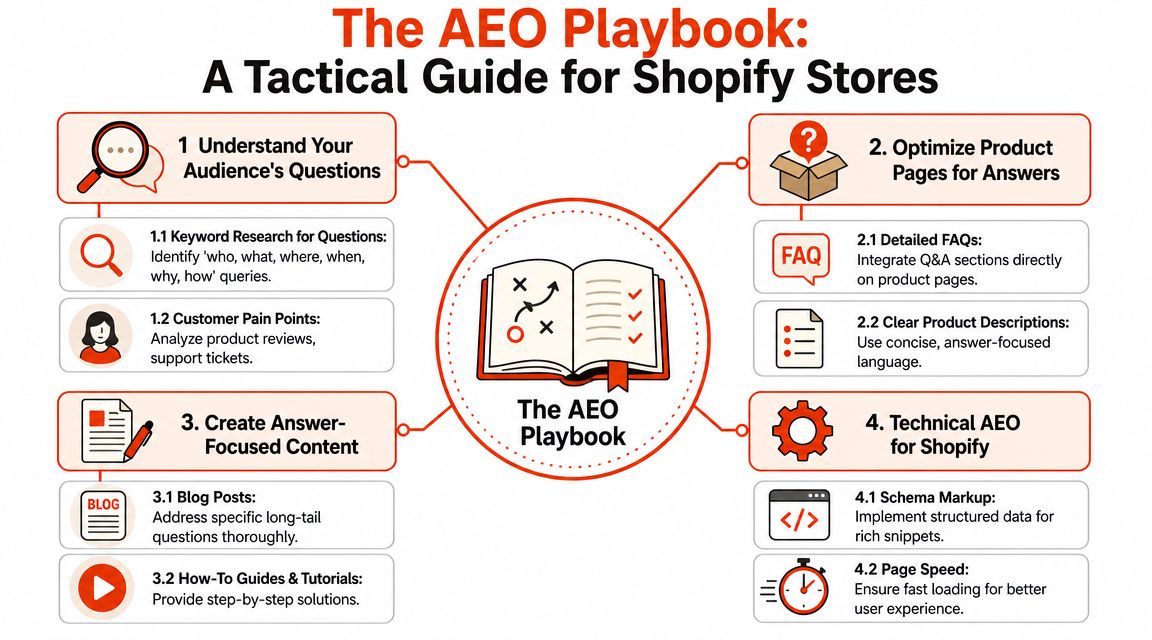
Start with answer-first content
The fastest change is usually editorial, not technical. Rewrite page openings so the first useful block answers the question directly.
On a Shopify product page, that often means opening a FAQ, feature explanation, or compatibility note with a plain answer instead of brand scene-setting. On an educational page, each section should resolve the heading immediately, then add context, proof, and buying guidance underneath.
A workable pattern looks like this:
- Question heading: “Is this ceramic mug dishwasher safe?”
- Direct answer: A short paragraph that resolves the question clearly.
- Support block: One to three sentences with care details, limits, exceptions, or fit notes.
That structure helps answer engines extract the right passage, and it helps shoppers scan faster. It also forces tighter merchandising copy. If your team cannot answer a product question in a few clean sentences, the page usually has a clarity problem.
Use this format where buying friction occurs:
- Product FAQs: “Will this fit a MacBook Air?” “Is this serum safe for sensitive skin?”
- Collection intros: “What's the difference between lightweight and heavyweight hoodies?”
- Comparison or education content: “Which candle wax burns cleaner?” “How often should you replace a dish brush?”
Concise copy still needs substance. The short answer gets the retrieval. The supporting detail gets the sale.
A quick explainer can help if your team needs a visual walkthrough:
Make your store easy for machines to read
Good AEO copy can still underperform if the page is hard to parse. I see this on Shopify themes all the time. Useful information exists, but it sits inside JS-heavy tabs, crowded accordions, or stylized sections that look polished and read poorly.
Answer systems reward pages that are easy to retrieve and interpret. Marcel Digital's guide to AEO points to the same technical signals practitioners keep seeing in the field: structured data, clear entities, readable HTML, visible authorship and dates, and pages that load cleanly without forcing a crawler to guess what matters. Marcel Digital covers those signals in its AEO overview.
For Shopify stores, that usually means:
- Use Product schema correctly: Include the product, brand, availability, price, and core attributes that help identify what the item is.
- Add FAQ schema where it fits the page: Mark up buyer questions that are useful and already visible on the page.
- Keep critical details in HTML text: Materials, dimensions, compatibility, care instructions, and shipping constraints should not live only in images or scripts.
- Cut theme clutter when it hides meaning: Interactive design can help conversions, but too many layered widgets make extraction harder.
There is a trade-off here. Rich merchandising experiences can improve conversion rate on-page. They can also bury the exact text answer engines need. The fix is not a boring store. The fix is making sure the important answer exists in plain, crawlable text before the design extras begin.
Build trust signals into the page itself
Answer engines reuse pages that look reliable. Shoppers do the same.
For Shopify brands, trust signals should be built into the page, not left to the footer or About page. A buying guide should show who wrote or reviewed it. A product education page should reflect current specs, materials, and compatibility notes. A store with frequent assortment changes should update timestamps and copy when products change, not six months later.
Strong trust signals usually include:
- Clear ownership: Brand name, and an author or editor when the content gives advice or guidance
- Current information: Updated ingredients, dimensions, care instructions, return details, and compatibility notes
- Specific wording: Exact claims a shopper can verify, instead of broad marketing language
This matters more for smaller stores than for household-name retailers. Large brands often get the benefit of recognition even when their content is slow or generic. Shopify merchants can close that gap by publishing sharper, more current answers on narrow product questions. That is one of the clearest AEO advantages available right now.
The best AEO copy sounds like a knowledgeable store associate answering the question the customer was about to ask next.
How to Measure AEO Success Beyond Clicks and Rankings
AEO gets frustrating when you judge it with the wrong scoreboard.
If the only metrics you watch are organic sessions and keyword rankings, you'll miss part of the picture. A page can contribute to discovery, trust, and brand recall before a customer ever clicks.
What to watch instead of only sessions
For Shopify stores, useful AEO measurement usually includes a mix of visibility checks and business signals.
Watch for patterns like these:
- Brand mentions inside AI tools: Run your core commercial and educational queries in ChatGPT, Gemini, Perplexity, and other answer interfaces. Look for whether your brand appears, whether your products are described accurately, and whether competitors dominate the answer.
- Presence in Google answer surfaces: Featured snippets and AI-led answer formats often reveal whether your pages are structured well enough for extraction.
- Brand search lift: When more people search your brand or product line after broad informational exposure, that's a clue your content is shaping discovery upstream.
- Assisted conversion behavior: Some shoppers learn from one query, leave, then return later through branded search, direct traffic, or email.
AEO also pushes teams toward a more qualitative review process. You're not just asking, “Did this page rank?” You're asking, “Did this page become the answer source?”
How to review AEO performance in practice
A simple recurring workflow works better than an overbuilt dashboard.
Try this monthly:
- Choose a fixed query set: Include category questions, comparison searches, “best for” searches, care questions, and fit questions.
- Check answer platforms manually: Review whether your brand appears, whether your page is cited or paraphrased, and which competitor pages seem to feed the answer.
- Compare with Search Console trends: If impressions hold while clicks soften on informational terms, that often lines up with answer-first behavior.
- Review downstream signals: Look at branded search demand, direct entries, and assisted paths to product pages.
You can also treat featured snippet wins as a strong operational signal. Pages that earn snippet-like visibility often have the right structure for broader answer extraction.
AEO success often appears first as influence, then as traffic.
That's a mindset shift, but it's a useful one. Especially for Shopify stores selling considered products, where education happens before purchase.
An AEO Checklist for Your Shopify Product Pages
A product page now has to do two jobs at once. It has to persuade the shopper on the page, and it has to give answer engines something clear enough to quote, summarize, or cite before that shopper ever clicks through.
That shift creates an opening for smaller Shopify stores. Big retailers often have more inventory, but they also carry slower approval cycles, messy templates, and generic copy at scale. A focused store can win the new long-tail of product discovery by answering narrow buying questions better than a giant catalog page does.
Use this quick audit on any page
Run this check on product pages, collection pages, and supporting articles:
- Does the page answer a real customer question near the top? Lead with a direct answer, then add a short explanation, proof point, or limitation. If the useful part starts after a gallery, promo block, and three accordions, the page is harder for both shoppers and answer engines to use.
- Do headings match the way buyers ask questions? Generic labels like “Benefits” or “Features” waste context. Specific headings like “Will this fit a 13-inch MacBook Air?” or “Is this fabric machine washable?” give the page clearer retrieval signals.
- Does the page cover hesitation points before support has to? Add FAQ content around sizing, compatibility, materials, care, shipping, setup, returns, and who the product is best for.
- Are product details available in plain text? Specs buried in images, tabs that fail to load, or design-heavy comparison charts are easy to miss. Put core facts where machines can parse them and shoppers can scan them.
- Are trust cues easy to verify? Clear brand attribution, current specs, realistic claims, review context, and visible update signals reduce ambiguity.
- Is the page easy to access and read? Slow scripts, intrusive popups, and cluttered layouts get in the way of extraction and conversion.
One practical test works well here. Pick a single high-intent question, such as “Is this carry-on accepted by Ryanair?” or “Which skin type is this serum best for?” Then look at the page cold. If the answer is not obvious within a few seconds, the page likely needs restructuring.
That matters because AEO rewards clarity at the query level. The winning page is often not the one with the most copy. It is the one that resolves a specific question cleanly, with enough context to be trusted and enough structure to be reused.
For Shopify brands, that is a significant opportunity. You do not need the biggest catalog to compete in answer-driven discovery. You need pages that answer buyer questions faster, more clearly, and with fewer layers than the bigger stores.
Integrating AEO into Your Workflow with wRanks
AEO usually starts as a content task. On a Shopify store, it turns into an operations task fast.
One product page gets updated. Then a shipping policy changes. Then support keeps hearing a new pre-purchase question that never made it onto the page. Before long, answer quality starts drifting across products, collections, blog content, image alt text, and schema. That drift is where visibility slips, especially for long-tail product discovery queries that larger retailers often ignore or update slowly.
Why consistency matters more than one-time fixes
Answer engines reward pages that stay current, easy to quote, and easy to verify. Frase cites an Ahrefs study of 17 million citations showing that AI-visible URLs were newer on average than URLs surfacing in traditional search. For a Shopify merchant, the practical takeaway is simple. Fresh, well-maintained pages have a better chance of being reused in AI answers.
That changes the job.
The goal is no longer publishing a single strong FAQ or polishing a few top sellers. The goal is keeping dozens or hundreds of pages accurate enough that answer engines can trust them, and structured enough that shoppers can act on them. Smaller Shopify brands can win here because they can update product knowledge faster than enterprise teams working through layers of approvals.
The work usually shows up in a few repeatable buckets:
- Refresh product copy: Compatibility, ingredients, materials, sizing, shipping windows, and care instructions change more often than many teams expect.
- Keep schema aligned with live content: Product and FAQ markup only helps when it matches what is present on the page.
- Add new answer blocks from real customer questions: Reviews, chat logs, and support tickets often reveal profitable long-tail queries before keyword tools do.
- Track visibility in AI search environments: If product discovery is shifting into answer engines, reporting has to cover more than rankings and organic sessions.
What a workable operating system looks like
A useful AEO workflow for Shopify needs one place to handle writing, optimization, structured data, indexing support, and visibility checks. Otherwise, teams end up stitching together prompts, spreadsheets, schema plugins, and rank trackers, then spend more time managing the stack than improving pages.
That is where wRanks fits. It gives Shopify merchants one workflow for producing answer-first product and blog content, adding JSON-LD for product and FAQ pages, improving image alt text, monitoring generative AI mentions, and keeping indexing work organized.
The trade-off is straightforward. A manual process can work for a small catalog with a hands-on founder. It usually breaks once the store grows, the catalog expands, or multiple people touch content. A systemized workflow keeps answer quality consistent, which is what helps a store show up for the specific product questions that drive high-intent discovery.
If you want to turn AEO into a repeatable Shopify process, wRanks brings those tasks into one place. It helps merchants create answer-first content, automate schema, monitor visibility across AI engines, and keep store pages discoverable without adding theme bloat.

About Sarah Mitchell
Senior SEO strategist with 8+ years in e-commerce search optimization. Sarah helps Shopify merchants turn organic traffic into revenue through data-driven content strategies.