How to Write Product Descriptions That Sell & Rank in 2026
You're probably staring at a Shopify product page right now with a half-finished title, a few specs from your supplier, and a blank description box that keeps getting pushed to “later.”
That's normal. It's also expensive.
A weak product description doesn't just fail to persuade. It makes your product harder to find, harder to trust, and harder to buy. I've seen stores spend serious money on ads while leaving product pages thin, vague, and lazy. Then they wonder why traffic doesn't convert and why organic search barely moves.
The honest truth is simple. Product descriptions are not admin work. They're sales assets. They sit at the intersection of conversion, SEO, and now AI-driven discovery. If you still write them like a feature dump, you're losing ground.
Good news. This is fixable.
If you want another useful perspective before you rewrite your catalog, BEDHEAD has a solid primer on how to learn to write better product descriptions. Then come back and apply a stricter Shopify-focused system.
Table of Contents
- More Than Words The True Goal of a Product Description
- The Pre-Writing Ritual Customer and Keyword Research
- Anatomy of a High-Converting Product Description
- Optimize for Google and AI Assistants with wRanks
- Scaling Your System with Templates and Automation
- From Description to Connection Your New Growth Engine
More Than Words The True Goal of a Product Description
A shopper lands on your product page from Google, a Shopify collection, or an AI-generated recommendation. They give you a few seconds. If the description does not answer, “Is this right for me, and why should I trust it?”, you lose the sale before price, reviews, or shipping even get a fair shot.
Here's the honest truth. A product description is not a box to fill. It is a decision tool.
On Shopify in 2026, that tool has to work for three audiences at once. It has to persuade a human shopper, give Google clear context, and give AI discovery engines enough structure to summarize your product accurately. If your copy only sounds nice, it underperforms. If it only chases keywords, it feels dead on the page. Good product copy does both.
That is why strong descriptions consistently do more than describe the item. They explain the use case, surface the payoff, remove doubt, and make the product easy to interpret by search systems. If you want a second perspective, this guide from BEDHEAD can help you learn to write better product descriptions.
The weak pages usually fail in familiar ways:
- They list features without a buyer outcome: “100% cotton” matters less than “soft enough for all-day wear and breathable in warm weather.”
- They read like supplier copy: Generic text makes your store feel replaceable.
- They hide the main selling point: Shoppers scan. Your strongest value has to appear fast.
- They give search and AI systems thin context: Vague copy makes it harder for your page to rank, match intent, or earn accurate summaries.
Use a simple standard. Every product description should do four jobs:
- Lead with the main benefit
- Answer the next obvious question
- Make the page easy to scan
- State the product clearly enough for search and AI systems to categorize it
This is also why keyword strategy belongs in the writing process, not bolted on afterward. If you have never built that workflow, start with a practical framework for keyword research for Shopify product pages.
Once you see the job clearly, the blank description field gets easier. You are not trying to sound clever. You are building a page that helps the right shopper say yes, and helps Google and AI engines understand why.
The Pre-Writing Ritual Customer and Keyword Research
A Shopify merchant sits down to write a product description, opens ChatGPT, pastes in a product name, and gets 150 polished words back in 10 seconds. Then the page goes live and does nothing. No rankings. Weak click-through. Low conversion. Here's the honest truth. The writing was never the problem. The inputs were.

If you want product copy that works in 2026, research has to serve three audiences at once. Human shoppers need clarity and trust. Google needs explicit relevance signals. AI discovery engines such as Gemini Overviews need clean context they can summarize without mangling the product. Skip that prep, and you get copy that sounds fine but underperforms everywhere.
Start with a buyer snapshot, not a persona deck
Forget the bloated marketing persona PDF. For product pages, you need a fast, usable buyer snapshot you can build in a few minutes.
Capture four things:
- Who the product is for: “Busy commuters who carry coffee in a tote” beats “women 25 to 45” every time.
- What job they need done: Stay organized, reduce pain, look sharper, save time, avoid hassle.
- What might stop the purchase: Sizing doubts, quality concerns, setup friction, ingredient questions, shipping anxiety, price resistance.
- What result they want after buying: The lived outcome, not the material or spec.
That last point matters more than merchants think.
If you sell a standing desk mat, “high-density foam” is support detail. “Feet feel better by midday” is the buying reason. One is a spec. The other is a conversion trigger.
Research the language buyers use when they are close to purchase
Keyword research belongs here, before drafting. Not after.
Too many Shopify stores chase broad, high-volume phrases that bring the wrong visitor. Traffic is not the goal. Qualified traffic is. A shopper searching a specific product type, material, or use case is far more valuable than someone browsing loosely related terms.
Use a simple filter for every keyword:
- Would a shopper use this phrase when they are ready to compare or buy?
- Does the phrase match the exact product on the page?
- Can it fit naturally in the product title, opening lines, and bullets?
If the answer is no, drop it.
A ceramic espresso cup page should target the phrase a buyer would type when looking for that item, not a fuzzy topic like “coffee ideas” or “kitchen inspiration.” Broad terms belong in collection pages or blog content. Product pages need precision.
If you need a tighter process, use this keyword research framework for Shopify product pages. It keeps the focus where it belongs, on commercial intent and real product-page fit.
Rule: If the keyword sounds awkward in the product title and first paragraph, it does not belong on that page.
Study competitors for phrasing, not for copy
Good competitor research is not spying. It is pattern recognition.
Look at how similar products are named, which objections competing stores answer, what benefits show up repeatedly in reviews, and which use cases appear across multiple listings. That gives you language your market already understands. It also shows you where competing pages are thin, vague, or generic.
Then write a better page.
For a broader perspective on mastering product descriptions for 2026, compare how strong brands balance persuasion, scannability, and search visibility. The stores that win do not just sound better. They make the product easier to understand for humans and machines.
A short walkthrough can help sharpen that process:
Build one input sheet before you draft
This is the part that makes AI useful instead of sloppy.
If you use a tool like wRanks, your goal is not to ask for “a better description.” Your goal is to feed the model clean inputs so it can generate copy with the right buyer language, the right search terms, and the right product context. That is how you get scale without publishing junk.
Create one simple input sheet for every product:
| Field | What to capture |
|---|---|
| Primary keyword | The clearest purchase-intent phrase |
| Secondary phrases | Variations, materials, use cases, attributes |
| Core problem | What frustrates the buyer now |
| Desired outcome | What better looks like after purchase |
| Objections | What could stop the sale |
| Proof points | Materials, dimensions, use cases, care details |
Once this sheet is filled out, the blank description field stops feeling blank.
Strong product descriptions do not start with adjectives. They start with evidence, buyer language, and clear search intent.
Anatomy of a High-Converting Product Description
Most product descriptions fail because they have no structure. They ramble, repeat, and dump specs in random order.
You need a format that respects how people read online. They skim, pause, compare, and only then decide whether to read more. Mailchimp and BigCommerce both push a similar workflow: start with buyer research, turn features into customer-facing benefits, then tighten the copy with short sentences, bullets, and clear headings, as summarized in Mailchimp's guide to writing product descriptions.
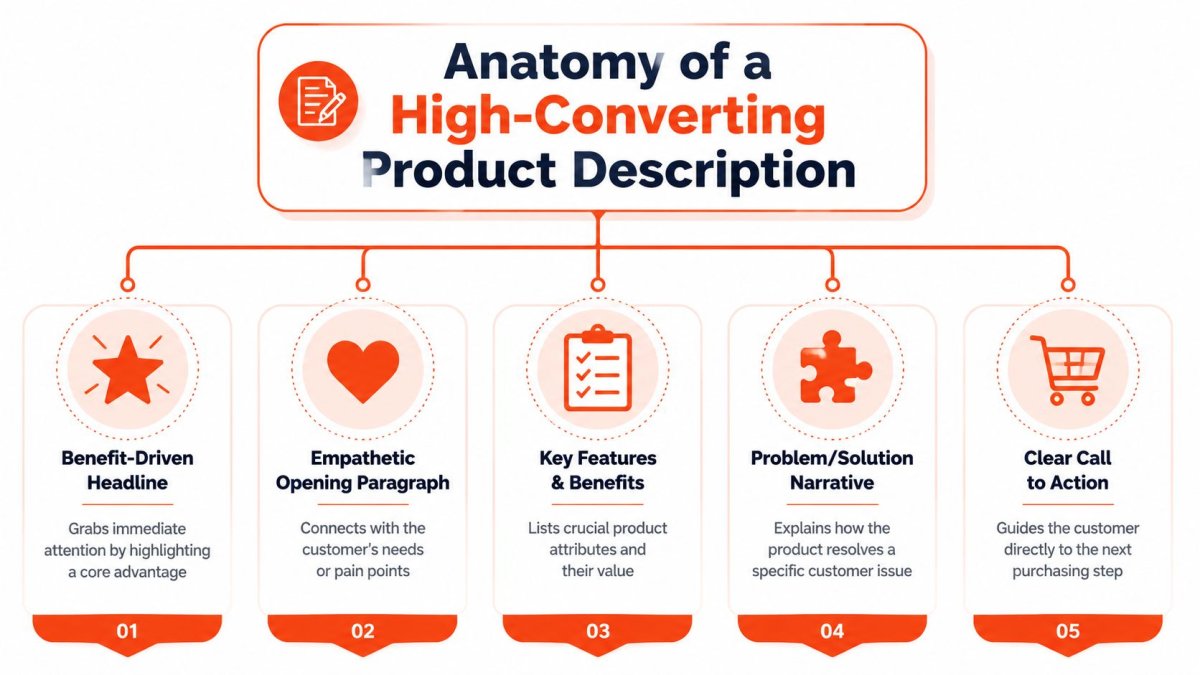
The structure that works on Shopify
Here's the template I recommend for most products.
1. Benefit-driven opening line
Lead with the outcome, not the raw feature.
Bad: “Made from double-walled stainless steel.”
Better: “Keeps your drink hot on the commute without leaking in your bag.”
2. Short empathy paragraph
Use two or three sentences that connect the product to the customer's use case. Show that you understand the context of purchase.
3. Bullet points for specs and benefits
BigCommerce's paragraph-plus-bullets approach works well. Paragraphs persuade. Bullets help shoppers confirm details fast.
- Material: State it clearly and connect it to why it matters.
- Use case: Name where or when the product fits into daily life.
- Key differentiator: Call out the one attribute that reduces hesitation.
- Care or fit detail: Remove an objection before it becomes a bounce.
4. Mini-story or problem-solution angle
For products with emotional or lifestyle appeal, add a compact narrative. Not fluff. Just enough context to help the shopper imagine ownership.
5. Clear call to action support
You don't need hype. You need clarity that makes the Add to Cart button feel like the obvious next step.
If you want another strong outside perspective, Humantext.pro has a useful piece on mastering product descriptions for 2026, especially if you're trying to modernize older ecommerce copy.
Product Description Transformation Before and After
Here's what the shift looks like in practice.
| Element | Before (Weak) | After (Strong) |
|---|---|---|
| Opening | “Premium cotton hoodie with kangaroo pocket.” | “A soft everyday hoodie that keeps you warm without feeling bulky.” |
| Features | “Made from 100% cotton. Ribbed cuffs. Drawstring hood.” | “Soft cotton feel for all-day comfort, ribbed cuffs that keep their shape, and an adjustable hood when the weather turns.” |
| Use case | “Suitable for casual wear.” | “Easy to throw on for school runs, coffee trips, or late-night walks.” |
| Objection handling | None | “Relaxed fit makes layering simple without looking oversized.” |
| Tone | Generic and flat | Specific, useful, and buyer-focused |
What most merchants get wrong
They confuse detail with persuasion.
A long description isn't strong just because it's long. A short description isn't weak just because it's short. The right length depends on the product, but the rule stays the same. Every sentence has to earn its place.
Common fixes I make on Shopify stores:
- Replace filler with clarity: Cut “high quality,” “premium,” and “perfect for any occasion” unless you prove them.
- Translate every feature: After each spec, ask “so what?”
- Front-load relevance: The first lines should carry the main benefit and product context.
- Format for scanning: Use spacing, bullets, and subheads so mobile users can parse the page fast.
If the buyer has to interpret the benefit on their own, you've made the page work too hard.
For product page layout and copy placement, this breakdown of Shopify product page optimization can help you align the description with the rest of the page instead of treating it like an isolated text box.
Optimize for Google and AI Assistants with wRanks
A shopper searches Google for your product. Another asks Gemini for the best option in your category. A third lands on your Shopify page from a comparison query and scans for ten seconds. Your description has to work for all three.
That is the actual standard in 2026.
Keyword placement still matters, but isolated keywords do not carry a weak page. Google needs clear topical signals. AI assistants need content they can extract and summarize without distorting it. Human shoppers need fast proof that the product fits their need. If your page is vague, overloaded, or poorly organized, you lose all three audiences at once.
Cover the page elements that affect visibility
Product description writing is part of on-page SEO. Treat it that way.
On Shopify, these elements do the heavy lifting:
- Product title: Match the exact search phrase and name the product plainly.
- Description body: Explain the product in natural language with clear attributes, use cases, and benefits.
- Meta title and meta description: Control how the page appears in search and shape click-through.
- Image alt text: Improve accessibility and give search systems more product context.
- Structured data: Help Google and AI systems identify product type, availability, brand, and other core details.
Store owners usually handle the title and body, then stop there. That leaves easy wins on the table.
Write for extraction, not just persuasion
Here's the honest truth. Clever copy gets admired. Clear structure gets found.
Search engines and AI assistants do better with explicit language than brand-heavy phrasing. If you sell a waterproof trail jacket, say that. State the material. Name the weather conditions. Clarify fit. Add care details. Answer the obvious question about layering or packability if buyers are likely to ask it.
That does two jobs at once. It helps a shopper decide, and it gives Google and AI systems clean signals they can reuse in search results, summaries, and product comparisons.
A strong page usually includes:
- A title that names the product clearly
- An opening line that says who it's for or what problem it solves
- Bullets with specs, fit, material, size, compatibility, or use case
- Supporting copy that answers purchase questions and objections
- Metadata and schema that reinforce the same meaning across the page
Consistency matters more than flair. If your title says one thing, your bullets say another, and your alt text says nothing useful, you create confusion for both rankings and conversions.
wRanks helps Shopify teams fix that at scale. Instead of treating SEO, AI visibility, and product copy as separate tasks, you can build pages that speak to all three audiences in one workflow. A tool like the wRanks AI product description generator for Shopify stores can speed up drafts, but the ultimate value is consistency across titles, descriptions, metadata, alt text, and structured content for every SKU.
That is what strong optimization looks like now. Your product page is no longer just a sales page. It is also a source document for search engines and AI discovery engines that may describe your product before a shopper ever visits your store.
Scaling Your System with Templates and Automation
Writing one strong description is manageable. Writing hundreds is where good intentions collapse.
Most stores don't have a copy problem. They have a systems problem. The team writes from scratch every time, quality varies by product manager, and older pages never get updated.

Build templates by product type
Don't create one universal template for the whole store. Build templates by category.
A skincare product needs a different structure than a dining chair. A fashion item needs different objection handling than a supplement organizer.
Use category-level templates like these:
- Apparel template: Fit, feel, fabric, occasion, care
- Home goods template: Material, dimensions, room context, durability, setup
- Beauty template: Skin concern, texture, routine placement, ingredients, how to use
- Gear template: Performance outcome, weight or capacity, environment, compatibility, care
That gives your team consistency without forcing every page into the same voice.
Use AI for drafts and humans for judgment
Merchants often waste time. They either reject AI completely or paste raw AI output live to the store. Both approaches are lazy in different ways.
Use AI for first drafts, variant support text, title ideas, metadata, and formatting help. Then let a human review for accuracy, tone, and product truth. That hybrid model is the sweet spot.
A simple workflow looks like this:
| Step | Owner | Output |
|---|---|---|
| Gather product facts | Merchant or merch team | Raw specs, use cases, objections |
| Generate draft | AI tool | Structured first version |
| Edit for accuracy and voice | Human reviewer | Final description |
| Add SEO fields | AI plus human check | Title, meta, alt text |
| Publish and review later | Team lead | Ongoing optimization |
If you want a practical look at that workflow, this article on an AI product description generator is useful because it focuses on store-level production, not novelty.
Expand for Markets without sounding translated
If you sell internationally, don't clone English copy and call it localization. Buyers can feel that instantly.
Shopify Markets gives you the storefront framework, but the copy still has to sound native. Product descriptions should reflect local phrasing, local search behavior, and local objections. A UK buyer and a U.S. buyer may want the same product but search for it differently and respond to different wording.
That's why templates matter. Once your structure is solid, you can localize with intent instead of just translating words.
The scalable move isn't automation alone. It's automation sitting on top of a template and review process that protects quality.
One more practical point. Test headlines and opening paragraphs on your top product pages. You don't need a fancy experiment matrix. Swap one angle at a time and compare results in Shopify and your analytics stack. Small wording changes at the top of the page can reveal what your buyers respond to.
From Description to Connection Your New Growth Engine
The biggest shift isn't tactical. It's mental.
Once you understand how to write product descriptions properly, you stop treating them like filler text under a product image. You start treating them like a conversion asset that also supports search visibility and AI discovery.
That changes how you work. You research before writing. You lead with benefits. You structure for scanners. You add the page elements that help Google understand the product. You build templates so the process can scale across your catalog instead of breaking after the first few SKUs.
The store owners who win with organic growth usually don't have the fanciest products. They have clearer pages. They answer buyer questions faster. They remove uncertainty sooner. They make their products easier to understand for humans and machines.
Start with one product today. Pick a page that gets traffic but underperforms. Rewrite the opening. Convert features into benefits. Add bullet points that handle objections. Tighten the title and metadata. Then move to the next page.
That's how product descriptions turn into a growth engine. One page at a time, then one system across the store.
If you want to speed this up without turning your product pages into generic AI sludge, try wRanks. It helps Shopify merchants create optimized product copy, metadata, image alt text, and structured SEO outputs at scale, so you can spend less time wrestling with blank fields and more time improving the pages that drive revenue.

About David Chen
Technical SEO engineer focused on structured data, indexing optimization, and Core Web Vitals. David turns complex technical requirements into actionable Shopify solutions.