Mastering Keyword Research for Shopify in 2026

You're probably looking at search results for your products and seeing the same thing most Shopify owners see. Big retailers, marketplaces, review sites, and brands with years of authority already baked in. That can make SEO feel like a game you can't win.
It isn't. But it is a game you can't play blindly.
Keyword research for Shopify isn't a spreadsheet exercise for its own sake. It's how you figure out what your customers type, what they mean when they search, and which page on your store deserves to rank for that intent. Done well, it stops you from wasting time on broad terms you won't win and starts giving each page a real job.
That's the shift. You're not trying to beat giant brands at everything. You're trying to show up for the right searches, with the right page, at the right stage of the buying journey.
If your organic traffic feels flat, or your product pages aren't ranking even though they're optimized, the issue often isn't effort. It's mapping. You may have keywords, but not a system.
Table of Contents
- Your Starting Point for Shopify SEO Success
- Building Your Initial Seed Keyword List
- Expanding and Prioritizing Your Keyword Master List
- Mapping Keywords to Your Shopify Store Structure
- Optimizing Shopify Pages with Your Keywords
- Tracking, Iterating, and Future-Proofing Your Strategy
Your Starting Point for Shopify SEO Success
If you sell on Shopify, the hardest part of SEO usually isn't publishing pages. It's deciding which searches are worth your attention.
Shopify's own keyword research guidance has pushed merchants toward a structured workflow instead of casual brainstorming: start with seed terms, expand them with a keyword tool, group by intent, map terms to product, category, and blog pages, build a content calendar, and keep updating the list over time. Shopify also recommends prioritizing terms with around 1,000 monthly searches as a baseline while balancing relevance and difficulty in the same decision process, as outlined in Shopify's keyword research guide.
That matters because it gives smaller stores a realistic way to think. You don't need to chase every huge head term. You need a working shortlist that matches your catalog, your margins, and the kinds of pages your store can support.
Practical rule: A keyword is only valuable if the right Shopify page can satisfy it.
A lot of merchants skip that part. They gather keywords, export them into a file, and then optimize whatever page feels closest. That's how product pages get stuffed with blog-style terms, blog posts try to rank for shopping queries, and collection pages compete against their own products.
A better approach starts with the customer question behind the query. Are they comparing options, looking for a category, or ready to buy a specific item? Once you answer that, your SEO work gets simpler.
If you need a broader view of how search traffic grows over time, this breakdown of how to improve organic search traffic is a useful companion to the keyword process. It helps frame keywords as one part of a larger compounding system, not a standalone tactic.
Building Your Initial Seed Keyword List
Most weak keyword strategies fail at the first step. The seed list is too shallow. It includes obvious product names and little else.
Your first list should reflect how customers think, not just how your catalog is labeled.

Start with what you already sell and what customers actually say
Begin with your core commercial terms. Product names, materials, use cases, audience segments, and category phrases. If you sell handmade candles, don't stop at “soy candle.” Add terms tied to scent, occasion, room, gifting intent, and burn preferences.
Then move away from internal naming and listen to customers.
Three places usually give you better language than your own product taxonomy:
- Customer reviews: People describe benefits in natural phrasing. They write “doesn't trigger headaches” or “good for small apartments,” which often reveals intent-rich modifiers.
- Support tickets and chats: These surface comparison and pre-purchase questions. “Is this dishwasher safe?” or “what size fits a carry-on?” often become strong informational or commercial phrases.
- Sales calls, DMs, and comments: Repeated objections and use cases can become keyword themes. If buyers keep asking whether a product is safe for sensitive skin, that language belongs in your research.
Long-tail thinking gains importance. Shopify-focused guidance has moved away from basic keyword lists toward topic clustering and long-tail targeting, with related phrases grouped around a pillar theme instead of isolated page optimization. That shift is useful because long-tail keywords usually reflect more specific intent and are described as converting better than broad generic terms in Shopify-focused guidance from First Pier's Shopify keyword research resource.
Don't build your list around what sounds important. Build it around what buyers repeatedly ask before they purchase.
If your team creates content in batches, a visual workflow can help. For merchants experimenting with faster ideation, LunaBloom's get started with AI video is a practical reference for turning rough topic ideas into content inputs without starting from a blank page.
Use competitors and internal search to widen the lens
Next, look outward and inward at the same time.
Competitor analysis gives you adjacent language. Plug competing domains into Ahrefs or Semrush and look for terms attached to their product, collection, and blog pages. Don't copy their targets blindly. Use them to spot patterns you missed, especially modifiers tied to style, use case, or subcategory.
Internal site search is even more valuable because it reflects what your visitors expected to find on your store. If shoppers search for “refill,” “starter kit,” “gift set,” or “travel size,” that's direct evidence of demand and language fit.
A solid first pass usually produces a workable set of core themes. You're not aiming for perfection yet. You're trying to leave this stage with a list that covers:
- Primary commercial terms: Your obvious money phrases.
- Modifier terms: Material, color, fit, audience, use case, problem solved.
- Question terms: Comparison, care, sizing, compatibility, selection help.
- Category terms: Broader themes that may belong on collection pages later.
That gives you enough raw material to build a serious keyword map instead of reacting page by page.
Expanding and Prioritizing Your Keyword Master List
Once your seed list is in place, the job changes. You're no longer trying to think of keywords. You're trying to separate viable opportunities from noise.
That means expansion first, then hard filtering.
Turn seed terms into a usable universe
Use a keyword tool to pull related queries, long-tail variations, question keywords, and competitor overlaps. Shopify-focused workflows commonly expand seed terms through tools, competitor-domain discovery, and SERP analysis, then filter by search volume, keyword difficulty, intent, relevancy, and organic CTR rather than relying on volume alone, as described in this Shopify keyword workflow guide.
Good tools for this step include Ahrefs, Semrush, and Google Keyword Planner. If you want this inside the Shopify workflow, one option is wRanks, which combines keyword tracking, store auditing, content generation, and Shopify-linked optimization workflows in one app. The point isn't the interface. The point is to get your keywords into a system you'll revisit.
You'll probably generate far more phrases than you can use. That's normal. Expansion creates options. Prioritization creates strategy.
A lot of merchants make one predictable mistake here. They sort by volume and start at the top.
That usually produces a list full of vague, broad terms that don't fit a product page, don't match buyer intent, and often belong to stronger domains.
For product-heavy stores, this practical piece on ecommerce keyword strategy for product listings is useful because it highlights the overlap problem that shows up when too many pages chase similar terms.
How to weigh the five filters that matter
The most useful keyword lists aren't the biggest. They're the ones with clear trade-offs.
Here's a simple way to evaluate candidates.
| Keyword | Intent (T/I/N) | Monthly Volume | Keyword Difficulty | Relevance Score (1-5) | Priority |
|---|---|---|---|---|---|
| organic cotton baby onesie | T | around 1,000 | Low to medium | 5 | High |
| baby clothes | T | Higher | High | 3 | Low |
| how to wash baby onesies | I | Lower | Low | 4 | Medium |
| newborn essentials checklist | I | Lower to medium | Medium | 4 | Medium |
| ribbed cotton baby onesie snap closure | T | Lower | Low | 5 | High |
A few rules make this table more useful in practice:
- Search volume matters, but only after fit. Shopify recommends using around 1,000 monthly searches as a baseline consideration while balancing relevance and difficulty, not as a standalone rule. A keyword with less volume can still be the better target if the page can satisfy it cleanly.
- Difficulty needs context. A harder term isn't bad by default. It may be worth keeping for a collection page or a broader cluster even if it's unrealistic for a product page now.
- Intent is a gatekeeper. If the SERP is full of guides, your product page probably won't rank well. If the SERP is full of category pages, your blog post won't be the right asset.
- Relevancy is paramount. Close enough usually isn't close enough. A term can look attractive in a tool and still bring the wrong visitor.
- Organic CTR changes the math. Some results pages are crowded with shopping elements, forums, videos, or AI summaries. That doesn't make the keyword useless, but it does affect expected traffic value.
A keyword with modest volume and clear purchase intent usually beats a bigger term that sends the wrong visitor.
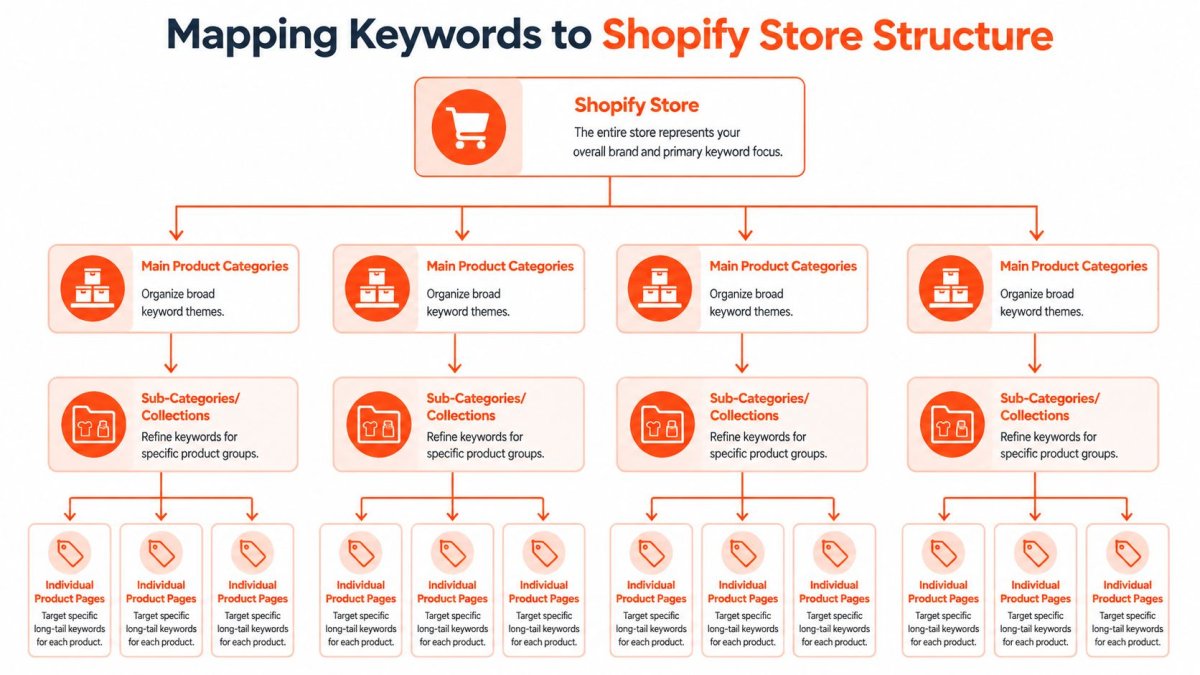
Once you've filtered, cluster related phrases under a parent topic. One collection page might target the parent theme, while product pages support narrower transactional variants and blog content handles adjacent questions. That structure lowers the risk of cannibalization and makes your content plan easier to maintain.
Mapping Keywords to Your Shopify Store Structure
Keyword research for Shopify transitions into store strategy rather than mere list management.
Most merchants don't really have a keyword problem. They have a page-matching problem. They've found phrases, but they haven't decided which Shopify page type should rank for each one.
One keyword list, three page types
A major gap in Shopify keyword research guidance is internal search and conversion intent mapping. Many guides explain how to find terms but don't explain how to separate keywords for product pages, collection pages, and blog posts. The more reliable advice is to analyze the SERP and match the page type to search intent, as discussed in Blackbelt Commerce's guidance on Shopify keyword research.
On Shopify, the main page types do different jobs:
| Page type | Best intent fit | What it should rank for |
|---|---|---|
| Product page | Transactional | Specific item, model, variant, feature-rich buying terms |
| Collection page | Commercial or navigational | Category and subcategory searches |
| Blog post | Informational | Questions, comparisons, education, problem-solving queries |
This sounds simple, but it solves a lot.
If someone searches for “women's waterproof hiking boots,” Google often prefers collection-style results because the searcher hasn't picked a single product yet. If they search for “women's waterproof hiking boots size 8 brown leather,” that's much closer to product intent. If they search for “how to choose waterproof hiking boots,” that belongs in content.
How to decide what belongs where
Use the SERP as your tie-breaker. Search the keyword and look at what already ranks.
- If product pages dominate, assign the term to a product page or a tightly related product family page.
- If category or collection pages dominate, use a collection page.
- If guides, comparisons, and educational posts dominate, build blog content.
- If mixed results appear, ask which page type can satisfy the search most completely without forcing the intent.
A clean mapping framework looks like this:
- Transactional terms go to product pages when the query is narrow and purchase-ready.
- Broader shopping terms go to collection pages when users need options to browse.
- Research-stage queries go to blog posts, FAQs, or buying guides.
If the page has to fight the query to make sense, it's the wrong page.
This is also where technical architecture matters. Internal links, collection depth, crawl paths, and duplicate URL handling all influence how clearly search engines interpret your page roles. If you're tightening that side of the store, this guide to technical SEO for ecommerce is a useful companion.
When merchants get this right, the store stops competing with itself. Product pages stop chasing broad category terms. Blog posts stop trying to convert queries that belong on collections. Collections stop sitting thin and underdeveloped.
Optimizing Shopify Pages with Your Keywords
Once each keyword has a page, implementation becomes much more straightforward. You're no longer asking where a term should go. You're asking how to use it well without making the page awkward.
What to change inside Shopify
For higher-confidence targeting, Shopify keyword work should lean toward long-tail and niche terms instead of generic head terms, and the main failure mode is still keyword stuffing. Shopify-focused SEO guidance warns that stuffing titles, descriptions, and body copy with repeated terms makes content awkward and reduces quality. The better approach is natural placement in titles, meta descriptions, product copy, and alt text where the keyword adds meaning, as explained in Praella's Shopify keyword research article.
Use that guidance as a checklist, not a slogan.
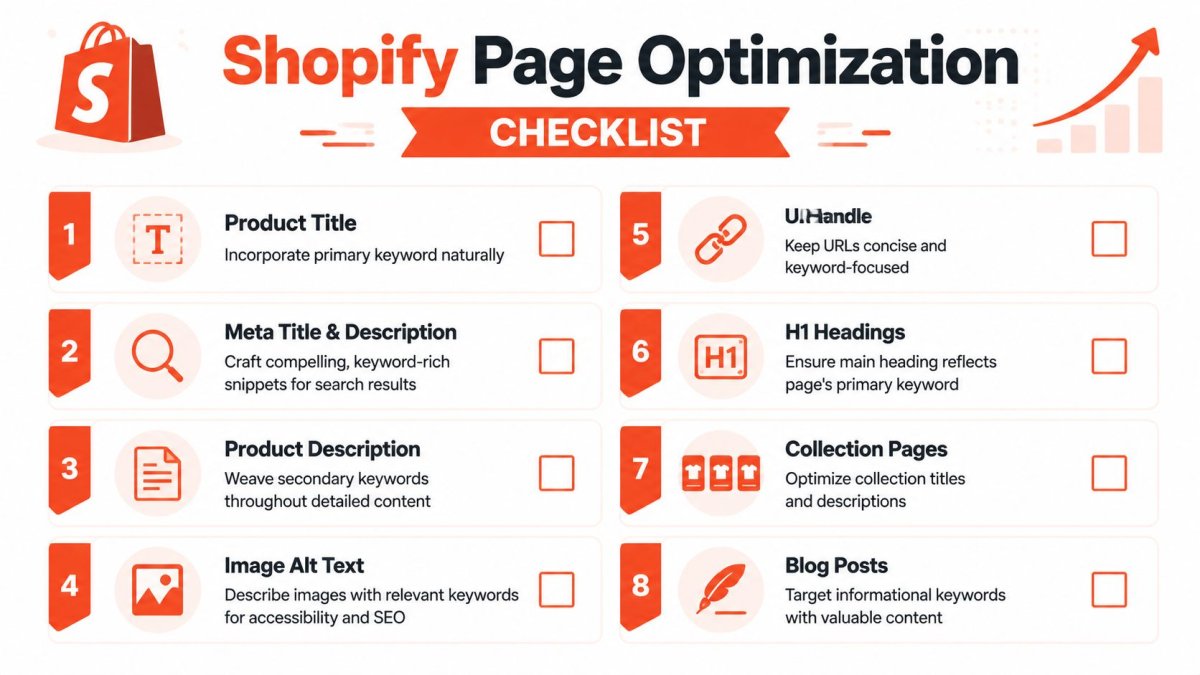
For each page, review these elements:
- URL handle: Keep it short, readable, and aligned with the primary phrase.
- SEO title: Put the core keyword in a natural way. Don't cram variants.
- Meta description: Write for clicks first, then include the keyword if it fits.
- H1 heading: Usually close to the main title, but still human.
- Body copy: Support the main topic with specifics, not repetition.
- Image alt text: Describe the image accurately. Add keywords only when relevant.
- Structured data: Make sure product, FAQ, and other schema elements are present where appropriate.
A product title often improves by becoming more descriptive, not more stuffed.
| Before | After |
|---|---|
| Linen Shirt | Men's Linen Shirt in Sand |
| Ceramic Mug Handmade | Handmade Ceramic Coffee Mug |
| Protein Powder Organic | Organic Vanilla Protein Powder |
The “after” versions aren't clever. They're clearer. That's usually enough.
A walkthrough can help if you want to compare your pages against common product-page patterns:
Keep optimization natural and commercially useful
Collection pages deserve more attention than they usually get. Many Shopify stores leave them thin, which creates a gap between broad category intent and specific product intent. A strong collection page needs a clear title, a useful intro, internal links to subcollections or relevant guides, and product organization that supports the keyword theme.
Blog posts should do a different job. They should answer a real question, use the mapped informational keyword naturally, and create a clean path toward collections or products where relevant. A buying guide that ranks but never connects to inventory is only doing half the work.
Good on-page SEO sounds like a merchant who knows the product, not a tool repeating a phrase.
For product-specific implementation patterns, this guide to ecommerce product page SEO is worth reviewing while you update titles, descriptions, and internal links inside Shopify.
The quick test is simple. Read the page out loud. If the keyword usage sounds forced, buyers will feel it too.
Tracking, Iterating, and Future-Proofing Your Strategy
Keyword research for Shopify isn't done when you publish the pages. That's when the useful feedback starts.
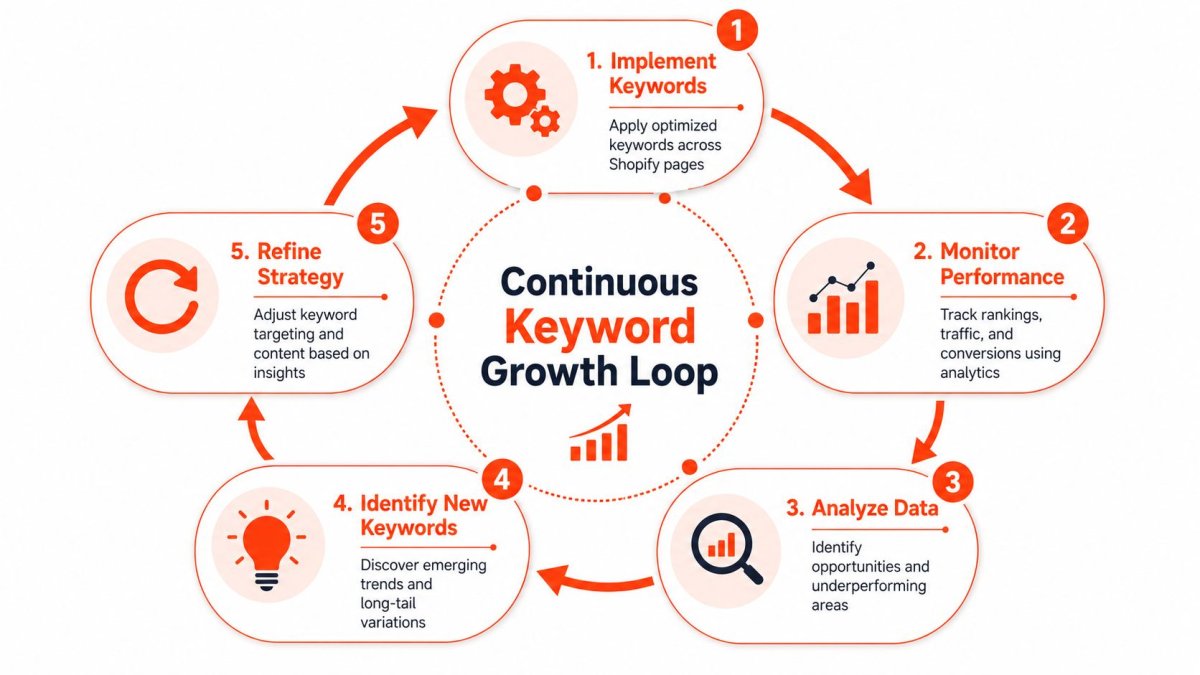
A static keyword map goes stale. Search behavior changes. Your catalog changes. New questions appear. Some pages gain traction and deserve expansion. Others never match the intent well enough and need to be reassigned or rewritten.
Treat keyword research like an operating rhythm
Shopify's own framing treats keyword research as an ongoing workflow rather than a one-time setup. That's the right mindset.
A practical review cycle usually includes:
- Rank tracking: Watch which mapped pages are moving for their target terms.
- Traffic checks: Look at landing pages, not just sitewide organic sessions.
- SERP review: Recheck the result mix when a page stalls. Intent may have shifted.
- Content refreshes: Expand weak pages, tighten bloated ones, and improve internal links.
- Keyword pruning: Drop targets that never fit the page or the business.
Many teams need discipline more than new tools. They keep adding pages but rarely revisit existing assignments.
One useful habit is to maintain a living keyword tracker with page assignment, intent type, main query, supporting queries, and notes from performance reviews. It doesn't need to be fancy. It needs to stay current.
If you want a model for systematic review thinking, even outside ecommerce, this SEO audit guide for professional firms is a useful reference because it shows how to move from observation to action instead of collecting findings you never prioritize.
Prepare for AI search and multi-market SEO
One of the more underserved areas in Shopify SEO is keyword research for environments where AI-driven discovery and multilingual search behavior are changing quickly. Current guidance still leans heavily on classic search tools, but a growing strategic question is how merchants should prioritize keywords when they also want content that can surface in AI summaries and local-market versions, a gap noted in Shopify's niche keyword research article.
That doesn't mean abandoning classic SEO. It means making your keyword map more resilient.
A few practical adjustments help:
- Write clearer entity signals: Product pages should be specific about attributes, use cases, and differentiation.
- Support commercial pages with explanatory content: AI systems often pull from pages that define, compare, and clarify.
- Localize by market intent, not just translation: A direct translation may not match how buyers search in another market.
- Tighten page purpose: AI visibility often favors pages that are unambiguous about what they cover.
The future-proof store doesn't target more keywords. It targets intent more cleanly across more contexts.
If you use Shopify Markets, this becomes even more important. Different regions may need different collection structures, different modifiers, and different informational content. The keyword itself may stay similar while the best landing page changes by market.
The stores that adapt fastest usually do one thing consistently. They treat keyword research as business intelligence, not just SEO administration.
If you want a faster way to turn keyword research into action inside Shopify, wRanks is built for that workflow. It helps merchants audit storewide SEO issues, generate and refine page content, track rankings and AI search visibility, and connect recommendations directly to Shopify editing tasks so the research doesn't sit unused in a spreadsheet.

About James Rodriguez
AI & GEO specialist helping brands maximize visibility across AI platforms like ChatGPT, Gemini, and Claude. James pioneers generative engine optimization techniques for e-commerce.