How to Optimize for Featured Snippets on Shopify in 2026
You search one of your biggest product questions on Google and see a competitor sitting in the answer box above the regular results. They didn't just win a ranking. They became the brand Google chose to summarize first.
That stings a little because you know your store has better products, better support, and often better content. The problem usually isn't expertise. It's packaging. Google can only feature answers it can extract fast, trust, and display cleanly.
For Shopify stores, that matters more than most SEO advice admits. Buyers don't move from problem to purchase in one click. They compare materials, care instructions, sizing logic, ingredients, compatibility, and alternatives. If your store answers those questions clearly, you can show up before the shopper ever lands on a collection page.
Table of Contents
- Why Snippets Are a Goldmine for Shopify Stores
- Decoding the Different Types of Featured Snippets
- A Practical Guide to Finding Snippet Opportunities
- How to Write and Structure Content That Wins Snippets
- The Technical Edge with Schema and wRanks
- Your Ongoing Snippet Optimization Workflow
Why Snippets Are a Goldmine for Shopify Stores
You've seen the pattern. Someone searches “what is French terry fabric,” “how to clean white sneakers,” or “are collagen gummies effective,” and Google pulls a short answer from one site. If that site is your competitor, they become the trusted explainer before the shopper even starts browsing products.
That's why featured snippets matter for ecommerce. They catch buyers in the research phase, when people are forming preferences and deciding which brands seem credible. A snippet can make a smaller Shopify store look bigger than it is because Google is effectively putting your answer on a pedestal.
BrightEdge reports that featured snippets can achieve a 35.1% click-through rate, compared with 28.5% for the first organic result without a featured snippet, while the first result beneath a featured snippet drops to 23.3% in its featured snippet CTR analysis. For a store owner, the takeaway is simple. Position zero can steal attention from everyone below it.
Research intent is where stores earn trust
A shopper rarely starts with “buy now.” More often, they start with questions:
- Material questions like “what is French terry”
- Care questions like “how to wash linen sheets”
- Comparison questions like “ceramic vs stainless steel cookware”
- Use-case questions like “best gifts for coffee lovers”
Those searches may land on blog posts, FAQs, product pages, or collection guides. The page type matters less than the clarity of the answer.
Practical rule: If a question helps someone feel safer buying, it's a snippet candidate.
This is also why snippet work now overlaps with broader answer-engine visibility. If you want to improve visibility in search answer engines, the same discipline applies. Write answers that are clean enough for Google to extract and useful enough for a shopper to keep reading.
The trade-off store owners should understand
Snippets aren't automatically good for every query. Some informational searches get answered so completely on the results page that the click never comes. That's not a reason to ignore snippets. It's a reason to choose your battles.
For Shopify brands, the best targets usually sit close to commercial intent. Product-adjacent questions, comparison terms, ingredient explanations, sizing help, and troubleshooting content often move shoppers toward a purchase. Generic trivia usually doesn't.
Decoding the Different Types of Featured Snippets
If you want to learn how to optimize for featured snippets, stop thinking of them as one thing. Google uses different snippet formats for different search intents. A clothing brand, supplement brand, furniture store, or beauty store can use each one differently.
STAT Search Analytics estimates that about 11% of SERPs contain featured snippets, and paragraph snippets make up about 70% of all snippet results in its featured snippets research. That's why most Shopify opportunities start with direct-answer content, then expand into lists and tables where the query calls for them.
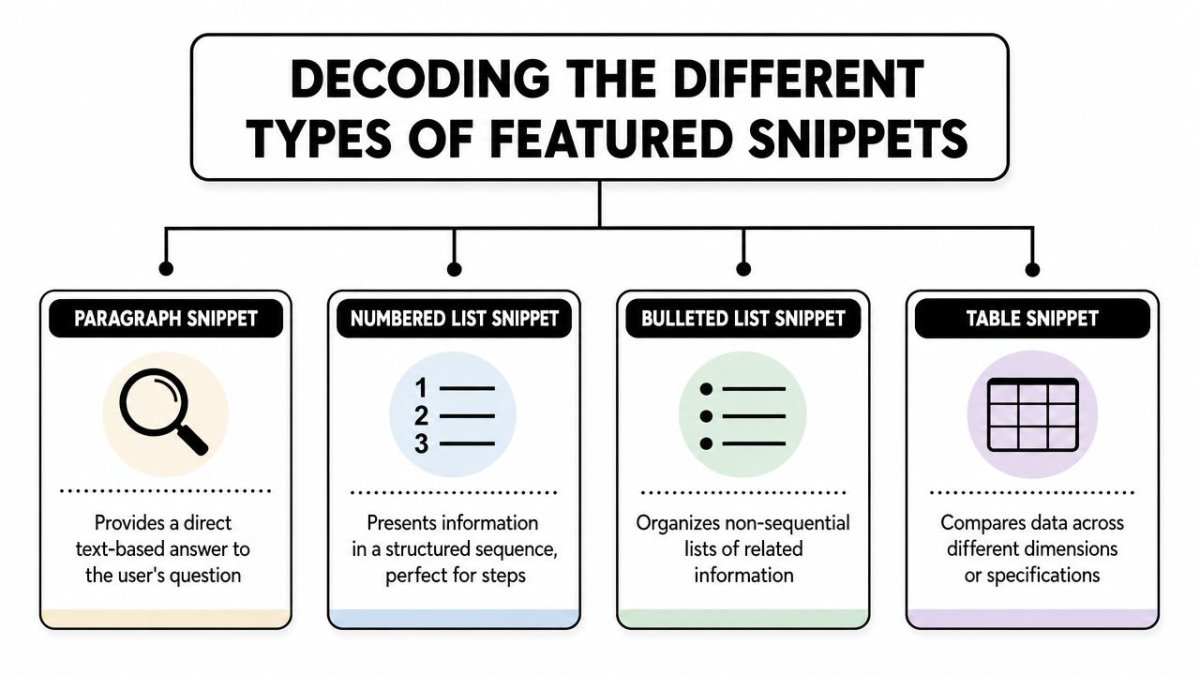
Paragraph snippets for product education
This is the workhorse format. Google pulls a short answer, usually from a page that defines, explains, or clarifies something.
For Shopify, paragraph snippets fit questions like:
- “What is French terry fabric” on an apparel blog
- “What is a non-comedogenic moisturizer” on a skincare store
- “What does broad spectrum sunscreen mean” on a beauty site
- “What is cold brew concentrate” on a coffee brand blog
These queries usually reward concise, neutral language. Not ad copy. Not storytelling. Just a direct answer, then supporting context below it.
Numbered lists for how-to intent
When the shopper wants steps, Google often prefers a sequence. This is common for care instructions, setup tasks, and product usage.
A Shopify store might target:
- How to clean white sneakers
- How to style a linen shirt
- How to season a cast iron pan
- How to use a silk sleep mask
This format works well when the searcher needs an ordered process. Google wants the steps easy to extract, and users want the process easy to follow.
Bulleted lists for roundup and gift content
Bulleted snippets tend to show collections of items rather than a sequence. Think ideas, features, examples, or categories.
Good Shopify fits include:
- Best gifts for coffee lovers
- Benefits of bamboo sheets
- Types of protein powder
- Features to look for in a travel backpack
These can come from collection copy, gift guides, or blog posts. The key is to keep the list clean and scannable, then expand on each item lower on the page.
A list snippet is often just Google borrowing your outline. If your outline is messy, your odds drop fast.
Tables for comparison queries
Table snippets are underrated for ecommerce because buyers compare constantly. Material, size, compatibility, features, ingredients, and product tiers all lend themselves to structured comparisons.
Here's where a table helps:
| Query type | Better page format | Shopify example |
|---|---|---|
| Product comparisons | HTML table | Espresso machine A vs B |
| Material differences | HTML table | Linen vs cotton sheets |
| Sizing guidance | HTML table | Men's jacket sizing by fit |
| Variant specs | HTML table | Supplement flavor and ingredient differences |
A table is useful when the shopper wants to weigh options side by side. It also keeps you from burying important distinctions in long paragraphs.
Google's format choices usually mirror user intent. If the query asks “what is,” use a direct definition. If it asks “how to,” use steps. If it asks “best” or “types,” use a list. If it asks “vs” or “compare,” give it a table.
A Practical Guide to Finding Snippet Opportunities
Most store owners make this harder than it needs to be. They brainstorm random questions, publish a few blog posts, and hope Google notices. A better approach is to hunt where snippets already exist.
That matters because you're not trying to invent demand. You're looking for questions Google already answers on the results page, then deciding which ones are worth taking.

Start with the SERPs you can see
Open Google and search the kinds of questions your customers ask before they buy. Use plain language, not SEO jargon. Search like a customer who's unsure.
A simple starting set looks like this:
- What is plus your product category, material, ingredient, or feature
- How to plus care, setup, cleaning, or usage actions
- Best plus audience, occasion, or use case
- Difference between plus two product types or materials
- Why plus a common objection or confusion
Look for three things on the results page:
- Is there already a featured snippet?
- What format is Google using?
- Is the current answer weak, vague, outdated, or hard to read?
If the current snippet is bloated or buried in fluff, that's an opening.
Use People Also Ask like a merchandiser
People Also Ask is one of the easiest places to build a content backlog. Click through the questions and watch how Google expands the set. You'll start seeing patterns that map directly to your catalog.
A bedding brand might find clusters around materials, breathability, washing, and seasonal comfort. A supplement brand might uncover questions around timing, ingredients, and compatibility. A footwear store might see cleaning, sizing, and break-in questions.
Treat those questions like shelf labels in a store. They tell you how shoppers organize uncertainty.
Don't chase every question. Chase the ones that remove friction before purchase.
Prioritize the snippets that can lead to revenue
Not all snippets deserve your time. Some are useful for awareness but weak for sales. Others sit one step before a conversion.
Google made position zero a major traffic lever because snippet CTR can exceed standard organic rankings, as BrightEdge noted earlier. That's why snippet selection matters. If you're going to invest effort, point it at terms with business value.
Here's a practical way to sort opportunities:
| Priority level | Query example | Why it matters |
|---|---|---|
| High | “how to choose the right weighted blanket” | Helps a buyer choose |
| High | “collagen powder vs capsules” | Supports product comparison |
| Medium | “what is French terry” | Builds category understanding |
| Medium | “how to wash linen sheets” | Helps after purchase and attracts pre-purchase shoppers |
| Low | Broad trivia unrelated to your catalog | Brings attention without buying intent |
If you use a rank tracker, tag keywords that already show snippets and separate them from standard organic targets. That gives you a shortlist of pages to rewrite first. For Shopify stores with large catalogs, that's much more effective than treating every blog post equally.
A quick walkthrough helps if you want to see this research process in action:
Manual research works, especially at the start. Then you scale it with tracking. The goal is simple. Find questions that already trigger snippets, line them up against pages you already have, and focus on the gaps that can move someone closer to checkout.
How to Write and Structure Content That Wins Snippets
This is the part most stores get wrong. They write decent content, but they bury the answer under a brand intro, a founder story, and three paragraphs that sound polished but don't answer the query.
Google isn't grading style first. It's looking for extractable answers.
A practical workflow for how to optimize for featured snippets is to target queries that already trigger snippets, use the exact query as an H2 or H3, place a direct 40 to 60 word answer immediately below it, and support it with clean HTML lists or tables according to this featured snippet optimization workflow.
Use the answer-first pattern
If the query is “What is French terry fabric,” your page should include that exact or near-exact heading and answer it immediately.
Bad version:
French terry has become one of the most popular fabrics in modern casualwear because it combines comfort, versatility, and style. In today's apparel landscape, many shoppers are curious about how it compares with fleece and cotton.
Better version:
French terry fabric is a knit fabric with a smooth outer surface and soft looped texture on the inside. It's lighter than fleece, breathable, and commonly used for sweatshirts, joggers, and loungewear.
That second version is easier for Google to extract and easier for a shopper to understand.
Add snippet blocks to pages you already have
You do not need a new blog post for every question. Many Shopify stores can win snippets by improving existing pages.
Here's where snippet blocks fit naturally:
- Product pages with FAQ sections for size, fit, materials, ingredients, or use
- Collection pages with short buying guides and comparison blurbs
- Blog posts with question-based subheadings and direct answers
- Help pages for care, shipping, returns, compatibility, and troubleshooting
A strong product page for a weighted blanket, for example, might include FAQ blocks like:
- What weight blanket should I choose?
- Are weighted blankets hot to sleep with?
- Can a weighted blanket help with relaxation?
Those aren't filler FAQs. They address real purchase hesitation.
Format matters more than clever writing
A snippet-ready page usually looks plain in the best way. Clear headings. Short paragraphs. Real lists. Real tables. No decorative nonsense around the answer block.
Use this simple recipe:
- Match the query in a heading.
- Answer it in the next paragraph.
- Keep the answer compact and factual.
- Expand with details after the answer, not before.
- Use proper HTML formatting for lists and comparisons.
Here's a Shopify-specific before-and-after.
Before
A sneaker care article opens with a long intro about the importance of maintaining footwear, then eventually explains cleaning steps halfway down the page.
After
How to clean white sneakers
White sneakers can be cleaned by removing loose dirt, treating stains gently, washing the upper with a mild cleaner, and letting the shoes air dry fully. The safest method depends on the shoe material, so canvas, leather, and suede should be cleaned differently.
Then follow with an ordered list of the actual steps.
The snippet answer is the label on the box. The rest of the page is what's inside.
If the query is comparative, use a table instead of forcing the comparison into prose. A mattress store comparing latex and memory foam should not make users hunt through paragraphs for differences in feel, heat retention, and motion isolation.
If the query is a roundup, use bullets. If it's procedural, use numbered steps. If it's definitional, use one tight paragraph. That alignment is what makes the page feel obvious to Google.
One more thing. Don't stuff the answer block with sales copy. “Our premium, luxurious, customer-favorite serum is the ultimate solution” won't win many snippets. Neutral language often performs better at the extraction point. Sell after you answer.
The Technical Edge with Schema and wRanks
Good snippet content needs technical support. Not because schema forces Google to award a snippet. It doesn't. But clear technical signals make it easier for search engines to understand the role of the content on the page.
For Shopify stores, this matters because themes, apps, and page builders often create messy output. The copy may be fine, but the structure underneath it can be inconsistent.
Schema helps clarify what the page is doing
Think of schema as labeling bins in a warehouse. The products are still the products, but the labels make retrieval easier.
For snippet-adjacent content on Shopify, the most useful structured data patterns are usually:
- FAQPage for product FAQs and help content
- HowTo for step-by-step usage or care guides
- Product for core product entities and details
Google's own featured snippets documentation also makes an important point that many store owners miss. Snippet visibility is controllable. Google notes that featured snippets are shown only when enough text is available to generate a useful snippet, and pages can be excluded with max-snippet. That means snippet ownership isn't automatically the goal for every page and query.
For a merchant, that's the true technical lesson. Structure the page so it can be featured, then decide whether that visibility serves the business.
Shopify execution is where most stores stumble
Adding FAQs in an accordion app isn't the same as making them snippet-friendly. Sometimes the content is hidden in ways that make it harder to interpret cleanly. Sometimes the headings are generic. Sometimes the answer is too long and too promotional.
A technical benchmark for snippet-ready content is to keep the answer compressed and structurally obvious. Several practitioners recommend putting the direct answer in the first two sentences or within roughly 40 to 55 words, with short paragraphs and a clear heading hierarchy, as outlined in this snippet-ready content benchmark.
That benchmark is useful because it forces discipline. If a store can't explain a product question clearly in that space, the answer usually isn't sharp enough yet.
Here's what usually works on Shopify:
| Page element | What helps | What hurts |
|---|---|---|
| FAQ blocks | Real customer questions as headings | Generic headings like “More info” |
| Comparison sections | Simple HTML tables | Image-based comparison charts |
| Blog subheadings | Exact question phrasing | Cute copy that hides intent |
| Product descriptions | Separate answer blocks for FAQs | One long wall of marketing copy |
Technical cleanup supports snippet retention
Winning a snippet is one thing. Keeping it is another. If your page gets updated, restructured, or slowed down by bloated apps, you can lose the clarity that made it eligible.
A few practical checks matter:
- Heading hierarchy should be logical. Don't jump around randomly.
- Lists and tables should use clean HTML, not fake visual formatting.
- FAQ content should be indexable and easy to read in the source.
- Page intent should stay focused. Don't mix five unrelated goals on one URL.
There's also a wider strategic point. Many guides still treat snippets as a purely formatting problem. That's too narrow. The same structured blocks that help classic snippets can also make your content easier for newer answer surfaces to cite and reuse.
That doesn't mean every FAQ deserves a schema plugin and a new page template. It means your highest-value questions should be technically obvious, not just well written.
Your Ongoing Snippet Optimization Workflow
Featured snippets aren't a trophy you win once and frame on the wall. They behave more like shelf space in a retail store. If you stop maintaining it, someone else takes it.
The workflow is simple enough for a busy team to repeat.
Optimize then request discovery faster
When you update a page for snippet intent, don't leave it sitting unnoticed. Improve the heading, tighten the answer block, clean up the formatting, and push the page back in front of search engines as quickly as your process allows.
A practical loop looks like this:
- Find a query that already triggers a snippet
- Rewrite the answer block
- Improve on-page structure
- Request faster discovery
- Track whether the snippet appears or changes hands
That rhythm matters more than one big quarterly content sprint.
Monitor losses like inventory problems
If you lose a snippet, treat it like a stockout on a bestseller. Something changed. Maybe a competitor wrote a cleaner answer. Maybe your page drifted. Maybe Google shifted the preferred format.
Watch for:
- Pages that rank but don't get extracted
- Snippets won by weaker domains with clearer formatting
- FAQ sections that are too wordy
- Comparison content that should really be a table
A store owner doesn't need perfect rank obsession here. You need a shortlist of commercially useful queries and a habit of revisiting them.
If a question helps people buy and Google is already featuring an answer, that keyword should stay on your watchlist.
Build for snippets and AI surfaces at the same time
There's still a lack of recent, data-backed guidance on how snippet optimization should evolve alongside AI Overviews, as noted in this analysis of AI-era snippet optimization. The practical answer is not to abandon classic snippet tactics. It's to write content that is reusable across both environments.
For Shopify stores, that means:
- Definitions for product education
- FAQs for objections and pre-purchase friction
- Tables for comparisons
- Short answer blocks that identify the product, material, ingredient, or use case clearly
That structure gives you two shots at visibility. The classic answer box and the newer AI-driven surfaces that often favor clean, well-scoped source material.
The stores that do this well don't just “do SEO.” They make their catalog easier to understand. That helps Google. It also helps customers decide faster, with less doubt, and that's what turns visibility into sales.
If you run your store on Shopify and want one place to handle content, schema, indexing, rank tracking, and answer-engine visibility, wRanks is built for that job. It helps merchants find snippet opportunities, generate structured content for products and blogs, add JSON-LD without theme headaches, and monitor the keywords that matter to revenue.

About David Chen
Technical SEO engineer focused on structured data, indexing optimization, and Core Web Vitals. David turns complex technical requirements into actionable Shopify solutions.