
Ecommerce SEO Best Practices: 10 E-commerce SEO Best

You launch a Shopify store, clean up the theme, add a stack of apps, write product descriptions, and publish a few blog posts. A month later, traffic is flat, key pages are barely moving, and the stores outranking you look impossible to catch. That pattern is common on Shopify because the platform makes selling fast, but it also creates SEO friction in places merchants do not always expect.
The friction is specific. Collections can create duplicate paths to the same product. Variant handling can muddy page targeting. Apps can slow templates and clutter code. You are also competing with marketplaces and established brands that have more authority, more content, and more people working on SEO full time. Busy store owners do not need another generic checklist. They need Shopify-specific choices that are worth the effort, in the right order.
Search visibility now depends less on stuffing broad keywords into pages and more on matching search intent across product, collection, and content pages. On Shopify, that means clearer titles, tighter metadata, stronger schema, cleaner internal linking, and a technical setup that does not collapse under app overload. It also means using AI with judgment. AI can speed up title writing, copy drafts, alt text, and issue triage, but it still needs rules, review, and prioritization.
This shift matters because Google is judging whether your store helps a shopper make a decision, not just whether a page repeats a phrase. Price, availability, reviews, shipping details, returns, and page clarity all support that decision.
That is the angle of this guide. Each practice is built for Shopify implementation, not theory, and paired with realistic ways to execute it using apps, AI workflows, and a priority lens so you do not waste weeks polishing low-impact tasks. If you want a stronger foundation before the tactical list, start with this ecommerce product page SEO guide for Shopify stores and this external guide to product page SEO.
Table of Contents
- 1. Product Page Optimization with AI-Generated Meta Tags and Titles
- 2. Technical SEO Audits, Issue Prioritization, and 301 Redirect Management
- 3. Structured Data Markup JSON-LD Implementation for Rich Snippets
- 4. Keyword Research and Ranking Tracking for Competitive Intelligence
- 5. On-Page Copy Optimization Using AI Assistants
- 6. Image Alt Text Optimization Using Vision Models
- 7. Blog Content Strategy and AI Blog Writer Implementation
- 8. Internal Linking Strategy and Site Architecture Optimization
- 9. Fast Indexing and Discoverability via Google Indexing API, Bing IndexNow, and AI Engines
- 10. Multi-Language SEO and Localization for Global Shopify Markets
- 10 Ecommerce SEO Best Practices Comparison
- Your Action Plan for Shopify SEO Dominance
1. Product Page Optimization with AI-Generated Meta Tags and Titles
Most Shopify stores don't lose search visibility because the products are bad. They lose it because the search snippet is vague, duplicated, or sounds like every other store selling the same item. A title tag that says “Brown Watch | Brand Name” wastes valuable space. A better one tells both Google and the shopper what makes the product specific.
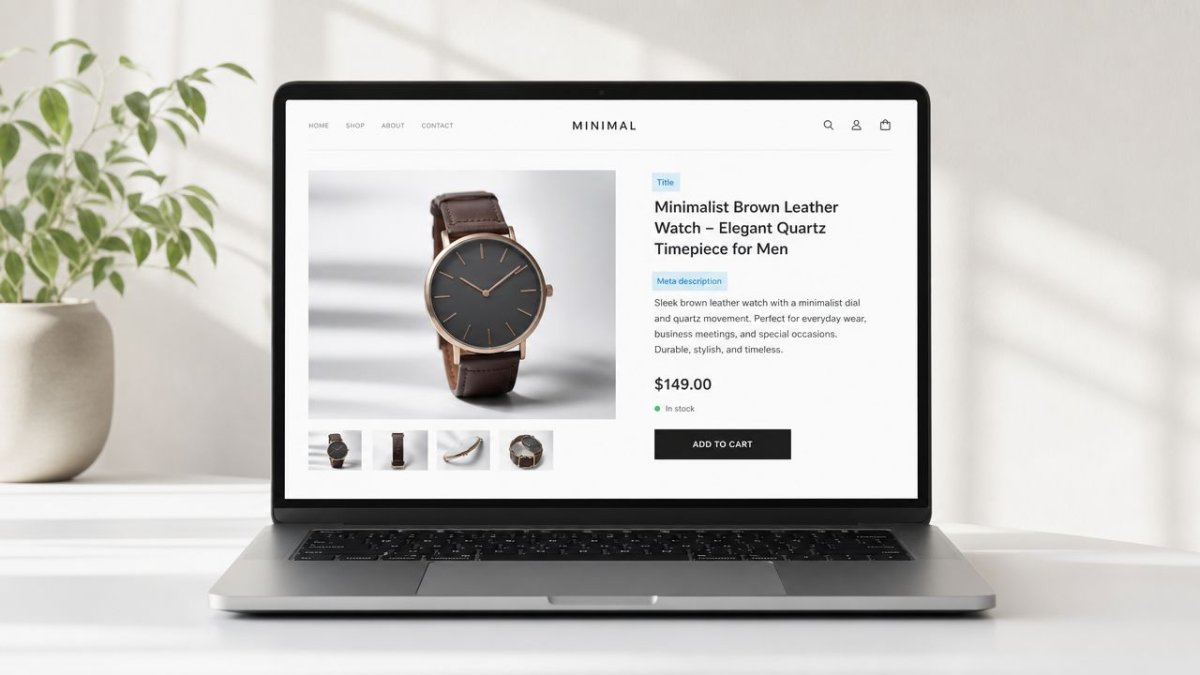
AI helps most when you use it like a production assistant, not a final editor. For a fashion store, that might mean generating title options around material, fit, and color. For electronics, it might mean pulling in model names, compatibility, and key specs across a large SKU set. For beauty, it often means emphasizing benefit plus format, such as serum, balm, or mist.
What strong Shopify product metadata looks like
Shopify pages usually need three things working together: the SEO title, the meta description, and the visible product title or H1. They shouldn't be identical. Think of them like a storefront sign, a shelf label, and a sales pitch. Related, yes. Repetitive, no.
Use the primary phrase early, especially if the product name itself is generic. Add intent modifiers only when they read naturally, such as shop, buy, or best. Then review the draft so it sounds like your brand and not a robot trying too hard.
- Lead with the product type: “Men's Brown Leather Quartz Watch” is clearer than “Classic Timepiece.”
- Add differentiators shoppers search for: include size, scent, material, voltage, compatibility, or finish when relevant.
- Keep variants distinct: don't let every colorway inherit the same weak metadata if each has its own search demand.
Practical rule: Let AI write version one. Let a human remove fluff, fix tone, and make the snippet worth the click.
If you're scaling this across a large catalog, use a repeatable workflow tied to collections and product attributes. A good starting point is this ecommerce product page SEO guide, along with a broader guide to product page SEO.
2. Technical SEO Audits, Issue Prioritization, and 301 Redirect Management
Technical SEO on Shopify is where good intentions go to die. Merchants install apps, remove products, rename collections, migrate themes, and suddenly the store has redirect chains, duplicate URLs, and broken pages buried under the surface. None of that feels urgent until rankings dip or paid traffic starts landing on dead URLs.
This is why audits matter. Not because an audit report looks impressive, but because Shopify stores change constantly. Every app, every merchandising decision, and every collection update can affect crawling and indexability.
Fix the issues that actually move the store forward
A monthly audit is usually more useful than a giant once-a-year cleanup. Start with broken pages, redirect problems, duplicate templates, and pages that shouldn't be indexed. Then move to deeper issues like faceted navigation, canonicals, and script bloat.
One commercially important reason to care about performance is simple: 40% of shoppers abandon an e-commerce site if it takes more than 3 seconds to load, according to the statistic cited in this 2026 ecommerce SEO checklist video. That same guidance also emphasizes LCP, TTFB, mobile-first layouts, compressed images, caching, reduced third-party scripts, and clean crawl controls.
What works on Shopify is prioritization. Fixing one redirect loop that affects a major collection often matters more than obsessing over low-value warnings.
- Redirect before removal: if a product is retiring, map the old URL before you unpublish it.
- Consolidate chains: old URL to old collection to new collection is sloppy. Point to the final destination.
- Control crawl waste: use canonicals, noindex rules, and robots.txt carefully so filters and duplicate paths don't eat attention.
A practical Shopify walkthrough is this technical SEO for ecommerce guide, and this complete 301 redirect guide is useful when you're cleaning up migrations or discontinued products.
3. Structured Data Markup JSON-LD Implementation for Rich Snippets
A common Shopify scenario looks like this. The product page is live, reviews are showing, inventory updates inside the admin, and Google still displays a plain blue link with none of that context. Usually the problem is not the product. It is missing, broken, or conflicting JSON-LD.
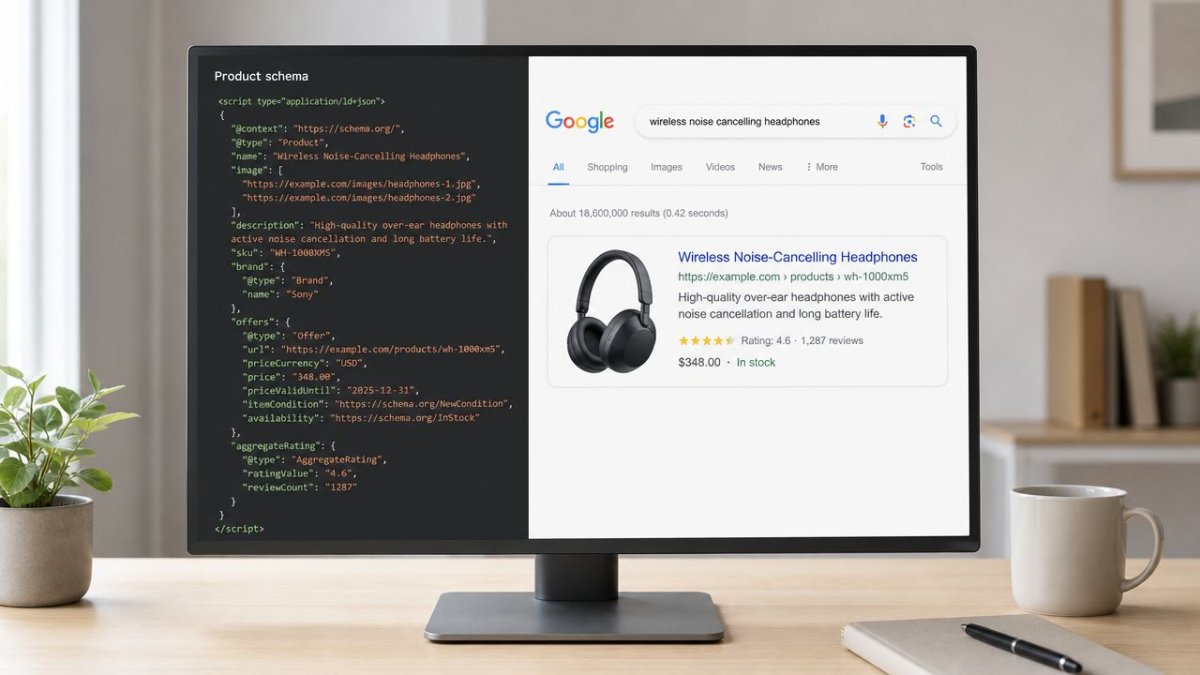
On Shopify, structured data works like a product feed for search engines. It gives Google and other platforms a cleaner read on your catalog, pricing, availability, reviews, and site hierarchy. That matters even more if you are competing with giant retailers, because rich results can help a smaller brand earn more attention from the same search results page.
The trap is app overload. Merchants install a review app, a filter app, a schema app, and sometimes a theme with built-in markup. Then each tool outputs its own version of Product schema. I see this often on Shopify stores. One page ends up declaring two prices, outdated stock status, or duplicate review counts. Search engines do not guess which one is right.
What to implement first on Shopify
Start with the schema types that tie directly to revenue and crawl understanding:
- Product schema: for product name, description, price, availability, brand, and review data
- Breadcrumb schema: for category context and cleaner hierarchy signals
- FAQ schema: only on pages where the questions and answers are visible and useful
- Organization and WebSite schema: useful at the store level, but lower priority than getting product markup right
Product schema deserves the first pass because it changes often. Prices change. Variants go out of stock. Review counts grow. If your markup is hand-coded and never updated, it becomes stale fast.
That is why Shopify implementation matters more than theory. Busy merchants need a setup that stays synced with the catalog.
The practical Shopify setup
Use one source of truth for JSON-LD. That can be your theme, a dedicated schema app, or a Shopify SEO app with schema controls. Do not let multiple apps print overlapping product markup unless you have tested the output carefully. If you use a platform like wRanks for Shopify SEO workflows, pair it with a simple schema process. Audit the live code, identify duplicate entities, then keep only the markup source that updates reliably with your store data.
A clean workflow looks like this:
- Inspect live product pages and confirm which app or theme is generating JSON-LD.
- Remove duplicate schema output from apps that overlap.
- Map schema fields to Shopify data so price, currency, stock, SKU, and reviews pull from live values.
- Validate sample URLs after theme edits, app installs, and review app changes.
- Recheck high-value products first instead of trying to perfect every page at once.
That last point matters. On Shopify, twenty bestsellers usually deserve attention before the long tail. If you only have an hour this week, fix the markup on the products that drive the most revenue.
Use AI to speed up the boring parts
AI is useful here, but not for generating random schema blocks and pasting them sitewide. Use it to review outputs, compare visible page content against markup, flag missing fields, and build QA checklists for your team or developer. That saves time without introducing another layer of technical debt.
For example, an AI assistant can help you spot patterns such as:
- missing
aggregateRatingon products with visible reviews offersmarkup showing out-of-date availability- breadcrumb paths that do not match the collection structure
- schema properties pulled from placeholder theme text instead of real product data
If you also publish answer-focused support content, this guide on optimizing for featured snippets can help you structure visible content in a way that supports richer search presentation.
One rule matters more than the rest
Your structured data has to match what shoppers can see on the page.
If the product page shows one price and the JSON-LD shows another, that inconsistency weakens trust. The same goes for reviews, stock status, and FAQs that exist only in code. Schema helps when it reflects reality. On Shopify, the winning approach is simple. Keep the markup accurate, keep it singular, and keep it tied to live store data.
4. Keyword Research and Ranking Tracking for Competitive Intelligence
Keyword research for Shopify isn't about grabbing the biggest phrase in your niche and hoping for the best. If you're selling running shoes, “shoes” is too broad to guide anything useful. The best opportunity usually lives in terms with clear buying intent and lower competition, especially at the collection and product level.
Broad keywords are like trying to win a citywide election, while long-tail commercial terms are like showing up where your actual customers already live.
Track intent, not just volume
Across mainstream SEO tooling, ecommerce teams consistently rely on commercial-intent filtering, rank tracking, and competitor gap analysis to find useful opportunities. Semrush recommends filtering for transactional intent, using volume and keyword difficulty or PKD to choose targets, and reviewing competitor domains to uncover untapped terms. It also frames organic traffic, rankings, CTR, and conversion rate as a stronger measurement set than revenue alone in its ecommerce SEO workflow.
For Shopify merchants, that's the practical model. Build lists by category, not by random inspiration. A collection for trail shoes should track different phrases than a blog post about marathon training.
- Prioritize buyer language: “buy blue running shoes” tells you more than “blue shoes.”
- Watch competitors by collection: giant retailers may dominate broad terms, but they often leave niche modifiers open.
- Track rankings by geography: local variations matter, especially if you sell in multiple markets.
What doesn't work is checking rankings only when sales drop. By then, you're reacting late. Monthly review is usually enough for stable catalogs, with closer watch on seasonal collections and newly launched pages.
5. On-Page Copy Optimization Using AI Assistants
Shopify merchants often have one of two copy problems. Either every product description sounds like the manufacturer feed, or every page sounds like a branding exercise with no clear product relevance. Neither helps SEO much. Search engines need specifics, and shoppers do too.
AI is useful here because it can turn structured product data into readable first drafts fast. But speed only helps if the inputs are good. If you feed vague product details into the system, you'll get vague copy back.
Use AI where repetition hurts humans most
This is especially effective for large catalogs. A beauty brand can turn ingredient lists into benefit-led copy. An electronics store can convert specs into buyer-friendly language about compatibility and use cases. An apparel merchant can create unique copy around fabric, fit, and occasion instead of duplicating the same template across every SKU.
Good AI-assisted copy should answer obvious buyer questions before they become objections. What does it feel like? Who is it for? When should someone choose this model over another one?
- Start with source material: product specs, materials, dimensions, use case, care instructions, and shipping notes.
- Set category rules: a serum page shouldn't sound like a sneaker page. Build separate prompts for different product types.
- Edit for voice and accuracy: AI can draft. Your team still needs to verify claims and remove bland phrasing.
One thing that consistently works on Shopify is giving category pages and product pages different jobs. Product copy sells the item. Collection copy clarifies selection, differences, and use cases. When both pages say the same thing, you waste indexing opportunities and confuse shoppers.
6. Image Alt Text Optimization Using Vision Models
Alt text is one of the easiest SEO tasks to ignore because it feels small. On Shopify, it adds up fast. A store with multiple angles per product, user-generated photos, and collection banners can end up with hundreds or thousands of images needing descriptions.
The right mindset is accessibility first, SEO second. Alt text should describe what the shopper would need to know if they couldn't see the image. Search benefit follows from that clarity.
Write for humans, not image stuffing
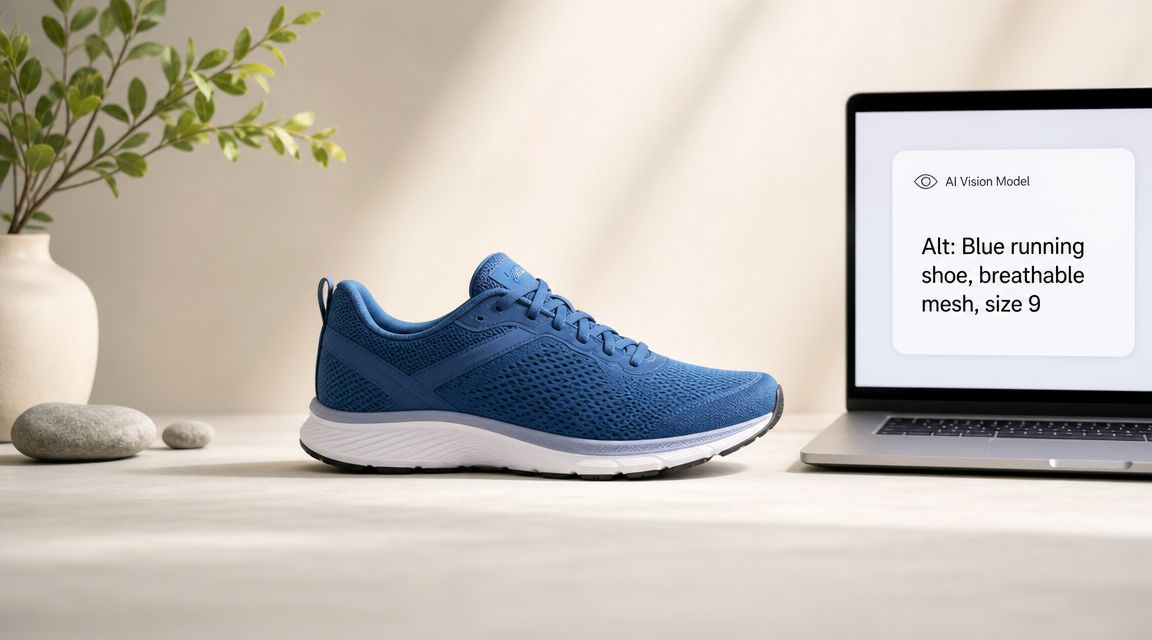
Vision models can help generate workable drafts at scale, especially for apparel, furniture, and electronics where images carry meaningful details. For a running shoe, “Blue mesh running shoe with white sole, side profile” is useful. “Best blue running shoe buy online cheap” is spammy and weak.
If you sell furniture, describe material, room setting, and visible style cues. If you sell cosmetics, note package type, color, or texture when that's the visual point of the image. If you're using multiple product angles, each alt text should reflect what's different in that shot.
Most Shopify image alt text fails for one reason. It repeats the product title instead of describing the image itself.
A practical standard is to keep alt text concise, specific, and natural. Don't write “image of.” Don't force every keyword into every image. And don't let apps mass-fill useless placeholders across the catalog. A partially optimized image library with real descriptions is better than full coverage with junk output.
7. Blog Content Strategy and AI Blog Writer Implementation
A lot of Shopify stores publish blogs like an afterthought. One post about “summer trends,” another about “our brand story,” then nothing for months. That doesn't build topical relevance. It just creates isolated pages with no clear role.
The better model is to treat blog content as the education layer above your collections and products. Product pages capture demand that already exists. Blog posts help create and route demand from people who are still comparing, learning, or narrowing options.
Publish content that supports actual merchandising
Shopify itself recommends publishing blog articles for informational queries as part of a more mature search strategy in its guidance on ecommerce SEO best practices. That matters because many merchants still overinvest in transactional pages and underinvest in the content that introduces new visitors to the brand.
For a running store, that might mean posts about training surfaces, shoe rotation, or fit differences. For home goods, it might mean care guides, style combinations, or room-specific buying advice. For skincare, educational content around routine order and ingredient roles tends to connect naturally to product discovery.
AI blog writers help most when you already know the topic cluster and destination pages. They can draft outlines, intros, FAQs, and metadata quickly. But they still need human editing for accuracy, examples, and brand point of view.
- Choose topics from search intent: answer questions that connect naturally to categories you sell.
- Link to relevant collections: every article should point readers toward a next step.
- Refresh older posts: if a seasonal article still attracts visits, update links, examples, and product references.
What doesn't work is publishing generic educational content with no path back to products. Traffic without internal routing is expensive attention.
8. Internal Linking Strategy and Site Architecture Optimization
Internal linking is the closest thing Shopify merchants have to a free advantage. You already own the pages. You already control the navigation, collection descriptions, blog copy, and related product sections. The issue usually isn't lack of pages. It's that the pages don't reinforce one another.
Think of internal links like aisle signs in a store. If the signs are clear, shoppers move confidently. If every aisle loops into three others with no logic, people leave.
Build paths between education, category, and product pages
The strongest Shopify stores create obvious paths from broad to specific. A blog article about sustainable fabrics should link to the eco-friendly collection. That collection should link to subcategories or featured products. Product pages should link back to relevant collections and sideways to meaningful alternatives.
This also helps search engines understand hierarchy. Google's ecommerce documentation emphasizes crawlable product pages and technically sound site structure in its ecommerce search guidance. That principle applies directly to internal linking. If your key pages are buried, duplicated, or disconnected, they are harder to understand and easier to overlook.
- Link with context: “organic cotton duvet covers” is more useful than “click here.”
- Support low-visibility pages: send links from stronger blog posts and high-traffic collections.
- Keep architecture shallow: important collections and products shouldn't require a scavenger hunt.
Shopify can create messy URL pathways when collections, tags, and filters multiply. Clean internal linking helps counter that by signaling which destinations matter most.
9. Fast Indexing and Discoverability via Google Indexing API, Bing IndexNow, and AI Engines
One of the most common Shopify frustrations is publishing a page, updating a title, or launching a collection and then waiting. You know the page exists. Search engines just haven't caught up yet. That lag is especially painful for seasonal launches, limited drops, and fast-moving inventory.
Fast indexing tools don't replace strong SEO, but they reduce the dead time between publishing and discovery. For stores that update products often, that's a practical advantage.
Speed up discovery without creating chaos
The first rule is simple. Only push pages you want indexed. If your store still has duplicate collections, weak filtered pages, or thin placeholders, faster discovery just exposes the mess faster.
For solid pages, indexing tools can help search engines notice changes sooner. Bing IndexNow is worth setting up because it's lightweight and useful for frequent updates. Sitemap hygiene still matters too. If your XML sitemap is stale or packed with low-value URLs, you've already made discovery harder.
A newer layer now matters as well: AI engine discoverability. Merchants are starting to think beyond classic crawlers and toward systems that summarize, recommend, and cite product information in conversational interfaces. That means clean structured content, crawlable pages, and explicit discoverability signals are becoming more important.
If your store launches seasonal collections, indexability is part of merchandising, not just SEO.
On Shopify, this usually works best when indexing is tied to your publishing workflow. Launch the page, confirm canonical and metadata, update sitemap visibility if needed, and submit the URL through the tools you've configured. Busy teams need that process to be boring and repeatable.
10. Multi-Language SEO and Localization for Global Shopify Markets
International SEO is where many Shopify stores move from “good enough” to “broken.” They install hreflang, translate templates, and assume the job is done. It isn't. A translated store can still perform badly if the category terms are unnatural, the product language is thin, or every market inherits the same merchandising logic.
The challenge isn't tagging pages. It's making each market feel locally relevant without multiplying duplicate content problems.
Localize for search behavior, not just language
This gap shows up in a lot of ecommerce SEO content. The operational question isn't whether you should localize. It's how to localize category and product pages at scale without relying on thin or machine-translated copy. Google's ecommerce guidance emphasizes crawlable product pages and strong technical foundations, while the U.S. International Trade Administration frames SEO as a data-driven process that uses analytics and gap analysis to fix site issues, as summarized in the verified guidance above. In practice, that means international SEO is an ongoing localization and measurement workflow, not a one-time hreflang task.
For Shopify Markets merchants, start with native-market keyword research. The phrase that converts in the US may not match what shoppers type in Canada, Germany, or France. Then localize visible content, not just metadata. Product descriptions, category intros, shipping language, and returns messaging all contribute to relevance.
- Research each locale separately: direct translation rarely captures how people shop.
- Use native review and merchandising cues: sizing, material terminology, and seasonal framing often differ by market.
- Avoid duplicated templates across regions: if every localized page is the same skeleton with swapped nouns, quality suffers.
Competing globally doesn't require giant-enterprise complexity. It requires discipline. Fewer well-localized markets usually outperform a rushed rollout across too many languages.
10 Ecommerce SEO Best Practices Comparison
| Solution | 🔄 Implementation Complexity | ⚡ Resource Requirements | 📊 Expected Outcomes | 💡 Ideal Use Cases | ⭐ Key Advantages |
|---|---|---|---|---|---|
| Product Page Optimization with AI-Generated Meta Tags and Titles | Low–Medium, bulk AI generation with human review | Low dev effort; moderate editorial oversight; product data | Higher CTR and SERP relevance; scalable meta coverage | Shopify stores with 100+ products needing scale | Consistent, scalable meta tags; CTR lift; speeds up copywork |
| Technical SEO Audits, Issue Prioritization, and 301 Redirect Management | Medium–High, full site crawls, prioritization, redirect actions | Audit tools, developer time for fixes, monitoring | Fewer crawl/index issues, preserved link equity, faster remediation | Agencies, enterprises, stores undergoing migrations | Identifies critical issues; prioritizes fixes; prevents ranking loss |
| Structured Data Markup (JSON-LD) Implementation for Rich Snippets | Low–Medium, auto-injection but requires accurate data | Product/rating data; validation tools; occasional dev tweaks | Rich snippets (stars, price), ~20–30% CTR uplift; better shopping visibility | All eCommerce stores seeking improved SERP presence | Enables rich results, improves CTR and AI/voice understanding |
| Keyword Research and Ranking Tracking for Competitive Intelligence | Medium, setup tracking, geo-targeting, alerts | Subscription tools, analyst time, ongoing monitoring | Discovery of high-intent keywords; measurable ranking trends | SEO teams, agencies, data-driven merchants | Reveals opportunities, competitor gaps, trend alerts |
| On-Page Copy Optimization Using AI Assistants | Low–Medium, AI drafts with editorial workflow | AI credits, content editors, templates | Faster, SEO-friendly product/category copy; consistent tone | Merchants with large catalogs and content teams | Scales copy production; improves conversion messaging |
| Image Alt Text Optimization Using Vision Models | Low, API-driven bulk generation; review recommended | Vision model credits; product metadata; QA review | Better accessibility (WCAG), improved image search traffic | Stores with large image libraries | Automates alt text at scale; enhances image SEO and accessibility |
| Blog Content Strategy and AI Blog Writer Implementation | Medium, strategy + AI generation + editorial review | Content team, editors, SEO planning tools, AI costs | Increased organic informational traffic; topical authority | Established stores pursuing content marketing growth | Speeds publishing; builds internal linking and E-E-A-T |
| Internal Linking Strategy and Site Architecture Optimization | Medium–High, planning, structural changes, testing | SEO analysts, potential dev work, site audits | Improved crawlability, distributed authority, better UX | Sites with 100+ pages or complex category trees | Strengthens topical relevance; improves crawl depth and conversions |
| Fast Indexing and Discoverability via Google Indexing API, Bing IndexNow, and AI Engines | Medium, API integrations and llms.txt setup | Dev integration, monitoring, sitemap management | Faster discovery/indexing of new/updated pages; timely SERP updates | Stores with frequently changing inventory or seasonal launches | Accelerates indexation; keeps prices/inventory current in search |
| Multi-Language SEO and Localization for Global Shopify Markets | High, native content + hreflang + tech setup | Native translators, devs, ongoing localization resources | Rankings in multiple regions, better local UX, reduced duplicate content | Stores targeting multiple countries/languages at scale | True localization, hreflang compliance, improved international reach |
Your Action Plan for Shopify SEO Dominance
If this list feels long, that's normal. Shopify SEO touches content, technical setup, product data, UX, and ongoing maintenance. But you don't need to tackle all ten practices this week. You need the right order.
Start with your foundation. If the store has crawl issues, broken redirects, duplicate URLs, slow-loading templates, or bloated app code, content work won't reach its full value. That's why the first practical move is a technical audit. Find the errors that block crawling, weaken indexability, or create a poor user experience. Then fix the highest-impact items first. On Shopify, that's often dead URLs, duplicate pathways, unnecessary app scripts, and weak canonical control.
After that, move to product pages. Most merchants already have the raw ingredients for better rankings. They just haven't packaged them well. Use AI assistants to create stronger titles, meta descriptions, alt text, and product copy, but don't let automation publish unchecked. The winning workflow is fast draft, smart human edit, consistent rollout. That gives you scale without sacrificing trust.
Then build your middle layer. Add structured data that stays synced with product reality. Set up rank tracking around commercial-intent terms that map to collections and core products. Improve internal links so blog posts, collections, and product pages support one another instead of sitting in isolation. Following these improvements, Shopify stores often start to feel more coherent, both for users and for search engines.
Content comes next, but only if it's connected to buying journeys. Publish blog posts that answer real pre-purchase questions, then route readers toward the right collections and products. If you're expanding internationally, localize based on how each market searches and shops. Don't settle for copy-paste translation.
A practical monthly rhythm works better than a giant SEO sprint:
- Month one: audit the store and clean up technical issues.
- Month two: optimize top product and collection pages.
- Month three: add or improve structured data and internal links.
- Month four: publish supporting blog content tied to high-value categories.
- Month five and beyond: expand into indexing workflows, image optimization, rank monitoring, and localization.
Consistency wins on Shopify because the platform itself keeps changing. New products launch. Apps get added. Themes get updated. Collections shift with merchandising. SEO isn't something you finish. It's something you operate.
If you want extra support from a specialist, this Shopify SEO consultant guide gives a helpful overview of what expert help should look like.
If you want a faster way to apply these ecommerce SEO best practices inside Shopify, wRanks is built for exactly that. It combines technical audits, AI-generated product and blog optimization, structured data, rank tracking, redirects, indexing tools, and multilingual SEO in one Shopify-focused app, so you can spend less time juggling apps and more time fixing what drives growth.

About Priya Sharma
Content marketing expert and Shopify ecosystem authority. Priya has helped 200+ stores grow organic traffic through strategic blog content and keyword targeting.