How to Optimize for AI Search: Get Featured in 2026

You're probably seeing the same thing a lot of Shopify merchants are seeing now. You search for a product category you care about, Google shows an AI-generated answer at the top, and a competitor's store gets summarized before your product page even has a chance to earn the click.
That's the new search reality. The fight isn't only for rank anymore. It's for inclusion inside the answer.
If you want to understand how to optimize for AI search on Shopify, the shift is straightforward to describe and harder to execute well. Your pages need to be easy for systems to crawl, easy to parse, easy to verify, and easy to quote. That means better structure, tighter copy, stronger schema, cleaner technical SEO, and a measurement model that goes beyond old rank tracking.
Table of Contents
- The New Search Landscape What AI Overviews Mean for Shopify
- Structuring Content for AI Comprehension
- Crafting AI-Ready Copy and Product Descriptions
- Technical Foundations for AI Visibility
- Monitoring and Adapting Your AI Search Strategy
- An Actionable AI Optimization Plan for Your Store
The New Search Landscape What AI Overviews Mean for Shopify
A Shopify owner used to ask one core question. “How do I rank this page higher?” Now there's a second question that matters just as much. “Will Google use my page when it builds the answer?”
That change is already large enough to affect mainstream ecommerce visibility. Google says its AI Overviews can summarize complex topics, cite sources, and appear in Search for more complex questions, and by May 2024 the feature was reaching over 1 billion people per month across more than 100 countries and territories according to Google's AI search guidance.
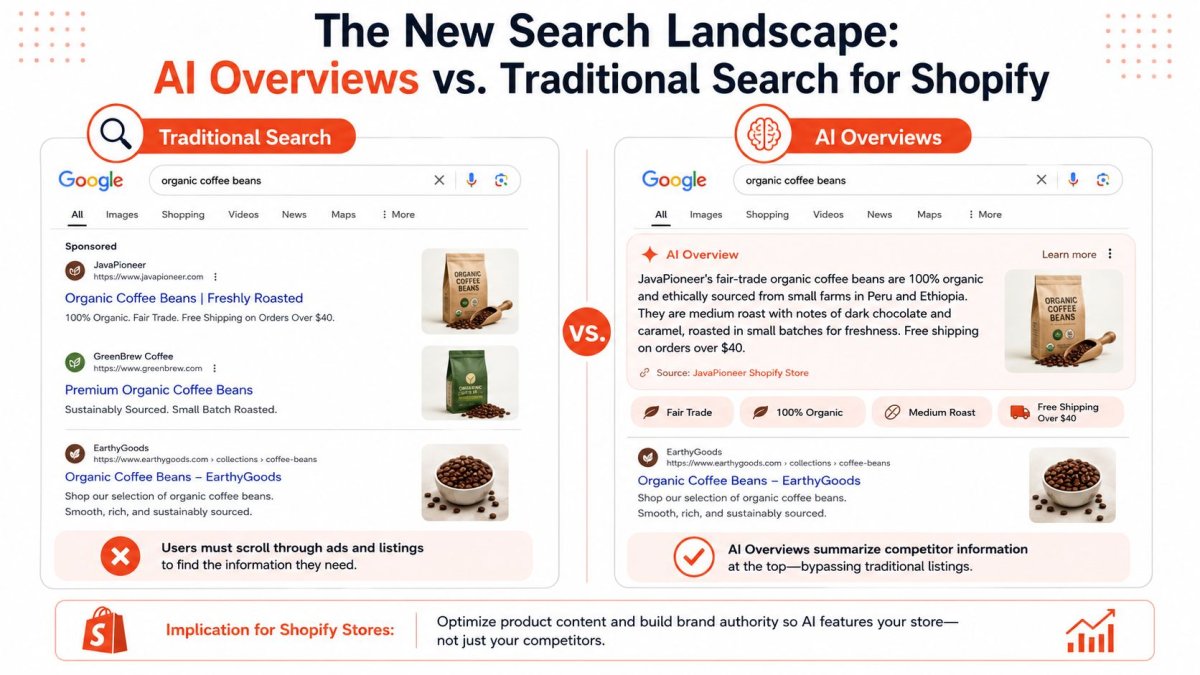
For Shopify stores, this creates a practical split between ranking visibility and citation visibility. A page can still rank, but if a competitor has cleaner product facts, stronger entity signals, and a tighter answer block, that competitor may be the one summarized in the AI layer.
What changes for merchants
Traditional SEO rewarded pages that were broader, stronger, and more authoritative than the rest of the results. AI search still values authority, but it also favors passages that are easy to extract. Consider packaging for a warehouse. If your information is loose, oversized, and hard to label, it won't move efficiently. If it's clearly boxed, tagged, and organized, retrieval systems can use it fast.
That's why the old idea of “just write a long product page and add keywords” doesn't hold up well anymore.
Practical rule: A Shopify page now has two jobs. Convince the shopper and assist the machine.
The impact goes beyond organic SEO teams. If you want a wider view of brand mention dynamics, this breakdown of how AI Overviews impact PR strategies is useful because AI answers often pull trust signals from beyond your own storefront.
For a plain-language primer on the broader shift from SEO to answer visibility, wRanks also published a solid overview of answer engine optimization.
The opportunity for smaller stores
This isn't only a threat. It's also an opening.
Large catalogs often have bloated templates, weak product explanations, and inconsistent metadata. A focused Shopify store can move faster. It can clean up collection pages, tighten product copy, add useful FAQs, fix schema, and create pages that answer real buying questions better than a giant retailer with a messier stack.
That's usually how early gains happen in AI search. Not through magic prompts. Through cleaner execution.
Structuring Content for AI Comprehension
Most Shopify content problems aren't writing problems. They're architecture problems.
A weak product page often has a long promotional paragraph, a buried spec list, and headings written for design instead of meaning. That format may look polished, but it's hard for retrieval systems to break apart and quote accurately.
Modern AI search work also happens at a larger operational scale than old keyword targeting. Practitioners recommend auditing between 1,000 and 10,000 prompts to find visibility gaps, which reflects how search has moved from single terms toward question clusters and intent patterns, as outlined by seoClarity's AI search optimization guidance.
From keyword pages to answer modules
The best-performing pages for AI comprehension tend to be modular. Each section has one job. Each heading signals a real question. Each paragraph can stand on its own without needing the whole page for context.
Here's the contrast:
| Traditional product page | Retrieval-ready product page |
|---|---|
| Brand-heavy opening copy | Direct answer near the top |
| Generic headings like “Overview” | Question-based headings |
| Specs mixed into prose | Specs separated into scannable blocks |
| One large description | Small sections with clear scope |
That doesn't mean every page has to sound robotic. It means each important idea should be easy to locate.
What this looks like on a Shopify page
For a product page, start with a short answer to the main buying question. If the product is a grinder, mattress topper, protein powder, or pet carrier, the top of the page should say what it is, who it's for, and the core differentiator in plain language.
Then build the rest of the page in chunks:
- Opening answer block: State the product type, primary use case, and material or model details right away.
- Question-based headings: Use headings such as “Is this safe for sensitive skin?” or “What size room does this cover?”
- Self-contained sections: Keep each section focused on one topic so it can be quoted cleanly.
- Scannable support: Use bullet points, short tables, and FAQs where they clarify the answer.
A lot of merchants already understand this idea from featured snippets. The difference is that AI systems can combine several of those blocks into one answer experience. If you've worked on snippet formatting before, this guide on how to optimize for featured snippets fits naturally into the same workflow.
If a heading doesn't match a real customer question, it usually isn't doing enough work.
One caution. Don't turn every page into an FAQ dump. That's a common overcorrection. AI-friendly structure works when the questions are tied to buyer intent, not when they're filler added for template symmetry.
A strong Shopify collection page follows the same principle. It needs a concise intro that defines the category, then subsections that explain differences, fit, materials, or use cases. Collection pages often underperform in AI results because they read like merchandising wrappers instead of useful source documents.
Crafting AI-Ready Copy and Product Descriptions
Good AI-ready copy doesn't start with generation. It starts with editorial discipline.
If the source material is vague, the output will be vague. If the page hides the important facts, AI systems will either skip the page or pull a partial reading that doesn't help your store.
Why vague copy disappears
A lot of Shopify product descriptions are still written like ad slogans:
- Premium quality
- Designed for modern lifestyles
- Perfect blend of comfort and style
- Crafted to enhance your routine
None of that gives a retrieval system much to work with. It also doesn't help a buyer compare products.
By contrast, practical AI-search workflows emphasize retrofitting important pages into answer-first modules with a direct answer, question-led headings, and tightly scoped sections that retrieval models can parse and cite, as explained in Elementor's AI search optimization workflow.
What strong Shopify copy actually includes
The copy that gets reused well usually contains recognizable entities and decision-making details. On a Shopify store, that means naming the product type, brand, model, compatible use case, material, format, and constraints clearly.
For example, this is weak:
“Our sleek travel mug is the ideal companion for busy days.”
This is stronger:
“This stainless steel travel mug is designed for commuters who want a spill-resistant lid, an insulated body, and a cup-holder-friendly shape.”
The second version gives both the shopper and the machine something concrete.
Use this checklist when rewriting descriptions:
- Name the product precisely: “Leather tote” is weaker than “full-grain leather laptop tote with zip closure.”
- Include real attributes: Materials, dimensions, compatibility, flavor profile, finish, or intended user matter.
- Answer implied questions: Is it washable, refillable, stackable, fragrance-free, USB-C compatible, vegan, or made for outdoor use?
- Reduce slogan density: Marketing language should support facts, not replace them.
One place where merchants get this wrong is with collections. They write category intros like homepage hero copy. AI systems don't need that. They need category definitions, differentiators, and buying guidance.
If you want a practical example of using AI to draft richer ecommerce text without settling for generic fluff, wRanks has a useful page on its AI product description generator.
This walkthrough helps show the difference between generating text and directing it well:
A simple test works well here. Remove the product image and brand name. If the description still tells a buyer exactly what the item is, who it fits, and why it's different, you're getting closer.
The trade-off most merchants need to accept
Shorter isn't always better. Cleaner is better.
Some merchants cut descriptions too aggressively because they think AI only wants a quick snippet. In practice, you need both. A concise top answer and enough depth underneath to support product selection, comparison, and trust. The page should feel like a well-organized sales floor, not a shelf tag.
Technical Foundations for AI Visibility
Great copy won't matter if the page is hard to crawl, hard to interpret, or missing the technical labels that explain what the content is.
Many Shopify stores often hit the wall. The merchant rewrites product copy, adds FAQs, and still sees weak AI visibility because the technical layer is thin or inconsistent.
Schema and crawlability come first
For AI visibility, the most repeatable technical levers are structured data, clean crawlability, strong linking, and current brand mentions, with common schema types including FAQ, HowTo, and Product, as summarized in ROI Revolution's guide to optimizing for AI search engines.
On Shopify, that turns into a short list of priorities:
Product schema on every eligible PDP
Your product pages should clearly identify the item as a product, not just as a generic webpage.FAQ schema where the FAQ is real
Don't fabricate support content. Add FAQs when customers genuinely ask the same pre-purchase questions.Collection-page clarity
Collections often need stronger internal links and better descriptive copy so crawlers can understand the category context.Clean indexable architecture
Important pages should be easy to discover through internal links, XML sitemaps, and consistent navigation paths.
A lot of stores make schema an afterthought. That's backward. Schema is one of the clearest ways to tell a machine, “this block is a product,” “this part is a question and answer,” or “this section is a procedure.”
Control what AI can show
Google's guidance also makes an important point that gets lost in a lot of AI-search advice. Eligibility still depends on classic technical SEO basics. Pages need to be crawlable and indexable, and site owners can use controls such as nosnippet, data-nosnippet, max-snippet, and noindex to manage what can appear, according to Google's guidance on succeeding in AI search.
That matters for Shopify stores with pages you don't want summarized loosely. Think of pages like:
- Wholesale information
- Policy content with edge-case language
- Thin promotional landing pages
- Internal duplicate variants that shouldn't surface
Field note: AI optimization isn't only about getting cited. It's also about deciding what should not be quoted.
If you don't control snippet behavior, you can end up with the wrong fragment representing your brand.
Shopify-specific technical priorities
Shopify makes some things easy and some things annoyingly repetitive. The stores that handle AI visibility well usually get the basics right before chasing advanced ideas.
Here's the order I'd use:
| Priority | Why it matters on Shopify | Common mistake |
|---|---|---|
| Product schema | Clarifies product entities | Incomplete or theme-dependent markup |
| Internal linking | Helps discovery of products and collections | Orphaned collections and buried blogs |
| Page experience | Supports usability and crawl efficiency | Heavy apps slowing templates |
| Fresh branded mentions | Reinforces off-site entity consistency | Outdated profiles and mismatched product names |
A few extra points are worth calling out.
- Avoid stale templates. If your theme outputs old schema or inconsistent product details, AI systems may read conflicting signals.
- Keep product naming consistent. The product title on the page, in schema, in feeds, and in external mentions shouldn't drift.
- Don't hide important copy in tabs without context. If critical facts are buried in collapsible sections with weak heading labels, the page becomes harder to parse.
- Use internal links intentionally. Blog posts should point to collections and products with descriptive context, not random “shop now” anchors everywhere.
There's also growing interest in files and tools that help with AI discoverability, including llms.txt. Merchants can explore those, but they shouldn't treat them as a shortcut. If your product pages are technically messy, a new file won't rescue visibility.
Monitoring and Adapting Your AI Search Strategy
A lot of merchants still judge performance with one reflex. They check rank.
That still matters. It just doesn't explain enough anymore. If Google answers the question directly, a number-one ranking below the AI layer can tell only part of the story.
Why rank tracking is no longer enough
Traditional rank tracking measures page position. AI search introduces a second layer of performance: whether your brand, product, or supporting content appears in the generated answer set.
That changes the scoreboard. A Shopify store can have decent rankings but weak presence in AI summaries. Another store can rank lower on classic results and still get surfaced more often because its content is easier to cite, better structured, or more clearly tied to the entity the system recognizes.
This is why merchants should start monitoring citation share, brand mentions, and answer presence across platforms. Not as a replacement for SEO reporting, but as a necessary extension of it.
What to watch instead
A useful monitoring setup looks at three buckets.
Brand mention accuracy
Are AI systems describing your brand, products, and differentiators correctly?Page-level citation presence
Which product pages, buying guides, and FAQs appear to influence AI answers?Competitive comparison
Which rival stores keep getting summarized for the same buyer questions?
If you're building your own collection system for SERP and answer monitoring, this guide to SERP API tools is a practical reference because gathering search-result data at scale gets technical fast.
Rankings tell you where your page sits. Citations tell you whether your information is being used.
Google's own guidance reinforces the broader point here. Technical eligibility remains imperative, and controls such as nosnippet and noindex still matter because pages must remain crawlable and indexable before they can be considered for AI results, as covered in Google's AI search documentation for site owners.
For Shopify merchants, the adaptation loop should be simple:
- Check where your store is cited or absent.
- Compare those answers with your actual page content.
- Fix factual gaps, weak formatting, and entity confusion.
- Refresh pages that have become outdated or too generic.
- Re-test the same query cluster.
The teams that improve fastest usually treat AI search like merchandising. They don't publish and forget. They revise the presentation until the product is easier to understand and easier to recommend.
An Actionable AI Optimization Plan for Your Store
Most stores don't need a huge AI-search project first. They need a sharper sequence.
Start with the pages that already matter to revenue. Product pages, collection pages, and a small set of buying-guide posts will usually move faster than trying to rework the whole site at once.
A practical store checklist
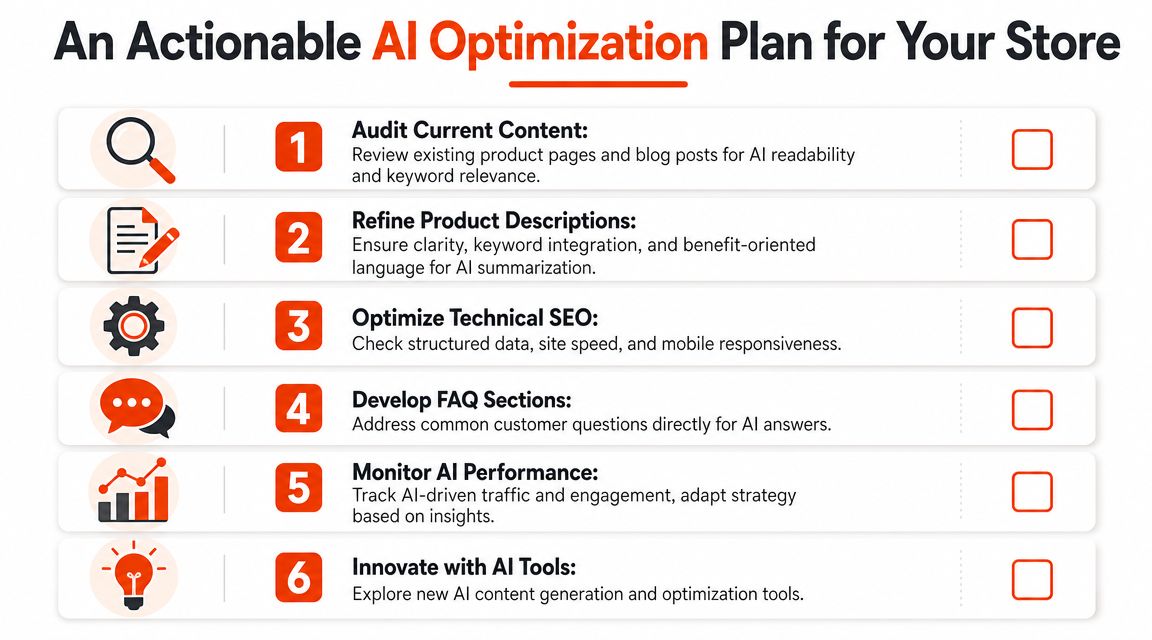
Print this list and work through it in order:
Audit your top commercial pages
Pick your most important product pages and collections. Check whether each page answers the main buyer question near the top.Rewrite for answer-first clarity
Add a direct opening summary, then rebuild sections with question-led headings and scannable subsections.Tighten product facts
Replace vague claims with specific attributes, compatibility notes, materials, and use cases.Implement the right schema
Product pages need Product schema. FAQ sections should use FAQ schema only when the questions are real and visible on-page.Review technical eligibility
Confirm key pages are crawlable, indexable, internally linked, and not weakened by template bloat or stale metadata.Track AI presence, not only ranks
Watch whether your brand and product pages appear in AI answers and whether those answers are accurate.
One reason this work becomes manageable is that merchants can automate the repetitive parts while keeping editorial control. If you're building a process around repeatable tasks, this guide on how to automate tasks with AI tools is a useful companion for deciding what to systemize and what still needs human review.
The main thing that works is consistency. A clean product page won't fix a messy store by itself. But a store with structured pages, factual copy, valid schema, clear internal linking, and active monitoring starts to look reliable to both search engines and answer engines.
If you want one Shopify-focused system for this work, wRanks is built for exactly that mix of content, technical SEO, and AI visibility. It helps merchants audit stores, generate and improve product and blog content, inject JSON-LD schema, monitor rankings and brand mentions across major AI platforms, and speed up fixes without theme-heavy implementation.

About Sarah Mitchell
Senior SEO strategist with 8+ years in e-commerce search optimization. Sarah helps Shopify merchants turn organic traffic into revenue through data-driven content strategies.