
Gross Merchandise Value (GMV)
Quick Definition
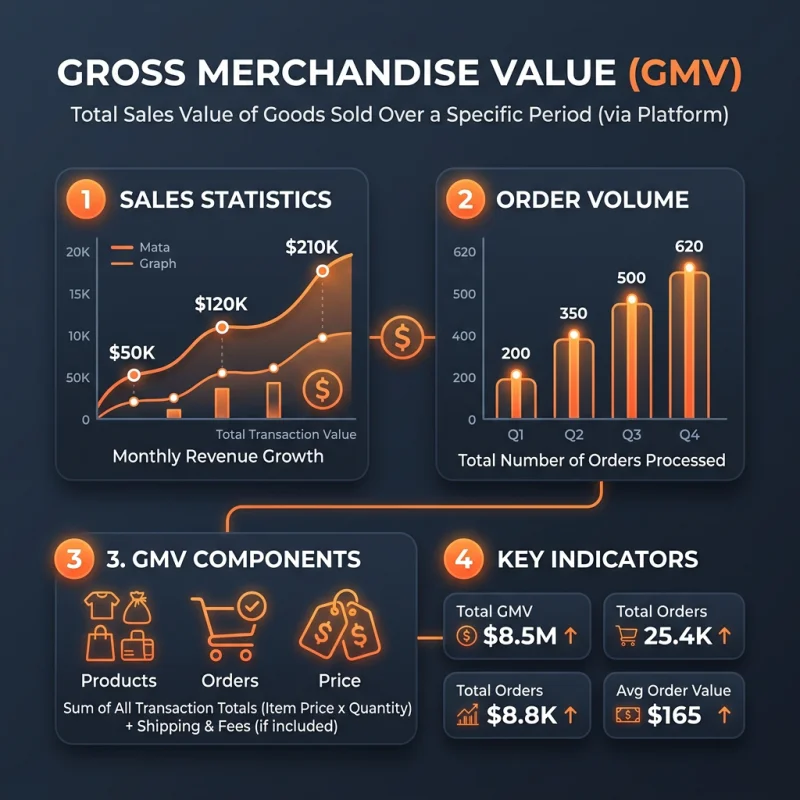
Gross Merchandise Value (GMV) is the total dollar value of all merchandise sold through a Shopify store over a specific time period, before deductions.
Table of Contents
- Understanding Gross Merchandise Value (GMV)
- How to Configure GMV Tracking in Shopify
- The Strategic Business Value of GMV
- Optimization Tips for Increasing GMV
- Conclusion
- Frequently Asked Questions
- How do I calculate GMV for my Shopify store?
- Can GMV be used to measure profitability?
- What are the main differences between GMV and revenue?
- How can I improve my GMV on Shopify?
Understanding Gross Merchandise Value (GMV)
Gross Merchandise Value (GMV) is a fundamental metric in the e-commerce industry that represents the total dollar value of all merchandise sold through an online store within a specific period. Unlike revenue, GMV does not account for deductions such as refunds, discounts, or costs associated with goods sold. It provides a raw measure of sales volume, offering insights into the overall scale and growth trajectory of an e-commerce business.
In practical terms, if a Shopify store sells 1,000 units of various products at different price points totaling $150,000 in a month, its GMV for that period is $150,000. This metric is especially useful for assessing the performance of marketplaces or multi-vendor platforms where multiple sellers contribute to total sales. It also serves as a key indicator for investors and stakeholders to gauge market traction and business potential.
Understanding GMV is crucial because it helps differentiate between sales volume and actual profit. High GMV with low profit margins might indicate aggressive marketing or pricing strategies that need reevaluation. Conversely, steady GMV growth can signal increasing market demand and customer engagement. As such, GMV is often used alongside other KPIs like average order value (AOV) and conversion rate to develop comprehensive business insights.
How to Configure GMV Tracking in Shopify
While Shopify does not directly display GMV as a built-in metric, it can be effectively tracked and analyzed through a combination of Shopify's native analytics, third-party apps, and custom configurations. Here's a step-by-step guide to setting up GMV tracking:
- Access Shopify Analytics: Log into your Shopify admin panel and navigate to Analytics. Here, you can view total sales, which serve as a proxy for GMV, especially if refunds and discounts are minimal.
- Enable Enhanced Ecommerce Tracking: Shopify integrates seamlessly with Google Analytics. To track GMV accurately, set up Google Analytics Enhanced Ecommerce. This allows you to monitor transaction data, product performance, and sales metrics in detail.
- Implement Custom Scripts or Apps: For more granular GMV data, consider installing Shopify apps like Shopify App Store tools that provide advanced sales analytics. Some apps can aggregate total sales data over custom periods and export reports for deeper analysis.
- Configure Your Reports: Use Shopify's reporting features or external BI tools to generate reports that sum total sales, filtering out refunds and discounts if necessary. Regularly exporting and analyzing this data helps monitor GMV trends over time.
- Integrate with External Data Platforms: For large-scale operations, integrating Shopify data with platforms like Google Data Studio or Tableau can facilitate real-time GMV dashboards and custom visualizations.
Proper configuration ensures that your GMV data is accurate, timely, and actionable. Regularly reviewing these metrics helps identify sales patterns, optimize marketing efforts, and forecast future growth.
The Strategic Business Value of GMV
GMV serves as a vital KPI for e-commerce businesses, especially those operating marketplaces or multi-vendor platforms. It provides a clear picture of sales volume, market demand, and customer purchasing behavior. High GMV figures often attract investor interest, facilitate funding rounds, and support strategic expansion plans.
From a business optimization perspective, tracking GMV helps identify which products, categories, or marketing channels drive the most sales. This insight allows for targeted inventory management, promotional campaigns, and pricing strategies to maximize growth.
However, it is essential to interpret GMV alongside profitability metrics. A business with high GMV but low profit margins may need to reevaluate its cost structures or pricing strategies. Conversely, a steady increase in GMV coupled with improving profit margins indicates a healthy, scalable business model.
Real-world examples include marketplaces like Amazon or Alibaba, where GMV is a primary indicator of platform health and growth potential. These platforms often report GMV figures to showcase their market dominance and attract investors.
Optimization Tips for Increasing GMV
- Enhance User Experience: Simplify navigation, improve site speed, and optimize checkout processes to reduce cart abandonment and increase sales volume.
- Leverage Data-Driven Marketing: Use customer data to personalize marketing campaigns, upsell, and cross-sell relevant products.
- Expand Product Range: Diversify offerings to appeal to broader customer segments and increase average order value.
- Implement Promotions and Discounts: Strategic discounts can boost sales volume, especially during peak shopping periods.
- Optimize Pricing Strategies: Use competitive pricing and dynamic pricing tools to maximize sales without sacrificing margins.
By focusing on these areas, businesses can effectively grow their GMV, improve overall sales performance, and strengthen their market position.
Conclusion
Gross Merchandise Value is a cornerstone metric in e-commerce, offering a comprehensive view of sales volume and market traction. While it does not directly equate to profit, GMV provides critical insights into business scale, customer demand, and growth potential. Proper tracking and strategic optimization of GMV can significantly impact a store's success, especially when combined with other key performance indicators.
For Shopify merchants, leveraging analytics tools, configuring detailed reports, and implementing best practices in marketing and operations are essential steps toward maximizing GMV. As the e-commerce landscape continues to evolve, understanding and utilizing GMV effectively will remain a vital component of sustainable growth and competitive advantage.
Frequently Asked Questions
How do I calculate GMV for my Shopify store?
Calculating GMV involves summing the total dollar value of all sales transactions over a specific period. In Shopify, you can view total sales in the Analytics dashboard, which reflects gross sales before refunds, discounts, or cancellations. For more precise GMV, consider integrating Google Analytics enhanced ecommerce tracking or third-party analytics apps that can aggregate sales data across multiple channels. Regularly exporting and analyzing this data helps monitor trends and assess the effectiveness of your marketing strategies.
Can GMV be used to measure profitability?
No, GMV does not account for costs, refunds, or discounts, so it is not a direct measure of profitability. High GMV indicates strong sales volume but does not reflect profit margins. To evaluate profitability, you need to analyze net revenue, gross profit, and net profit after expenses. Combining GMV with profit metrics provides a comprehensive view of your business health and helps identify whether increased sales translate into sustainable profits.
What are the main differences between GMV and revenue?
GMV represents the total value of merchandise sold before deductions, while revenue is the actual income earned after subtracting refunds, discounts, and costs. Revenue reflects the real earnings of your business, whereas GMV indicates sales volume and market activity. For example, a store with a GMV of $100,000 might have a revenue of $80,000 after refunds and discounts. Understanding this distinction is crucial for accurate financial analysis and strategic decision-making.
How can I improve my GMV on Shopify?
To increase GMV, focus on enhancing the customer shopping experience, expanding your product catalog, and implementing targeted marketing campaigns. Use data analytics to identify high-performing products and customer preferences. Offering promotions, discounts, and bundling options can encourage larger purchases. Additionally, optimizing your website for mobile, streamlining checkout, and providing excellent customer service can boost conversion rates and overall sales volume, thereby increasing GMV over time.

About Amira Hassan
Digital growth consultant specializing in AI-powered commerce strategies. Amira bridges the gap between cutting-edge AI tools and practical Shopify store growth.