
Average Order Value (AOV)
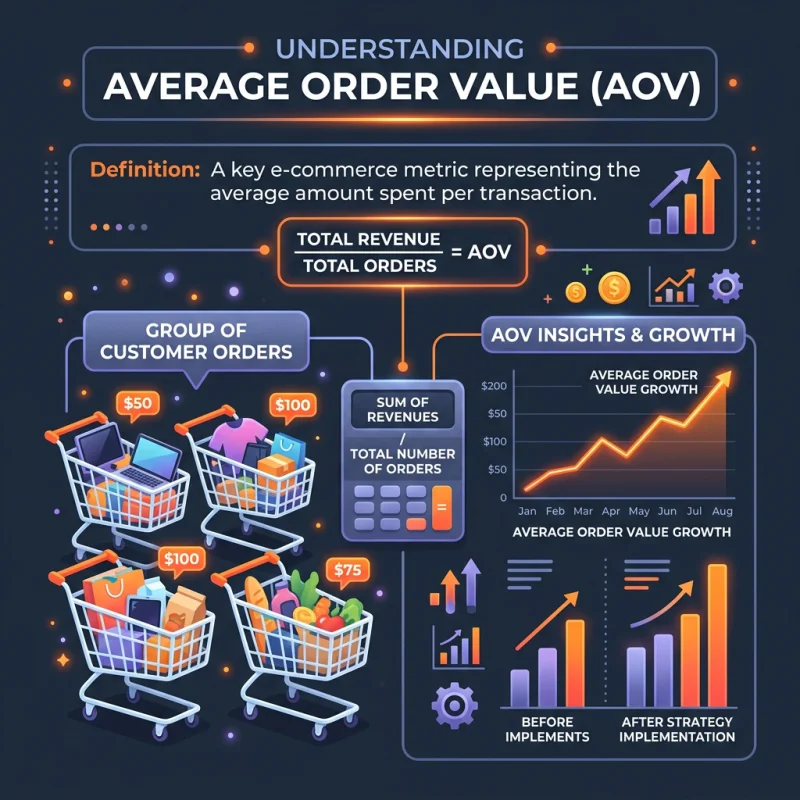
Quick Definition
Average Order Value (AOV) measures the average dollar amount spent by a customer each time they place an order on your Shopify store.
Table of Contents
- Understanding Average Order Value (AOV)
- Deep Conceptual Overview of Average Order Value
- Implementing AOV Optimization in Shopify
- The Strategic Business Value of AOV
- References and Additional Resources
- Frequently Asked Questions
- How do I calculate my store's AOV?
- What are effective strategies to increase AOV?
- How does increasing AOV impact my overall revenue?
Understanding Average Order Value (AOV)
Average Order Value (AOV) is a critical e-commerce metric that indicates the average amount of money customers spend per transaction on your Shopify store. It is calculated by dividing total revenue by the number of orders over a specific period. For example, if your store generates $50,000 in revenue from 1,000 orders in a month, your AOV is $50. This metric provides valuable insights into customer purchasing behavior, helping merchants identify opportunities to increase revenue without necessarily acquiring new customers. A higher AOV often correlates with increased profitability, as it can offset the costs associated with customer acquisition and retention. Understanding and optimizing AOV is essential for scaling your business efficiently and sustainably. It also influences other key performance indicators like conversion rate and customer lifetime value, making it a cornerstone of e-commerce analytics.
Deep Conceptual Overview of Average Order Value
In the realm of e-commerce, Average Order Value serves as a vital KPI that reflects the purchasing habits of your customer base. It encapsulates the typical spend per transaction, offering a snapshot of how much revenue each customer contributes during a single visit. This metric is particularly significant because it directly impacts your overall revenue and profitability. For instance, a store with a high number of transactions but a low AOV might struggle to reach revenue targets, whereas a store with a high AOV can generate substantial income even with fewer transactions.
Several factors influence AOV, including product pricing, bundling strategies, upselling and cross-selling techniques, and customer shopping behavior. AOV is dynamic and can fluctuate based on seasonal trends, promotional campaigns, and changes in consumer preferences. Therefore, continuous monitoring and strategic adjustments are necessary to maintain or improve this metric. Additionally, AOV is interconnected with other KPIs such as conversion rate and customer lifetime value, making it a comprehensive indicator of your store's financial health.
Implementing AOV Optimization in Shopify
Optimizing AOV on your Shopify store involves a combination of strategic planning and technical configuration. Here are detailed steps to effectively implement and boost your AOV:
- Set Up Upselling and Cross-Selling: Use Shopify apps like Bold Upsell or Recom.ai to suggest relevant products during the checkout process. Personalized recommendations encourage customers to add more items to their cart, increasing the total spend.
- Create Product Bundles: Bundle complementary products at a discounted rate to incentivize larger purchases. Shopify's native features or third-party apps like Bundle Products facilitate easy bundle creation.
- Offer Free Shipping Thresholds: Set a minimum order value for free shipping, motivating customers to add more items to qualify. This can be configured under Settings > Shipping and delivery in your Shopify admin.
- Implement Volume Discounts: Encourage bulk purchases by offering discounts based on quantity or total order value. Shopify apps like Volume & Tiered Discounts can automate this process.
- Optimize Checkout Experience: Simplify the checkout process to reduce cart abandonment and make it easier for customers to add additional items or upgrade their purchase. Customize checkout settings under Settings > Checkout.
Additionally, tracking and analyzing AOV trends through Shopify analytics or third-party tools like Google Analytics helps identify what strategies are most effective. Regularly testing different tactics and monitoring their impact allows for continuous improvement.
The Strategic Business Value of AOV
From a business perspective, Average Order Value is more than just a number; it's a strategic lever for growth. Increasing AOV can significantly boost revenue without the need to acquire new customers, which often involves higher marketing costs. For example, a 10% increase in AOV can lead to a proportional rise in revenue, assuming sales volume remains constant.
Optimizing AOV also enhances overall profitability, as higher-value transactions typically incur proportionally lower costs per dollar of revenue. This allows businesses to allocate resources more efficiently toward marketing, product development, and customer experience improvements. Furthermore, a higher AOV can improve your store's conversion rate and customer lifetime value, creating a virtuous cycle of growth.
Real-world examples include brands like Gymshark and Allbirds, which leverage bundling and exclusive offers to encourage larger purchases. These strategies are often supported by data-driven insights, emphasizing the importance of analytics in AOV optimization.
References and Additional Resources
- Shopify Analytics Guide
- Google Analytics Developer Resources
- Schema.org Offer Schema
- Web.dev Optimization Tips
Frequently Asked Questions
How do I calculate my store's AOV?
Calculating your Shopify store's AOV is straightforward. Divide your total revenue over a specific period by the number of orders placed during that same period. For example, if your store earns $100,000 in revenue from 2,000 orders in a month, your AOV is $50. Shopify's built-in analytics dashboard provides this metric automatically, but you can also calculate it manually using your sales reports. Regularly monitoring AOV helps you understand purchasing trends and evaluate the effectiveness of your sales strategies.
What are effective strategies to increase AOV?
Effective strategies include implementing product bundling, offering volume discounts, setting free shipping thresholds, and utilizing upselling and cross-selling techniques. Personalizing product recommendations during checkout can also encourage customers to add more items. Additionally, creating limited-time offers and exclusive deals motivates larger purchases. Consistently testing and analyzing these tactics allows you to identify what resonates most with your audience, leading to sustainable AOV growth.
How does increasing AOV impact my overall revenue?
Increasing your store's AOV directly boosts overall revenue without necessarily increasing traffic or conversions. For instance, a 20% increase in AOV can significantly enhance your profit margins, especially if your fixed costs remain stable. Higher AOV also improves your return on advertising spend and can fund further marketing efforts. Moreover, it can lead to better customer lifetime value, as larger purchases often correlate with higher engagement and loyalty. Therefore, focusing on AOV optimization is a cost-effective way to scale your business.

About Amira Hassan
Digital growth consultant specializing in AI-powered commerce strategies. Amira bridges the gap between cutting-edge AI tools and practical Shopify store growth.