SaaS SEO Services vs SEO Automation
Why Shopify stores must compare SEO services with automation
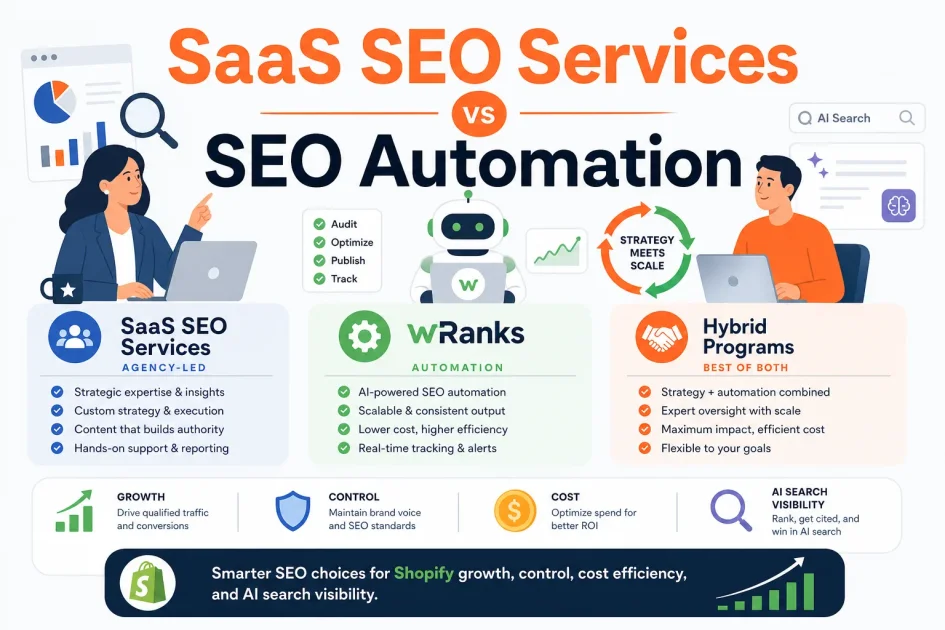
Shopify merchants can choose agency-led SaaS SEO services, automated optimization through wRanks, or a hybrid program, but these models solve different operational problems. Optimizing one product page by hand is very different from maintaining hundreds or thousands of products, collections, pages, and blog posts. The right choice depends on catalog scale, strategic content needs, measurement requirements, and visibility across Google and AI platforms.
Agency-led SaaS SEO services typically begin with the business rather than the store admin. Sure Oak describes SaaS SEO as a customized strategy shaped by the audience, business goals, and marketing funnel, with an emphasis on lead generation, sales, conversions, and long-term growth. Impression Digital adds metrics such as product-qualified leads, sales-qualified leads, monthly recurring revenue, inbound leads, and customer retention. Ember Tribe makes a related point: SaaS SEO differs from generic SEO because the buyer journey, content architecture, and success metrics require a different approach.
That strategic work matters for a Shopify brand selling considered products, subscriptions, or business services. An agency can research positioning, map content to funnel stages, build authority, plan tests, and decide which collection or blog themes deserve investment. It may also shape content for AI search and improve the chances that relevant pages earn citations in large language model results, a growing discovery consideration for SaaS companies in 2026.
Those recommendations still need to reach the catalog. The merchant needs accurate meta tags, structured data, image alt text, internal signals, and content updates across products, collections, pages, and blogs. Automation handles these repeatable tasks and supports ongoing monitoring. wRanks provides AI-powered SEO for Shopify stores, helping merchants optimize products, collections, pages, and blogs while connecting keyword tracking with Google Search Console insights.
Neither option replaces the other in every case. The practical comparison is agency depth versus implementation scale, with a hybrid model available when both matter. The assessment below focuses on catalog coverage, execution speed, strategic depth, measurement, cost and workload control, and visibility in Google and AI search platforms.
Judge each option by Shopify fit, execution speed, and revenue evidence
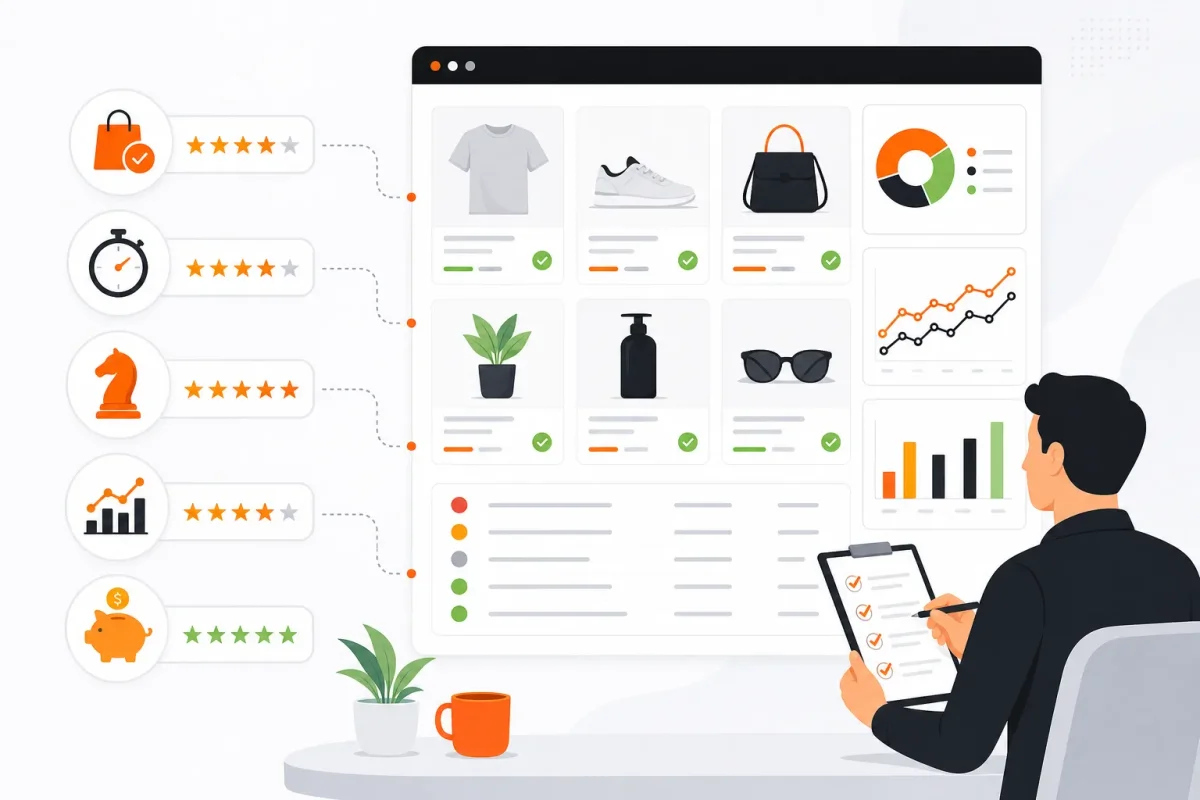
Agency research often starts with audience goals, keyword mapping, content, link building, PQLs, SQLs, and MRR. For a Shopify store, those priorities must also work inside a live catalog, where queries need to connect with products, collections, pages, and blogs. Five practical tests show whether services, automation, or a hybrid model can turn SEO priorities into measurable store work.
Shopify coverage across every indexable content type
Audience research means identifying the shoppers, problems, and use cases behind each product category. Keyword mapping means assigning high-value queries to the right product, collection, page, or blog rather than forcing every term onto the homepage. Content optimization then improves page-level relevance, while product-led content explains how an item solves a specific customer problem.
A store manager can score this test by checking how many indexable URLs receive a clear keyword target, useful copy, accurate meta tags, structured data, and descriptive image alt text. An agency may provide deeper mapping, while automation can apply repeatable improvements across hundreds or thousands of products.
Automation speed versus strategic judgment
Speed matters when a catalog changes weekly or seasonal products need visibility before a promotion. The comparison should measure how quickly each option updates metadata, structured data, and alt text, then check whether those changes remain consistent across templates and product types.
Strategic depth still matters. Sure Oak connects keyword research with conversion-focused pages, and Impression Digital emphasizes customer needs throughout the funnel. Controlled testing and incremental refinement should decide which titles, descriptions, content blocks, and internal links deserve another iteration. Link building remains a separate authority-acquisition task, not a substitute for sound Shopify execution.
Organic traffic, conversions, and AI-platform visibility
Traffic alone is weak evidence. The useful score combines keyword movement, clicks and impressions in Google Search Console, product engagement, assisted conversions, and revenue from organic sessions. Keyword tracking shows direction, while Search Console reveals which queries and pages create actual search demand.
Structured data, clear product information, and well-organized content may also improve how AI platforms interpret a store. That supports AI-search visibility, but it cannot promise placement or conversions.
Budget control, ownership, and scalability
The final test covers monthly cost, internal workload, approval rights, and the ability to expand coverage without adding equal manual effort. A service-led model may suit complex positioning or major content decisions. wRanks suits repeatable AI-powered SEO work across Shopify stores, with merchant control over implementation and monitoring.
The stronger model depends on the store's catalog size, team capacity, sales targets, and need for strategic guidance. Sophistication is not the deciding factor. Shopify fit and revenue evidence are.
Agency-led SaaS SEO services: deepest strategy, slowest catalog execution
Agency-led SaaS SEO services are strongest when a Shopify business faces high-value decisions that require judgment, research, and commercial context. They can clarify which audiences matter, how search intent maps to revenue, and where human expertise should guide the store's next move. The tradeoff appears when that strategy must be applied repeatedly across hundreds or thousands of Shopify URLs.
Shopify coverage across every indexable content type
An agency can define audience segments, map funnel stages to keywords, decide whether a product page or collection should target a query, and shape product-led content around customer problems. Sure Oak, for example, emphasizes audience analysis, keyword research, content optimization, link building, and strategies aligned with a company's industry and goals. Impression Digital also connects content to requirements across the marketing funnel, which helps a store distinguish an informational blog topic from a commercial collection opportunity.
That strategic work is valuable when a merchant sells a considered product and buyers research tools, compare alternatives, read reviews, and look for proof before contacting a business. It can also guide technical prioritization and authority building across product pages, collections, pages, and blogs. The challenge is applying the resulting plan to every eligible URL without creating a large recurring workload.
Automation speed versus strategic judgment
Human specialists are better suited to ambiguous choices, such as whether a new collection deserves a dedicated landing page, whether a product-led article should target a comparison query, or which technical issue could affect revenue most. An agency may produce the recommendation, briefing, and test plan. Yet recurring Shopify work, including updating meta tags, adding structured data, and writing image alt text, may still move through tickets, reviews, approvals, and manual implementation.
That doesn't make every agency slow. It creates a scalability risk. A team can plan catalog coverage well while giving the merchant less direct control over turnaround, workflow, and the cost of each new execution cycle.
Organic traffic, conversions, and AI-platform visibility
Agency strategy can connect keyword intent to product education, collection structure, internal links, conversion paths, and authority signals. It can also identify content that answers the evidence-seeking questions buyers bring to Google and AI platforms. Results depend on execution, though, and a well-researched plan has limited value if routine catalog changes remain incomplete.
Budget control, ownership, and scalability
Agency programs fit Shopify stores where strategic depth outweighs catalog volume, especially during repositioning, expansion into new markets, or complex technical work. They are less suitable when a merchant needs frequent, consistent optimization across a large inventory at a predictable operating cost. For those stores, an automated platform such as wRanks can handle repeatable AI-powered SEO tasks while the agency concentrates on decisions that genuinely need specialist judgment.
wRanks automation: fastest Shopify coverage with hands-on control
Routine Shopify SEO work often involves applying better metadata, supporting structured data, writing image alt text, and checking keyword movement across hundreds of URLs. wRanks brings those repeatable tasks into an AI-powered SEO platform, giving merchants faster coverage without sending every small update through an agency. The tradeoff is clear: automation improves execution speed, while specialist teams remain stronger at unusual strategic problems.
Shopify coverage across every indexable content type
wRanks helps optimize Shopify products, collections, pages, and blogs for search engines and AI platforms. A merchant can work through a defined catalog segment, improve AI-assisted meta tags, add structured data, generate image alt text, and review keyword opportunities in one workflow. AI-generated content can support page updates when a store needs more useful copy, while the merchant retains control over what gets published.
That coverage matters when a store has 500 products, seasonal collections, or a blog that has grown without consistent optimization. Instead of waiting for an agency queue, the team can apply a repeatable process across priority URLs and keep moving.
Automation speed versus strategic judgment
Automation is not a replacement for bespoke SaaS SEO strategy. Specialist teams are better suited to audience research, funnel strategy, product-led content architecture, continual experimentation, and relationship-based link building. They can also assess unusual positioning problems, such as whether a store should target professional buyers, budget shoppers, or a narrow technical niche.
wRanks is weaker when the answer depends on original research, complex information architecture, or authority acquisition built through personal relationships. It handles defined optimization actions well. It doesn't independently create the full strategic direction behind a difficult repositioning.
Organic traffic, conversions, and AI-platform visibility
wRanks connects keyword tracking with Google Search Console, so merchants can compare target terms with impressions, clicks, and resulting changes after updates. That feedback supports faster iteration across product and collection pages. Structured data, clearer metadata, and useful content can also give search engines and AI platforms better signals about what a store sells, although no tool can promise rankings or generative-search inclusion.
Budget control, ownership, and scalability
For lean teams, wRanks keeps routine SEO work closer to the people who know the catalog and customers. Its Quick Start Guide explains how to begin optimizing a Shopify store, while the platform's repeatable workflow reduces reliance on agency hours for every change. wRanks is strongest when a merchant needs consistent execution, measurable feedback, and practical control across a growing catalog. A specialist team still earns its place when the store needs deeper research, complex strategy, or link-led authority building.
Hybrid SEO programs: strategy from specialists, execution through wRanks
A hybrid SaaS SEO program divides responsibility instead of asking one team to handle every decision and Shopify task. An agency or in-house strategist owns the direction, while wRanks manages repeatable implementation across the store. This model can close the gap between high-level SaaS strategy and the daily work of improving a large product catalog, but it adds coordination.
Shopify coverage across every indexable content type
The strategic team can research audiences, funnels, product-led content, keyword priorities, technical issues, and authority-building opportunities. Impression Digital, for example, emphasizes targeted experiments and continual testing, while its product-led approach connects content with high-intent conversions by showing how a product solves a customer problem. Ember Tribe also identifies programmatic opportunities such as integration, use-case, and vertical-specific pages.
wRanks then handles recurring Shopify execution across products, collections, pages, and blogs. That work can include meta tags, structured data, image alt text, keyword tracking, and Google Search Console feedback. A documented content plan can therefore become consistent page-level work instead of another backlog item waiting for developer time.
Automation speed versus strategic judgment
Specialists remain useful for decisions that need judgment, such as choosing between a comparison page and a use-case page, designing experiments, or deciding which technical issue deserves priority. Sure Oak describes link building as time-consuming prospecting that may depend on relationships and trusted sources, making it a natural responsibility for an agency or experienced in-house team.
wRanks is better suited to applying approved rules across hundreds of Shopify URLs, checking changes, and keeping optimization moving. Its AI-powered workflow supports structured data, metadata, and AI-search readiness, while the strategic team decides what the store should test and why.
Organic traffic, conversions, and AI-platform visibility
The hybrid model measures more than rankings. Reviews should connect organic traffic and conversions with page-level changes, then assess whether useful content earns visibility in AI platforms and potential LLM citations. Ember Tribe’s focus on AI search reinforces the need to consider generative-search visibility alongside traditional SEO.
Budget control, ownership, and scalability
Hybrid is not automatically superior. The merchant needs one backlog, named owners, timely approvals, shared success definitions, and regular reviews that reconcile strategic goals with wRanks execution. Costs rise when two systems create duplicated research or unclear reporting.
This approach best fits complex growth programs with enough team capacity to manage that added operational layer. Stores without that capacity may gain better control from wRanks alone, while larger teams can pair specialist strategy with dependable catalog coverage.
Agency, wRanks, or hybrid: the side-by-side Shopify decision
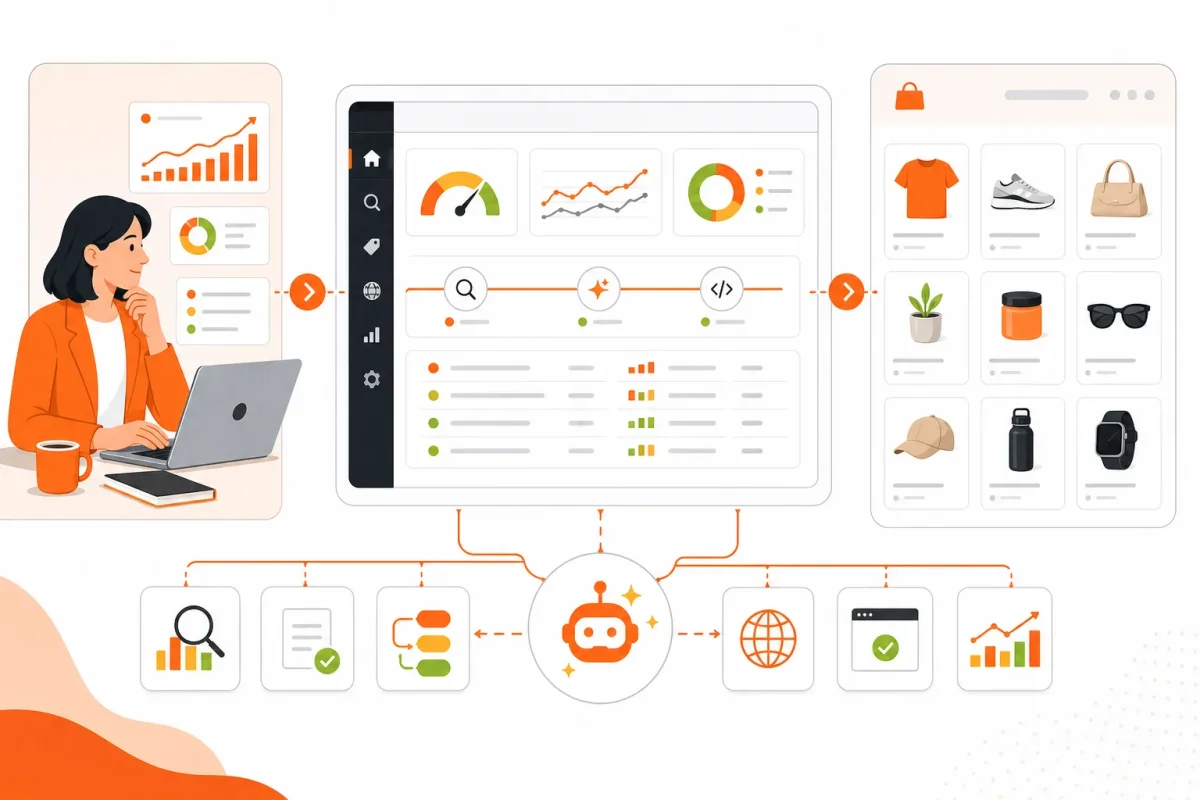
Shopify marketing managers need more than a list of SEO capabilities. Judge the operating model by catalog coverage, execution speed, strategic depth, measurement, and control. The table turns those tradeoffs into a practical decision surface without pretending that one model fits every store.
Coverage, speed, strategy, measurement, and control
| Operating model | Catalog coverage | Execution speed | Strategic depth | Measurement and control | Best fit |
|---|---|---|---|---|---|
| Agency-led SaaS SEO services | Medium. Product and collection coverage depends on the agency's recurring workflow. | Medium to low when frequent catalog changes require manual review. | High for audience research, funnel alignment, content, testing, prioritization, and link building. | Reporting depends on the agency process, with less direct control over execution. | Stores needing complex positioning, product-led content, or authority building. |
| wRanks automation | High across Shopify products, collections, pages, and blogs. | High for repeatable metadata, structured data, image alt text, and catalog updates. | Medium. Bespoke research, unusual positioning, and authority strategy need additional expertise. | High direct control through keyword tracking and Google Search Console integration. | Merchants seeking broad Shopify coverage with fast, hands-on execution. |
| Hybrid program | High when wRanks manages recurring implementation. | High for repeatable work, provided approvals are timely. | High when specialists own research, content, experiments, and authority building. | Broad capability, but shared ownership and reporting are required. | Established teams with the capacity to manage specialist strategy and software execution. |
The failure mode behind each apparent advantage
Agency depth can become a bottleneck when hundreds of product pages need updated meta tags or alt text before a seasonal launch. An agency may deliver strong audience insights, funnel-aligned keyword strategies, and link building, yet still underdeliver on catalog speed and day-to-day Shopify control.
wRanks reverses that tradeoff. Its AI-assisted tools cover repeatable work across products, collections, pages, and blogs, while keyword tracking and Search Console data keep merchants close to implementation and results. The limitation appears when a store needs bespoke content architecture, difficult market positioning, or relationship-based link acquisition.
Hybrid programs cover the widest range, but every added specialist, approval, and reporting system creates coordination overhead. A single backlog and named owners are essential. For catalog-heavy stores, wRanks is the practical default; agencies suit strategic and authority challenges; hybrid fits teams prepared to manage both.
Use the first 90 days to prove the model before expanding it
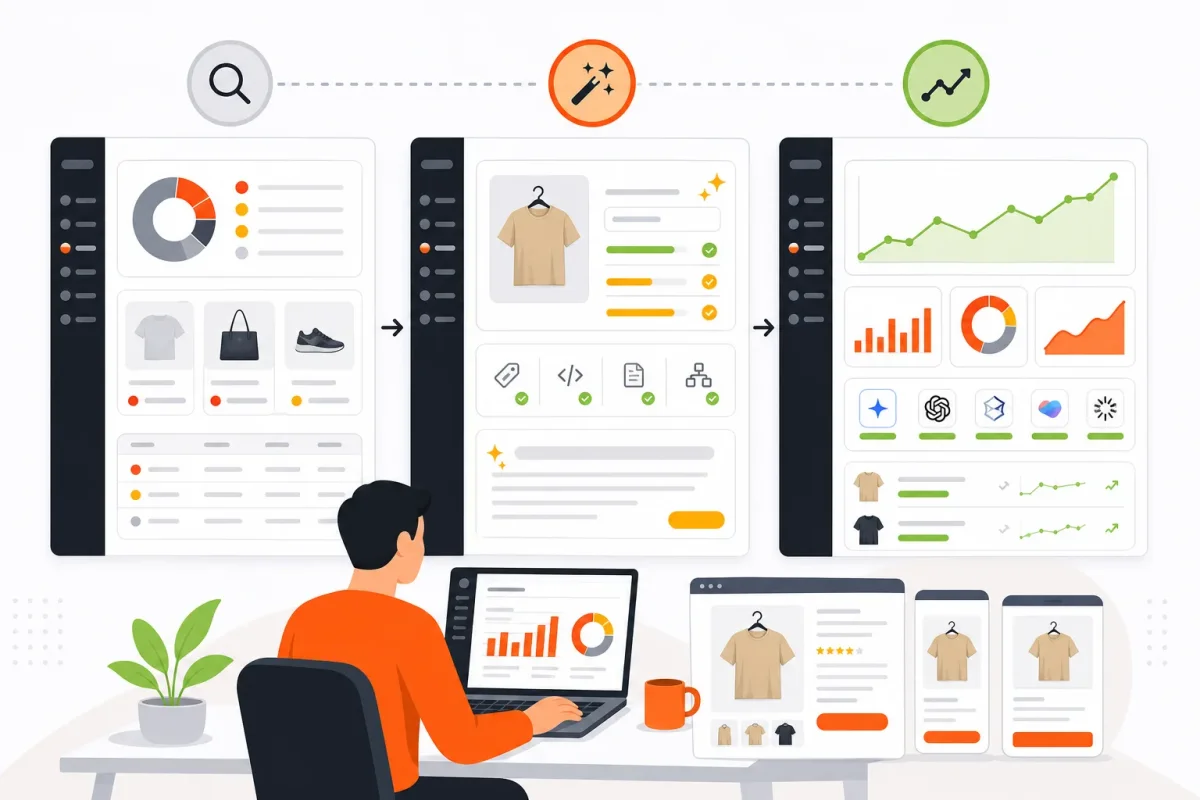
The practical next step is a controlled Shopify pilot, not a promise that rankings will rise on schedule. A 90-day test shows whether agency-led SaaS SEO services, wRanks automation, or a hybrid model can improve implementation quality and commercial outcomes for a defined part of the store. It also gives the team evidence before committing more budget or expanding the scope.
Select a representative product and collection segment
Choose one collection and its priority products, rather than changing the entire catalog at once. Record each starting URL, target query, title tag, meta description, indexation status, structured data state, and image alt text. Assign owners for research, implementation, approvals, and reporting before work begins. wRanks can handle repeatable updates across the selected Shopify pages, while an agency or in-house specialist can shape content decisions, positioning, and experiments.
Set baselines for keywords, traffic, and conversions
Before publishing changes, export keyword positions, impressions, clicks, and click-through rates from Google Search Console. Add organic sessions, product views, add-to-cart events, checkouts, purchases, revenue, and any other agreed commercial action. Keyword tracking and Search Console data should remain separate from business results. A ranking increase can be useful evidence, but it isn't proof that the pilot improved sales, signups, or customer acquisition cost.
Review metadata, structured data, and AI-search visibility
At 30 days, check coverage and implementation consistency. At 60 days, review indexing, query movement, organic traffic, and page-level engagement. The team should also inspect whether product information, structured data, and helpful content are clear enough for Google and AI platforms to interpret. Sure Oak describes SEO as ongoing work from research through optimization, while Impression Digital points to continual testing and incremental gains. Those ideas become measurable when each change has an owner, a date, and a recorded outcome.
Decide whether to scale, add strategy, or change the mix
At 90 days, compare the original baseline with rankings, impressions, clicks, conversions, revenue, and other commercial actions. Expand the model if implementation is consistent and the evidence supports wider coverage. Add specialist strategy if positioning, content architecture, or authority remains the constraint. Revise or stop the approach if coverage improves without meaningful business movement. Ember Tribe's warning about expecting results before SEO builds momentum is useful here. The pilot should create learning and momentum, not premature performance claims.
How much does an SEO service cost?
There is no universal price for SaaS SEO services because the cost depends on the work included, the number of Shopify assets covered, and who owns each task. Agency retainers, automation, and hybrid programs can produce very different workloads even when they use similar SEO language. Compare the recurring work and responsibility behind the fee, not just the headline retainer.
What changes the cost of Shopify SEO?
Strategic research usually raises the scope first. An agency may study audiences, map keywords to product and collection pages, align topics with the funnel, plan product-led content, and set technical priorities. Ongoing content production, link building, continual testing, reporting, and human review add further work. Ember Tribe’s point that SaaS SEO services are not a commodity matters here because agencies are not interchangeable, and the cheapest tier may omit the work a store actually needs.
- Strategy: audience research, keyword research, funnel mapping, content planning, and technical prioritization.
- Execution: Shopify implementation, product and collection updates, meta tags, structured data, image alt text, blog content, and link building.
- Monitoring: keyword tracking, Google Search Console analysis, conversion reporting, testing, and review of visibility across AI platforms.
- Ownership: approvals, merchandising input, developer access, content review, and responsibility for publishing changes.
An agency retainer may cover strategic planning and selected execution while leaving product approvals, Shopify changes, or catalog maintenance with the merchant. Automation through wRanks can reduce the labor required for recurring page-level optimization across products, collections, pages, and blogs, but the merchant still needs to guide priorities, review outputs, and interpret commercial results. A detailed explanation of wRanks plans and pricing can clarify what the platform includes, but it shouldn't replace a comparison of total operating responsibility.
A hybrid plan combines specialist strategy with automated implementation, which can suit a large catalog or a store pursuing both Google rankings and generative search visibility. It can also add coordination time or duplicate management work if responsibilities are unclear. Before choosing a budget tier, a Shopify team should ask how many products and collections are included, how often changes are reviewed, which measurement systems are used, whether AI-search work is covered, and who completes every recurring task.
Cost should be judged against that workload and ownership. A lower fee isn't automatically better value if important work remains undone.
Choose wRanks for scale, an agency for strategy, or both for complex growth
The practical choice depends on the Shopify team’s main constraint: unfinished catalog work, difficult strategic decisions, or both. wRanks suits merchants that need consistent execution and direct feedback, while agency-led SaaS SEO services suit businesses where positioning, research, and authority matter more than speed alone.
If you need catalog-wide execution, pick wRanks
Choose wRanks when a Shopify owner or lean marketing team needs to optimize a sizable catalog without turning every product, collection, page, and blog update into a separate project. Its AI-powered SEO tools support meta tags, structured data, image alt text, and AI-generated content, while keyword tracking and Google Search Console integration show what changes deserve attention next.
This model is the stronger fit when failure means inconsistent coverage, delayed updates, or no clear feedback from organic traffic. It also gives a Shopify team a practical way to prepare content for Google and AI platforms without promising inclusion in generative results. For repeatable work across hundreds or thousands of assets, wRanks keeps execution speed, coverage, and ownership easier to manage.
If you need bespoke strategy and authority, pick an agency
Agency-led SaaS SEO services make more sense when the central problem isn't missing metadata. It may be unclear audience positioning, weak funnel mapping, a complicated product-led content architecture, or the need to earn authority through research-driven content and link building.
Firms such as Sure Oak focus on customized audience research, goal alignment, keyword research, content optimization, and link building. Impression Digital emphasizes funnel strategy, product-led content, targeted experiments, and continual optimization. Those decisions require context and judgment, particularly when a Shopify brand is entering a crowded category or changing its commercial model.
If you need both, pick a hybrid program
A hybrid program fits a merchant that needs specialist strategy and authority building but wants wRanks to handle recurring optimization at catalog scale. The arrangement works only when ownership is explicit: the strategist sets priorities, the merchant approves commercial claims, and wRanks manages repeatable Shopify updates and AI-search readiness.
Test the choice against catalog coverage, execution speed, revenue evidence, measurement quality, and failure risk. As catalog size, team capacity, and strategic complexity change, the right model can change too. Shopify teams can review the wRanks blog for practical guidance before selecting an operating model.

About Amira Hassan
Digital growth consultant specializing in AI-powered commerce strategies. Amira bridges the gap between cutting-edge AI tools and practical Shopify store growth.