
Headless Commerce
Quick Definition
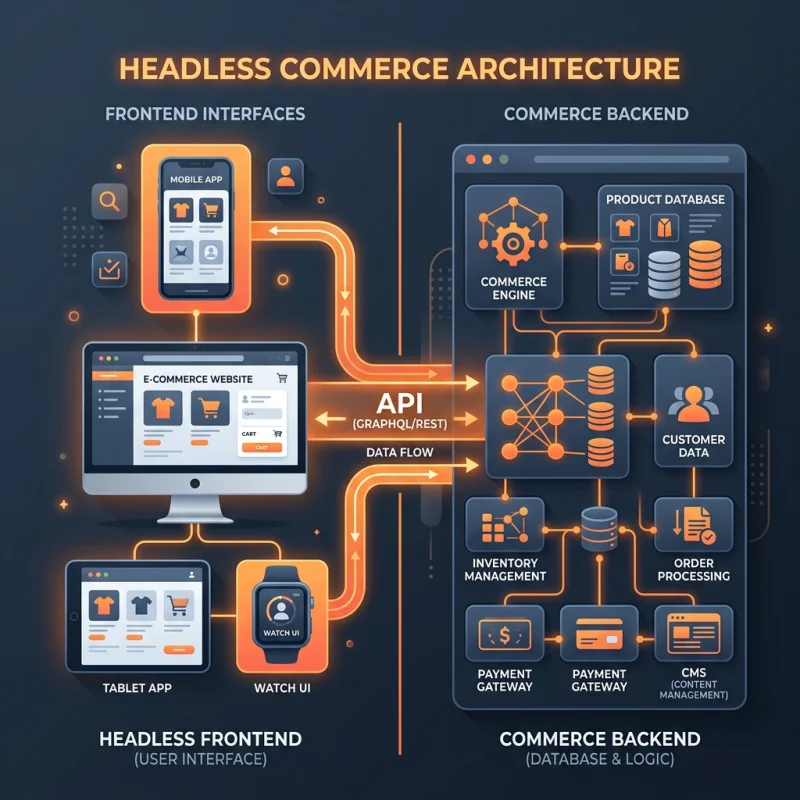
Headless Commerce is an architecture where the frontend layout of an e-commerce website is decoupled from the backend commerce database, communicating via APIs.
Table of Contents
- Understanding Headless Commerce
- Implementing Headless Commerce on Shopify
- Strategic Business Benefits and Optimization of Headless Commerce
- FAQs about Headless Commerce
- What is the main advantage of headless commerce over traditional platforms?
- How does headless commerce impact website performance and SEO?
- Can I implement headless commerce on Shopify without extensive coding?
Understanding Headless Commerce
Headless commerce represents a transformative approach in the e-commerce landscape, where the traditional coupling of frontend and backend systems is decoupled to enable greater flexibility, scalability, and innovation. In conventional e-commerce platforms, the frontend (the user interface) and backend (the commerce engine, databases, and business logic) are tightly integrated, often limiting customization and speed. Headless commerce, by contrast, separates these layers through the use of application programming interfaces (APIs), allowing developers to craft unique, highly tailored user experiences without being constrained by the underlying backend architecture.
This architecture leverages modern technologies such as HTML5, JavaScript frameworks (React, Vue.js, Angular), and GraphQL APIs to deliver dynamic, fast, and engaging storefronts. It also facilitates omnichannel retailing, where the same backend can serve multiple frontends - websites, mobile apps, IoT devices, and more - ensuring consistency and efficiency across channels.
From a technical perspective, headless commerce involves a headless content management system (CMS), a headless commerce platform, and API gateways that connect these components seamlessly. This approach is increasingly adopted by large enterprises and innovative startups alike, seeking to deliver personalized shopping experiences, optimize performance, and accelerate deployment cycles. According to recent industry reports, headless commerce is projected to grow at a compound annual growth rate (CAGR) of over 20%, reflecting its strategic importance in digital transformation.
Implementing Headless Commerce on Shopify
Shopify, traditionally a monolithic platform, has evolved to support headless commerce through its GraphQL API and storefront API capabilities. To implement a headless storefront on Shopify, follow these key steps:
- Choose a frontend framework: Select a JavaScript framework such as React, Vue.js, or Angular. These frameworks enable building dynamic, responsive user interfaces.
- Set up a Shopify store: Create and configure your Shopify store, ensuring you have access to the necessary API permissions. Navigate to Online Store > Themes to customize your theme or develop a custom storefront.
- Generate API credentials: In your Shopify admin, go to Apps > Manage private apps (or use Shopify Plus's custom app setup) to generate API keys for storefront access. Use the Shopify Storefront API for product, collection, and customer data retrieval.
- Develop your custom frontend: Use the API endpoints to fetch product data, cart management, checkout, and customer info. Implement these in your chosen framework, ensuring a seamless shopping experience.
- Integrate checkout: Shopify's checkout process can be embedded or customized via the API, or you can redirect users to Shopify's hosted checkout for security and compliance.
- Optimize and deploy: Test your storefront across devices, optimize load times, and deploy on a CDN for global reach. Use tools like Google Lighthouse to ensure performance standards are met.
For detailed technical guidance, consult Shopify's developer documentation on shopify.dev. Additionally, leveraging headless CMS solutions like Contentful or Sanity can enhance content flexibility alongside Shopify's commerce capabilities.
Strategic Business Benefits and Optimization of Headless Commerce
Adopting a headless architecture offers numerous strategic advantages for e-commerce businesses:
- Enhanced User Experience: Custom, interactive storefronts tailored to brand identity and customer preferences increase engagement and conversion rates.
- Faster Performance: Decoupled frontends can be optimized independently, resulting in faster load times and improved SEO rankings. According to web.dev, page speed is a critical ranking factor.
- Omnichannel Flexibility: A unified backend can serve multiple channels, including mobile apps, IoT devices, and emerging platforms, ensuring consistency and reducing operational complexity.
- Scalability and Agility: Teams can deploy updates and new features rapidly without risking backend stability, enabling quick adaptation to market trends.
- Personalization and Data Utilization: Headless setups facilitate integration with advanced analytics and personalization engines, delivering tailored shopping experiences that boost sales.
Pro Tip: Use analytics tools like Google Analytics and Shopify's native reports to monitor user interactions and optimize your headless storefront for higher conversions.
Real-world examples include brands like Nike and Tesla, which leverage headless commerce to deliver immersive, branded experiences that stand out in competitive markets. Implementing headless architecture requires careful planning, but the payoff in flexibility, speed, and customer satisfaction can be substantial. As the e-commerce landscape continues to evolve, headless commerce is increasingly becoming the standard for innovative, future-proof online stores.
FAQs about Headless Commerce
What is the main advantage of headless commerce over traditional platforms?
The primary advantage of headless commerce is its flexibility. It allows brands to create highly customized, interactive storefronts that are optimized for performance and user experience. Unlike traditional platforms, which often limit design and functionality to predefined templates, headless setups enable developers to craft unique interfaces tailored to brand identity and customer needs. This flexibility also facilitates faster deployment of new features and easier integration with emerging technologies, ensuring the store remains competitive and adaptable in a rapidly changing digital environment.
How does headless commerce impact website performance and SEO?
Headless commerce significantly improves website performance by enabling optimized, lightweight frontends that load faster and provide smoother interactions. Faster load times directly influence SEO rankings, as search engines prioritize speed and user experience. Additionally, headless architectures support progressive web app (PWA) features, offline capabilities, and enhanced mobile responsiveness, further boosting SEO. According to web.dev, optimizing core web vitals like LCP (Largest Contentful Paint) and TTFB (Time to First Byte) is crucial for search visibility, which headless setups facilitate effectively.
Can I implement headless commerce on Shopify without extensive coding?
Implementing headless commerce on Shopify typically requires some coding knowledge, especially when developing custom storefronts using APIs and JavaScript frameworks. However, Shopify offers tools like the Shopify Hydrogen framework, which simplifies building headless storefronts with React components and pre-built integrations. Additionally, many third-party developers and agencies specialize in headless Shopify solutions, providing ready-to-use templates and support. For non-developers, Shopify's native themes and app integrations can be extended with minimal coding, but achieving a fully custom headless storefront generally benefits from technical expertise.

About James Rodriguez
AI & GEO specialist helping brands maximize visibility across AI platforms like ChatGPT, Gemini, and Claude. James pioneers generative engine optimization techniques for e-commerce.