Shopify Meta Description Best Practices That Scale
Shopify meta description best practices focus on search intent, clear benefits, and unique differentiation to boost clicks without manual effort.
You polish a Shopify product page, choose a target keyword, and publish the changes. Later, the result still looks like a clipped sentence assembled from the page. Shopify meta description best practices can help, but the real fix often starts with search intent and differentiation. You need copy that gives each result a reason to earn the click without requiring manual writing for hundreds of URLs.
Most Shopify merchants don't have a meta description problem. They have a search-intent and differentiation problem. The practical question is how to make every result fit the query, present a clear benefit, and stand apart from related products.
This guide covers intent-led formulas for products, collections, and pages, along with safeguards against duplicate copy and inconsistent metadata. You'll also find validation steps and a measured rollout using wRanks, which can identify weak or repeated descriptions across products, collections, pages, and blogs while keeping human judgment ahead of automatic text generation.
Use Meta Descriptions to Win the Click, Not Chase a Ranking Factor
Your meta description has one job before the visit: help a searcher decide that your result fits. You earn that decision with relevance, clarity, and a reason to choose your Shopify store over the next listing.
Google may rewrite or truncate your snippet, so you can't control every impression. You can control whether your intended promise is clear, distinct, and aligned with the page behind it.
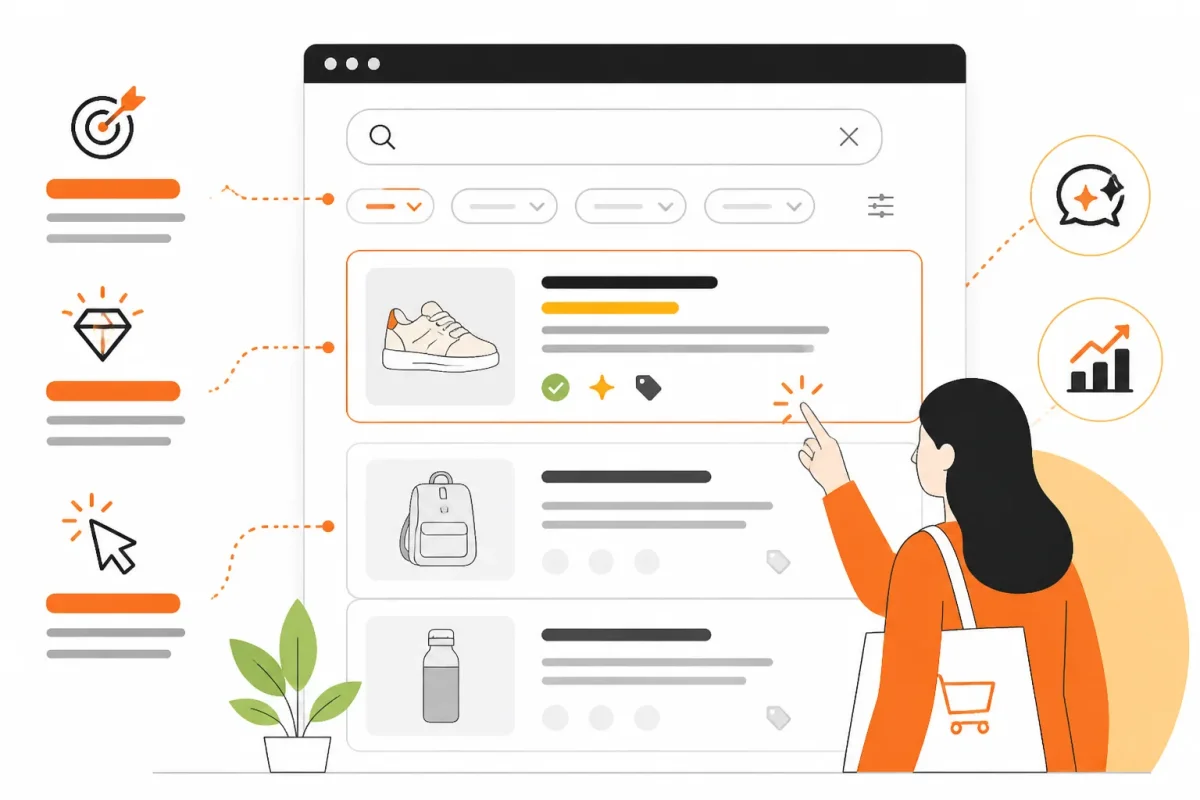
What a searcher should understand before clicking
Make the path from query to promise to click obvious. Your description needs the page subject, the shopper benefit, a credible differentiator, and a useful next step.
- Query: Reflect the searcher's wording naturally so your result feels relevant.
- Promise: State what your product, collection, or page helps the shopper find or do.
- Click: Give the searcher a specific reason to continue, such as free shipping, sizing help, or an expert comparison.
Shopify advises including target keywords naturally rather than stuffing them into your copy.
“Include target keywords naturally without keyword stuffing,” Shopify advises in its SEO guidance.
What belongs in a meta description
Combine the page subject, shopper benefit, credible differentiator, and next step in one compact promise. For example, “Organic cotton crew socks in everyday colors. Cushioned comfort, free US shipping over $50. Shop the collection.”
Weak: “Organic socks, cotton socks, crew socks, comfortable socks for men and women.”
Strong: “Organic cotton crew socks with cushioned comfort and easy everyday colors. Shop men's and women's pairs with free US shipping over $50.”
Why duplicate promises weaken a Shopify catalog
When every product and collection repeats the same benefit, you give searchers no reason to choose one result. Your catalog also loses useful signals about each page's distinct intent.
Practical rule: Write each description for one page intent, one shopper benefit, and one distinct reason to click.
The 150-160-character working rule
Keep your working draft around 150-160 characters, then inspect the rendered result because search engines can rewrite it. This range keeps your core promise compact without treating a character limit as a ranking target.
Choosing an AI marketing tool for Shopify
The best fit is a tool that covers your Shopify products, collections, pages, and blogs while supporting controlled templates, metadata checks, keyword tracking, Google Search Console connectivity, structured data, alt text, and human review. For a broader foundation, see our guide to Shopify SEO best practices. wRanks brings those tasks into one AI-powered SEO workflow, although automatic suggestions still need a person to check accuracy, intent, and brand fit.
Build Each Description in the Order the Searcher Makes a Decision
Start by identifying the page, matching the query, presenting the right promise, and checking every claim before publishing. This sequence gives you a repeatable system for products, collections, and informational pages without spreading one generic sentence across the catalog.
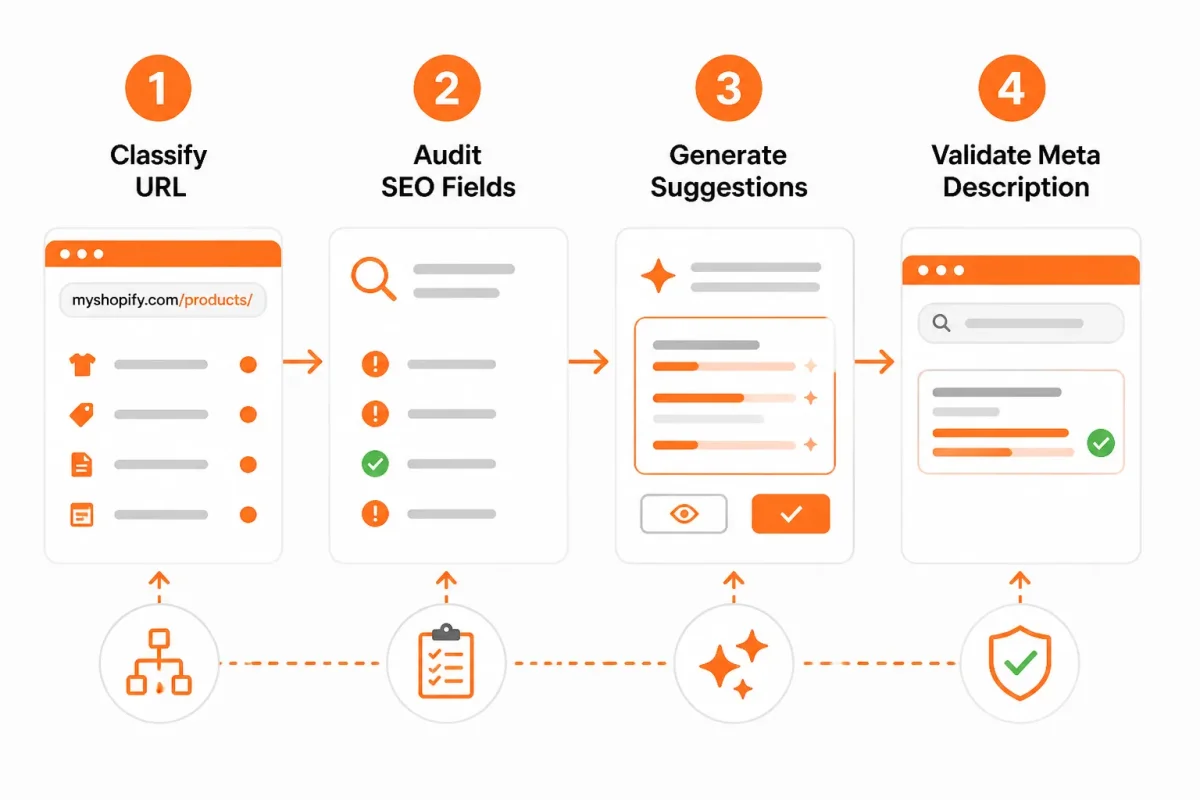
Classify the Shopify URL and its search intent
Label your URL as a product, collection, or informational page, then state what the searcher wants. A product search often signals purchase intent, a collection search signals comparison, and an informational search signals a need for an answer or service. You can edit a product or collection description through Search engine listing preview and Edit website SEO, according to Shopify's SEO editing documentation. Pages and blog posts use the Search engine listing preview at the bottom of the item, while your homepage is edited under Online Store, Preferences, and Title and meta description.
Make your Shopify website better with focused metadata
Align each description with one query intent and one clear next step. Page classification should produce a specific promise, not a recycled brand sentence.
Choose a formula for the page type
Use a product formula of product type + benefit + proof + action. Use a collection formula of range + shopper need + selection cue. For a page, use answer or service promise + audience + next step. The finished copy should sound native to that page type. If it sounds interchangeable across your catalog, the formula needs more specific inputs.
Weak: “Shop premium insulated bottles for your active lifestyle.”
TrailSip 32 oz insulated bottle keeps drinks cold for 24 hours, backed by a lifetime warranty. Shop the leakproof design.
Add one defensible differentiator
Choose one detail you can verify in your Shopify product data, collection rules, or page content. You might use a 24-hour cold rating, lifetime warranty, material, delivery promise, or audience-specific service. Avoid invented scarcity and unsupported performance claims. wRanks can help generate and organize suggestions, but you still need to confirm the differentiator against the offer.
How AI can manage parts of a Shopify store
AI can assist with your Shopify store, but reserve final decisions for human review. An AI-powered SEO platform such as wRanks can help draft meta tags, spot repeated copy, monitor keywords, and connect with Google Search Console. It can't reliably verify every product claim or brand nuance without your checks.
Validate uniqueness, length, and search-result fit
Before publishing, compare the finished description with nearby products and collections. Look for a distinct promise, natural query language, and a compact message that remains useful if Google rewrites the snippet.
- Page type: Name the URL as a product, collection, or informational page.
- Intent: State whether the searcher wants to buy, compare, or learn.
- Formula: Use the structure that matches the page.
- Differentiator: Verify the specific benefit or proof in your store.
- Duplication: Check for a repeated opening or generic closing across similar pages.
- Fit: Read the copy naturally as a search result before publishing.
Prevent Catalog-Wide Errors Before They Become Your SEO Template
A Shopify meta description can fail quietly when a template reaches hundreds of URLs. A copied benefit, invented claim, or empty field can then appear across products, collections, and pages instead of helping each searcher choose your result.
Test the system against real store data before applying it at scale. Repeated snippets usually point to a workflow problem, not a copywriter problem.
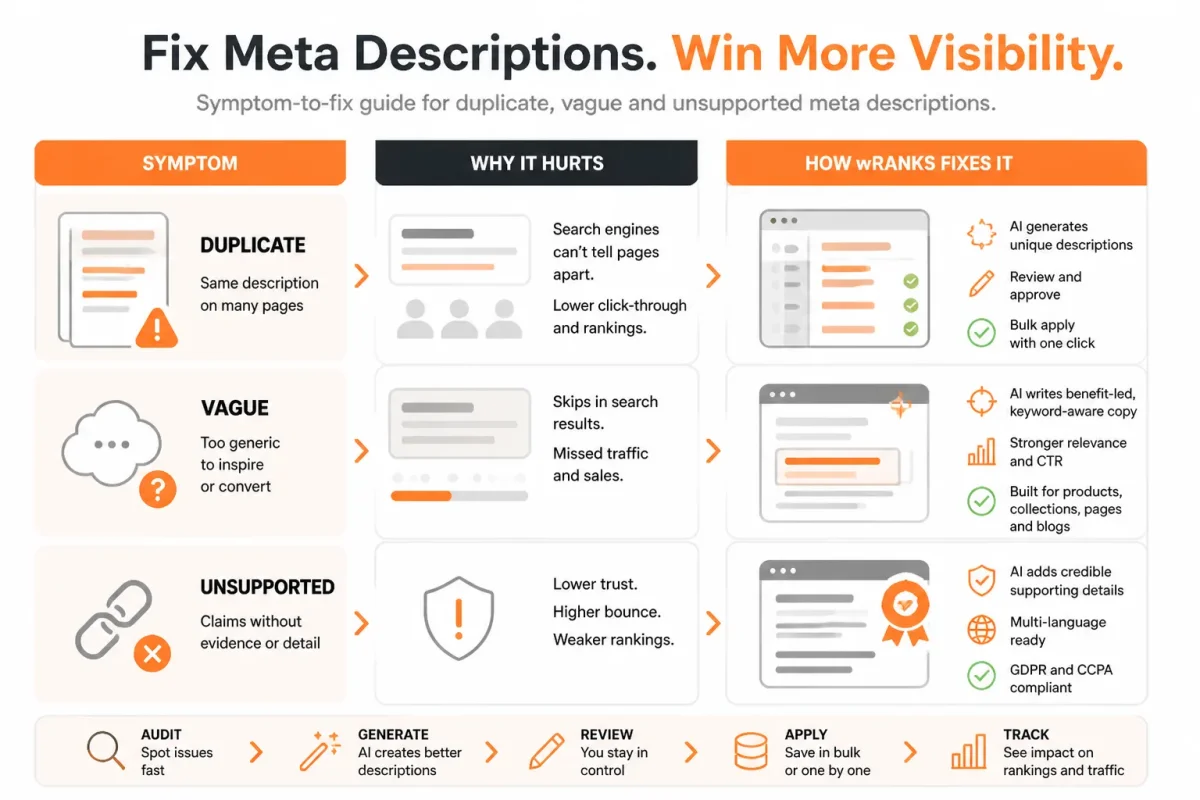
Duplicate descriptions across similar products
When neighboring URLs share the same opening, benefit, and call to action, your template probably uses only the category or store name. Add product-specific attributes, then compare nearby URLs before publishing.
Keyword stuffing without a reason to click
A target keyword alone doesn't explain why your page fits. Replace repetition with a shopper benefit and a credible differentiator.
- Weak: “Women's running shoes, running shoes for women, buy running shoes online.”
- Strong: “Women's trail running shoes with grippy soles and cushioned support for rocky weekend routes.”
AI claims that the product page cannot support
AI-generated copy can turn incomplete data into unsupported promises about results, certifications, shipping, or pricing. wRanks can help surface weak metadata across your Shopify catalog, but you still need human verification for every factual claim.
- Remove: “Clinically proven to eliminate back pain.”
- Use: “Memory foam seat cushion with washable cover for desk chairs.”
Templates that break on missing attributes
An empty material, size, or collection benefit can leave blanks and broken punctuation. Your fallback should trigger a review queue, not invented proof.
Before: “Shop {{material}} {{product_name}} with {{benefit}}.”
After: “Shop {{product_name}} with details selected for everyday use.”
| symptom | likely cause | first fix |
|---|---|---|
| Multiple products or variants show nearly identical snippets | A shared template uses only the store name or product category | Add product-specific attributes, benefits, and differentiators, then scan nearby URLs for duplication |
| The description promises a result the page cannot verify | AI generated an unsupported claim from incomplete product data | Remove the claim and require approved evidence fields before publication |
| The target keyword appears, but the snippet gives no reason to click | Keyword insertion was treated as the entire optimization task | Add a clear shopper benefit and a credible reason the page fits the query |
| Generated descriptions contain blanks, awkward grammar, or broken punctuation | The template has no fallback for missing product or collection fields | Create fallback wording and send incomplete records to review before bulk publishing |
Before applying any template store-wide, test it on several real products, collections, and pages. Your pre-launch quality gate should confirm unique openings, supported claims, complete fallbacks, and clean punctuation.
Answer the Bigger Shopify Questions Without Confusing Them With SEO Copy
Your meta description supports discovery and clicks, but it can't repair a weak offer, thin margins, or unreliable fulfillment. You can use wRanks to scale relevant copy across Shopify pages, though business results still depend on the decisions behind each page.
Shopify profitability in 2026
Shopify can still be profitable in 2026, but your result depends on demand, pricing, gross margin, acquisition cost, returns, fulfillment, and retention. A strong meta description may earn more qualified visits. It won't make an unprofitable product profitable or replace careful control of your operating costs.
What ChatGPT can do for a Shopify store
ChatGPT can help you plan products, organize collections, draft copy, prepare customer-service replies, and analyze store data, but you still need human review. You must check brand decisions, product claims, policies, payments, and fulfillment. A guide to the Shopify AI store builder fits this broader setup question.
Products that sell quickly on Shopify
No product category sells fast forever on Shopify. You need to validate demand, competition, supply, seasonality, and compliance first. You may find an opportunity in a focused niche, a timely product, or a repeat-purchase offer. Test margins and delivery capacity before scaling traffic or inventory.
Reaching $10K a month on Shopify
You can reach $10K in monthly Shopify revenue, but revenue is not profit. You need to model traffic, conversion rate, average order value, acquisition cost, refunds, and contribution margin. A meta description can support qualified clicks, while your offer and checkout experience determine how much of that traffic becomes profitable sales.
The downside to Shopify
Shopify's downsides include recurring platform costs, payment or transaction fees, app dependence, customization limits, and responsibility for marketing and fulfillment. You gain a practical commerce platform, but you still manage inventory, support, taxes, and customer acquisition. Your SEO copy can improve discovery without removing those operating demands.
Start With One High-Value Shopify Page and Scale the Proven Formula
Your store needs a focused test, not another store-wide rewrite. Choose one Shopify URL that already earns impressions but fewer clicks than its opportunity suggests, then use the result to judge your formula.
Scalable metadata comes from validating one useful pattern before expanding it. Your catalog needs differentiated inputs, not thousands of interchangeable sentences.
The seven-step rollout sequence
- Choose one URL: Select one important product, collection, or page with visible search impressions.
- Identify intent: Decide whether searchers want to buy, compare, learn, or find a specific product type.
- Match the formula: Use the product, collection, or page structure that fits that intent.
- State the difference: Add one specific benefit and one verified differentiator, such as material, compatibility, or shipping coverage.
- Check length: Keep the working draft near 150-160 characters, then read it aloud for clarity.
- Compare nearby pages: Check related URLs for repeated openings, benefits, and claims before publishing.
- Publish and monitor: Update the description, then review impressions and clicks in Google Search Console.
The first page to optimize today
Start with the single product or collection page already attracting impressions but earning fewer clicks than its opportunity warrants. A weak draft might say:
Weak: Shop the Blue Ridge Running Jacket. Great quality, great style, and fast shipping from your trusted online store.
Shop: Stay dry on wet trail runs with the Blue Ridge Running Jacket, a lightweight shell with sealed seams and free US shipping.
- Done: The page has one clear search intent and a matching formula.
- Verified: Every product benefit and differentiator appears on the page.
- Distinct: Nearby Shopify URLs don't reuse the same opening or promise.
- Measured: Google Search Console data gives you a baseline for impressions and clicks.
wRanks can support the expansion phase by helping you optimize metadata across Shopify products, collections, pages, and blogs. Its keyword tracking and Google Search Console insights can help you prioritize follow-up work, although you still need accurate product inputs and human review.
If you want a faster way to optimize Shopify metadata, wRanks helps Shopify stores improve meta tags, structured data, image alt text, and keyword tracking across products, collections, pages, and blogs for search engines and AI platforms.

Senior SEO strategist with 8+ years in e-commerce search optimization. Sarah helps Shopify merchants turn organic traffic into revenue through data-driven content strategies.