How AI Search Uses Product Data
How AI search uses product data to match shopper intent with clear, consistent product facts for better visibility in AI-powered search results.
You update a Shopify product title before your first meeting, add a few keywords, and still watch AI search describe a similar item from another store. Your product exists, yet the answer engine seems unable to identify what makes it relevant. That mismatch shows how AI search uses product data: the system needs clear, consistent facts it can retrieve and repeat.
Most Shopify merchants don't have a traffic problem. They have a product-data clarity problem. AI answer engines evaluate public product feeds, structured markup, and web sources to answer shopping queries directly, according to Adobe for Business.
That makes product-page consistency practical SEO work. wRanks helps you improve meta tags, structured data, image alt text, and supporting content across your Shopify store, though no platform can replace accurate product information.
This guide connects AI-search theory to a Shopify workflow: make one product factually clear, semantically aligned, technically complete, and measurable. The guide to why products appear in AI answers fits the same visibility workflow.
What AI Search Reads From a Shopify Product Before It Recommends It
Your Shopify product may look complete while key facts remain unclear to an AI system. If the title says “Premium Bottle” but the description, variant data, and structured data disagree about size or material, you risk being misunderstood when a shopper asks for a specific product.
AI search turns catalog information into an answer, not just a list of keyword links. Visibility improves when every important product fact is clear, consistent, and reusable.

How AI search works
AI search uses artificial intelligence and machine learning to understand what you mean, not only the words you type, according to Salesforce. It matches conversational shopping questions with catalog attributes and shopper intent, so “a leakproof stainless steel bottle for hiking” can be matched with your product data.
That creates a practical risk for your store. Missing or contradictory facts may cause an AI platform to omit your product, describe the wrong attribute, or select a clearer competing result. Optimize the facts an AI system must repeat accurately, not just the phrases a shopper might type.
Practical rule: Make every product fact accurate in your Shopify page, structured data, feed, and connected search data before adding more keywords.
Where AI search gets product data
Audit the complete source map for one Shopify product. AI-powered search can interpret attributes and intent across catalog information, while Salesforce describes conversational search as a way for shoppers to explore catalogs through meaning and product attributes.
- Title: Name the product, material, type, and key use clearly. Weak: “Premium Bottle.” Strong: “HydraPeak 32 oz Stainless Steel Insulated Water Bottle.”
- Description: State benefits, dimensions, compatibility, care, and limitations in plain language.
- Variants: Keep size, color, price, inventory, and availability accurate for each option.
- Structured data: Match your visible product facts with price, stock status, reviews, and identifiers.
- Images: Use descriptive image alt text, such as “blue 32 oz insulated water bottle with carry handle.”
- Connected data: Check feeds and Google Search Console insights for inconsistencies beyond the product editor.
wRanks can organize meta tags, structured data, image alt text, and keyword tracking for your Shopify store, but automation cannot correct inaccurate source information. For a broader review, use this Shopify SEO guide alongside the product audit. Start with the audit.
Make One Shopify Product Legible to AI Search in Four Steps
Turn your first product into a repeatable template rather than a one-off SEO project. Use the fictional HarborPeak 32 oz Insulated Water Bottle to move from verified facts to measured visibility.
AI search engines favor structured facts, consistent presence across sources, and credible references when selecting products or merchants, according to Adobe for Business. Use that order of operations: clarify the product, write for its intent, mark up its facts, then check what search systems understand.
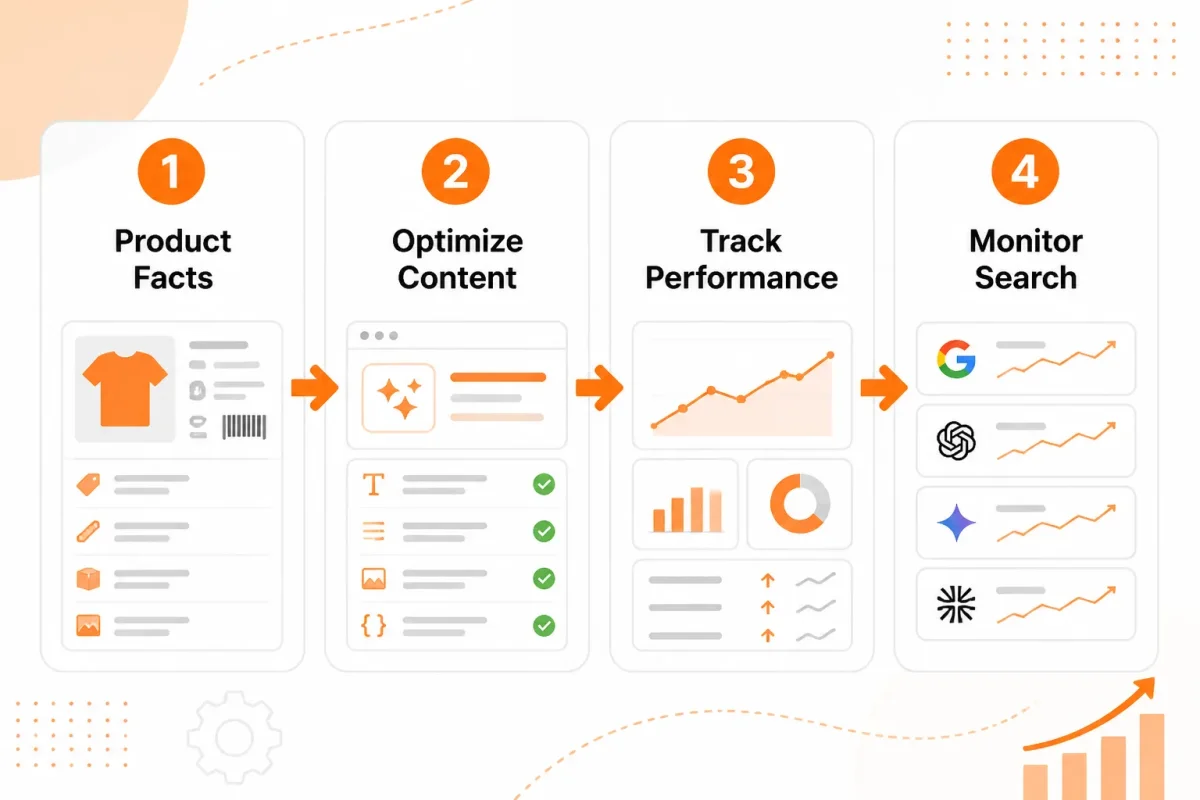
Using AI search to test product language
Use AI search to test the language shoppers use, then compare it with your verified product facts. Step 1, record the facts and intent: list capacity, material, insulation time, color, price, shipping region, and the search intent behind “32 oz insulated water bottle for commuting.” Done means having a fact sheet you can verify against Shopify, not assumptions generated by a tool.
Weak version: “Premium bottle for active lifestyles.”
Built for daily commutes: “The HarborPeak 32 oz Insulated Water Bottle is stainless steel, leak-resistant, and designed to keep drinks cold for up to 24 hours.”
This keeps the positioning specific, the claims supported, and the search intent aligned.
How brands stand out in AI search
Clear, consistent product facts give your brand a stronger chance of being understood across the page and connected sources. Step 2, align the title and description: put the product type, capacity, and defining benefit in the title, then explain use, materials, care, variants, and delivery terms in natural language. wRanks can suggest meta tags and draft content, but you must verify every specification, price, and availability detail.
Weak title: “HarborPeak Premium Bottle.”
HarborPeak 32 oz Insulated Water Bottle: “Leak-resistant stainless steel bottle for commuting, gym bags, and everyday hydration.”
Step 3, complete the page signals: confirm structured data matches visible price, stock, reviews, and identifiers, then add descriptive image alt text. wRanks can support structured data and alt text while you check the source facts.
How your brand can appear in AI search
Improve your chances by validating page signals against real search behavior, without expecting guaranteed inclusion. Step 4, measure and correct: track the target phrase in wRanks, connect Google Search Console, and investigate impressions, queries, indexing, and inconsistent snippets.
- Facts: Product attributes match Shopify and every variant.
- Copy: Title, description, and meta tags match the same search intent.
- Signals: Structured data and alt text describe what shoppers see.
- Validation: Keyword tracking and Search Console reveal what needs correction.
Adobe for Business also connects AI visibility with structured facts, consistent multi-source presence, and credible references. Repeat these four steps for each product, using generated copy for efficiency, never as a substitute for accurate product information.
SEO and AI SEO Failure Modes That Hide Product Data
Your Shopify product can be indexed and still be misunderstood. You may see impressions while an AI answer misses the product type, brand, or details that make the item relevant.
These failures rarely require a full rebuild. Separate discoverability from meaning, then correct the smallest data gap first.
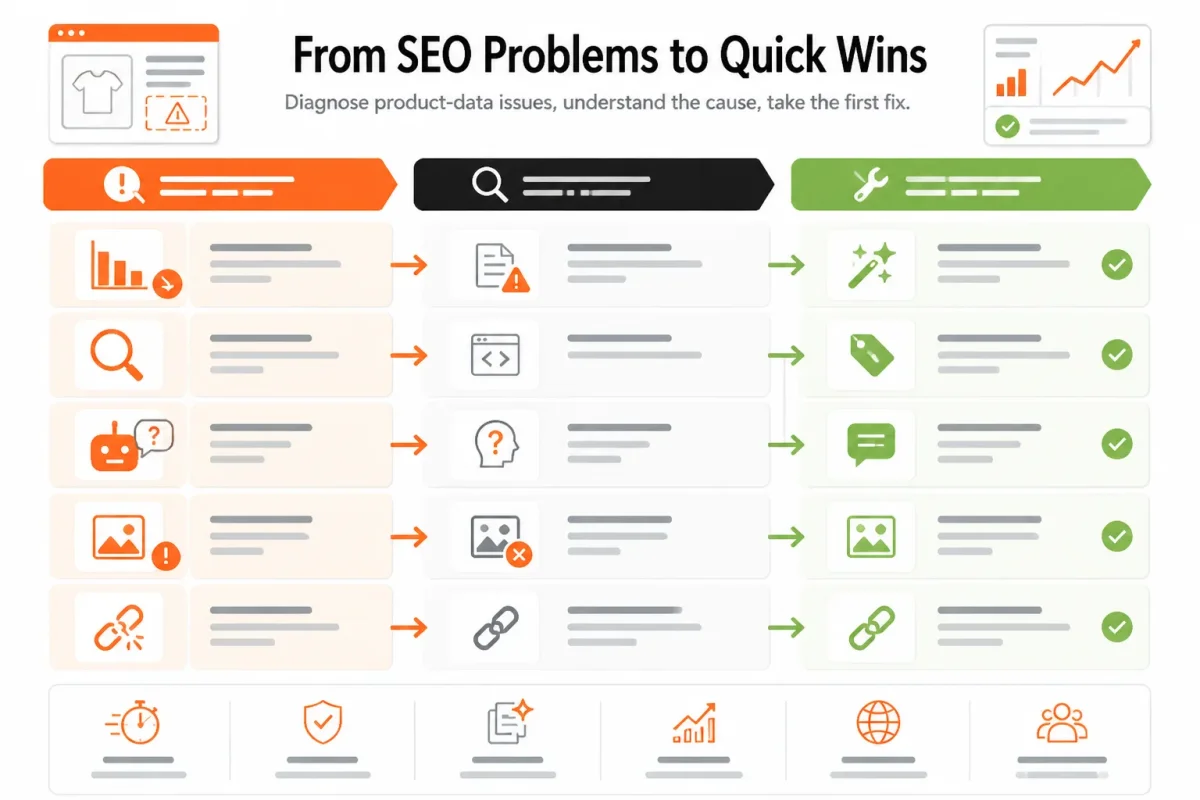
Difference between SEO and AI SEO
Conventional SEO helps your page get crawled, indexed, and ranked. AI SEO places added emphasis on semantic clarity, structured information, consistent facts, and answer-ready product details. They work together, and neither guarantees that an AI platform will cite your store.
For example, you may optimize a title around a phrase while hiding the product identity:
Weak version: Premium Outdoor Bottle Buy Insulated Water Bottle Online
HarborPeak 32 oz Insulated Water Bottle: Stainless steel bottle for commuting, hiking, and all-day cold drinks
The second version gives you a clearer entity, use case, size, and material. wRanks can help identify missing meta tags, structured data, and other on-page gaps, but you still need to verify product facts in Shopify.
Symptoms, likely causes, and first fixes
Use this table when you see a visibility problem but cannot tell whether your page lacks ranking signals or understandable product information.
| symptom | likely cause | first fix |
|---|---|---|
| The product is indexed but AI systems misunderstand what it is | The title and description do not clearly identify the product type, use case, or key attributes | Rewrite the title and opening description around the product identity and primary shopper intent |
| An AI answer describes the product but omits the brand | Brand information is inconsistent or weakly represented across page content, structured data, and other sources | Use one consistent brand and product name across visible content and structured data |
| Product attributes conflict across page elements | The description, variant data, structured markup, feed, or images present different specifications | Reconcile the source facts and update every product representation to match |
| The page sounds keyword-heavy but does not answer shopper questions | Optimization focused on phrases instead of product meaning, attributes, and intent | Replace repetitive wording with concise explanations of fit, use case, material, size, and other verified facts |
Six Answers to Clear Up AI Search Terminology for Shopify SaaS
You may see the same AI search terms used for different tools. These answers keep your Shopify decisions grounded in what each system actually does.
The 30% rule for AI
The 30% rule is a heuristic, not a universal law. You may hear that roughly 30% of content should address a particular AI-search factor, but no official percentage guarantees visibility. Your product data still needs clear facts, consistent naming, useful answers, and technically accessible pages.
SEO's role in AI search
SEO is not obsolete because you still need crawlability, indexability, relevance, technical quality, and useful content. AI SEO adds closer attention to semantic clarity, structured facts, consistency, and answer retrieval. Tools such as wRanks can help your Shopify store optimize these areas, but measurement and human review still matter.
Four types of SEO
A common framework gives you four types: on-page SEO, technical SEO, off-page SEO, and local SEO. Terminology varies by source, so you may see overlapping categories. For your Shopify store, on-page and technical work shape product discovery, while off-page and local signals support trust and geographic relevance.
What ChatGPT can do for SEO
ChatGPT can assist you with keyword research, outlines, content drafts, and analysis. It doesn't replace your verification, first-party data, technical implementation, or performance measurement. ChatGPT is a general AI assistant, not the same as Google’s shopping-oriented AI systems or a Shopify SEO workflow.
Names used for AI search
AI search may be called generative search, answer-engine search, or AI-powered search, depending on the product. You may also encounter different systems built for different purposes. Google’s shopping answers, ChatGPT, and a Shopify optimization platform should not be treated as identical channels.
Azure AI Search
Azure AI Search is Microsoft’s search service for applications and organizational data, not a public shopping answer engine. Databricks describes similar internal AI search as a way for you to query product records, sales metrics, permissions, and trusted business information in plain language. That scope differs from your Shopify product workflow.
FAQ
What the 30% rule for AI means
The 30% rule is a practical guideline for product content: aim to make at least 30% of your page materially useful for a specific buyer, rather than filling it with generic marketing language. Use that space for verified attributes, use cases, comparisons, compatibility details, and answers to questions your customers actually ask.
How to use AI to search for a product
Describe the product, your intended use, and any limits that matter, such as budget, size, material, or compatibility. An AI platform can compare those details across available product data, but its results depend on the sources it can retrieve. Check the product page, price, availability, and specifications before you buy.
Where AI pulls its data from
AI systems may use product pages, structured data, retailer feeds, reviews, product databases, and other publicly available sources. The exact sources vary by platform and query. Keep your product name, specifications, variants, pricing, and availability consistent across connected channels so an AI system has fewer conflicting facts to interpret.
How brands stand out in AI search
Brands stand out by making their product facts specific, complete, and easy to verify. Name the product type, audience, use case, dimensions, materials, and meaningful differences from similar items. Add accurate structured data and descriptive copy, then monitor how your pages perform in Google Search Console and other AI platforms.
How your brand can appear in AI search
Start with one product page and make its visible copy, meta tags, structured data, images, and connected sources agree. Use clear language instead of broad claims, and keep availability and variant details current. No brand can control every AI result, but consistent, retrievable product information gives your pages a stronger chance of being selected and cited.
Start With One Product Page and Build an AI-Readable Catalog
Your next move is not a catalog-wide rewrite. Choose one product where clearer facts could improve your organic visibility, then make every source agree. You need one page that an AI system can retrieve, interpret, and compare without guessing.
That page becomes your working template. You will see which gaps matter before applying the same process across your Shopify stores, collections, pages, and blogs.
The five-part action plan
- Choose one priority product: Start with a product that matters commercially and already receives relevant search attention.
- Record the facts: Document verified attributes, variants, audience, use case, and the search intent behind the page.
- Rewrite the page signals: Update the title, description, meta tags, and supporting copy so your product's identity stays consistent.
- Complete the technical details: Check structured data, image alt text, variant information, and connected product sources.
- Monitor before scaling: Use wRanks and Google Search Console to review keyword movement, indexing, queries, and content signals before copying the pattern.
Start with one priority product page
Compare your visible copy, structured data, variants, images, and connected data sources line by line. A weak title such as “Premium Bottle” leaves your page open to interpretation. HarborPeak 32 oz Insulated Water Bottle for Hiking gives your product type, capacity, and use context in one clear line.
- Facts: Every material, size, color, and feature matches the actual product.
- Intent: Your copy answers why the intended buyer would search for this item.
- Metadata: Your title and meta description reinforce the same product identity.
- Media: Each image has descriptive alt text tied to what the image shows.
- Measurement: Your dashboard records changes before you expand the template.
wRanks provides an operational layer for standardizing this work, though no platform can guarantee that an AI system will cite your product. Visibility begins with consistent, retrievable product facts. Audit one page today, document its gaps, and build a repeatable template only after that page is clear and measurable.
If you want a faster way to optimize Shopify products, collections, pages, and blogs, wRanks provides AI-powered SEO tools for meta tags, structured data, image alt text, keyword tracking, and Search Console insights. The wRanks blog for Shopify SEO guidance covers practical workflows for your store.

Senior SEO strategist with 8+ years in e-commerce search optimization. Sarah helps Shopify merchants turn organic traffic into revenue through data-driven content strategies.