What Is Keyword Cannibalization? Shopify Examples
What is keyword cannibalization and how can overlapping Shopify pages harm your SEO and sales? Discover clear examples and fixes for Shopify stores.
You publish a product page for running shoes, a running-shoes collection, and a blog post about choosing running shoes. Then Google alternates between them. The wrong page attracts the click, and you cannot tell whether your product, collection, or guide should earn the sale. This is the problem behind what is keyword cannibalization: related pages compete for the same search intent instead of serving distinct needs.
Most Shopify stores don't have a content shortage problem. They have a page-purpose problem. Related phrases aren't automatically harmful. The trouble starts when similar pages compete for the same search intent instead of giving shoppers distinct reasons to visit.
If you're trying to understand whether overlapping pages help visibility or weaken it, this guide separates healthy topic coverage from genuine cannibalization. It shows what your product, collection, and blog should each own. You can also use wRanks to inspect keyword tracking, Google Search Console data, and page-level optimization while you assign that ownership.
Why Overlapping Shopify Pages Can Cost Rankings and Sales
You can lose a sale without losing visibility altogether. If an outdated blog post or broad collection attracts the click for a product-led search, your higher-converting product page may never get the opportunity to turn that visit into revenue.
Google may choose one URL when several Shopify pages target the same query. Similar pages can also divide internal links, engagement, and click-through performance, making it harder for search engines and AI platforms to identify your best answer.
The meaning of cannibalization
Cannibalization means your own pages compete for the same search opportunity instead of helping each other. Semrush explains that search engines might select just one page when multiple pages on a site target the same keyword.
“Search engines might pick just one of the pages to rank when multiple pages on a site target the same keyword,” according to Semrush.
The meaning of keyword cannibalization
Keyword cannibalization means two or more URLs target the same keyword and search intent, so your Shopify store gives Google competing choices. Imagine a “men’s running shoes” collection ranking above a specific $140 trail shoe product for a product-focused query. The collection may earn the visit, while the product page misses a buyer ready to purchase.
That result is not a guaranteed penalty. You may still receive impressions and clicks. The commercial problem is misdirected visibility, especially when one URL has stronger pricing, reviews, stock information, and purchase options.
Keyword cannibalization in SEO
In SEO, keyword cannibalization means similar page focus makes it harder to determine which URL deserves priority. Yoast says pages with an overly similar focus may confuse search engines, which can struggle to decide which page should rank higher.
Competitor research cited by ChatGPT reports an average of 1.26 pages per domain appearing for a result, a useful reminder that clear page purpose matters for AI retrieval as well as traditional search. Your product, collection, and blog can all cover one topic, but each needs a distinct job. Our Shopify SEO guide explains how those page roles fit into a broader search strategy. wRanks can help you compare keyword tracking, Google Search Console data, and page-level optimization while you assign that job.
Practical rule: Give one search intent one primary URL unless each result answers a genuinely distinct need.
Normal multi-page rankings are not automatically harmful. You can rank a collection, product, and guide together when each serves a different need. The loss begins when your pages answer the same query with no clear reason for Google or an AI platform to prefer one.
The Four Keyword Types and the Difference Between Overlap and Cannibalization in Shopify SEO
You can target one topic across a Shopify blog, collection, and product page without creating a problem. The deciding factor is search intent: what the searcher wants to learn, compare, find, or buy.
Two URLs become risky when they offer the same answer to the same search. Your page roles should clarify ownership, not force every related phrase onto one URL.
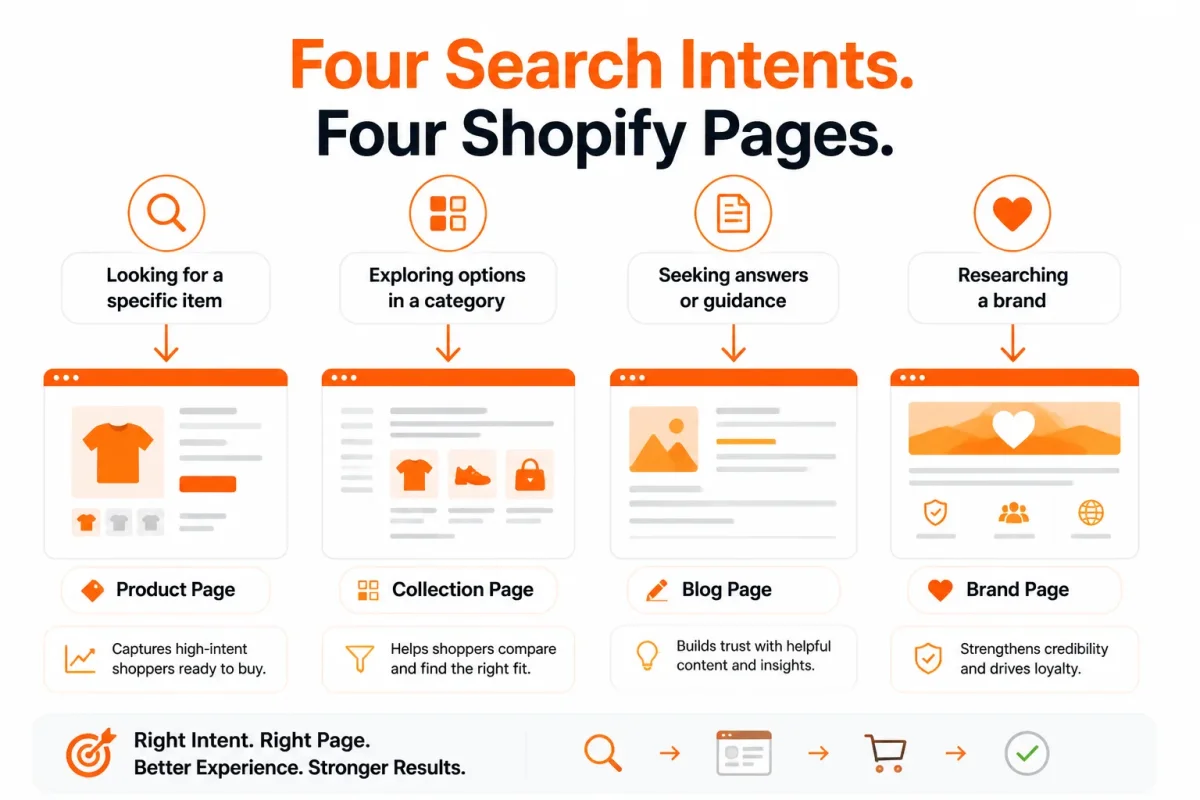
The four types of keywords by search intent
The four types are informational, navigational, commercial investigation, and transactional keywords. You can match each type to a Shopify page role:
- Informational: Your reader wants guidance, such as “how to choose waterproof hiking boots.” A blog post fits this need.
- Navigational: Your reader wants a particular brand, store, or page, such as “TrailForge women’s boots.” Your branded collection or product page may serve it.
- Commercial investigation: Your reader is comparing options, such as “best waterproof hiking boots for winter.” A comparison article or buying guide fits better.
- Transactional: Your reader is ready to act, such as “women’s waterproof hiking boots size 8.” A product or collection page should own this intent.
Your blog can explain how to choose hiking boots while your product page sells one pair. The pages support different decisions, so keeping both makes sense.
Weak targeting: “Waterproof Hiking Boots | TrailForge” on both a buying guide and a product page.
Strong targeting: “How to Choose Waterproof Hiking Boots” for the guide and “Women’s Waterproof Hiking Boots | TrailForge” for the product page.
Other terms for cannibalization
Another useful term is search competition, or internal competition between your own URLs. Semrush describes affected keywords as queries with more than top 100 results containing multiple ranking pages, according to Semrush’s July 14, 2026 guidance.
That measurement flags overlap, not automatic damage. You still need to compare intent, rankings, clicks, conversions, and page purpose before changing a URL.
Another word for cannibalization in business
In business, another word is internal sales competition. You see it when two Shopify products serve nearly identical buyers, or when a broad collection and its subcollection promise the same category.
Words related to synonyms
Similar words include equivalents, related terms, and near-synonyms. They are not automatically interchangeable targets: “waterproof hiking boots” signals shopping, while “how to choose waterproof hiking boots” signals research.
Healthy overlap versus competing Shopify URLs
Semrush calls URLs that share a ranking keyword with at least one additional URL cannibal pages, according to Semrush’s July 14, 2026 guidance. Treat that label as a prompt to investigate, not proof that one page must disappear.
| situation | better move | why |
|---|---|---|
| A blog explains how to choose running shoes and a product page sells one running shoe model | Keep both and differentiate informational from transactional targeting | The pages answer different stages of the buyer journey |
| Two product pages offer nearly identical women's waterproof hiking boots | Merge, differentiate the products, or target distinct attributes | Similar product intent can make the URLs compete for the same commercial click |
| A broad running-shoes collection and a near-identical subcollection target the same query | Assign one primary collection and give the other a distinct filter or audience purpose | Clear hierarchy reduces ambiguity about which page should own the category intent |
| A branded product page and a brand comparison article both rank for a branded query | Retain both when each satisfies a distinct branded need | Multiple branded results can be healthy when intent is served rather than duplicated |
Before you rewrite meta tags or URLs, compare intent, search results, conversions, and each page’s job. Your keyword tracking and Google Search Console data can show overlap, but your business context decides whether that overlap is useful.
A Product, Collection, and Blog Example of Keyword Cannibalization
Your Shopify store can create competing URLs without deliberately targeting different keywords. You might have a collection, product, and buying guide that all mention “women’s waterproof hiking boots,” yet each page can attract a different kind of shopper.
The problem starts when you make those pages deliver the same promise. Google may alternate between URLs, while your product page loses the commercial click. Give each page clear intent ownership, and you create a cleaner path from search to purchase.
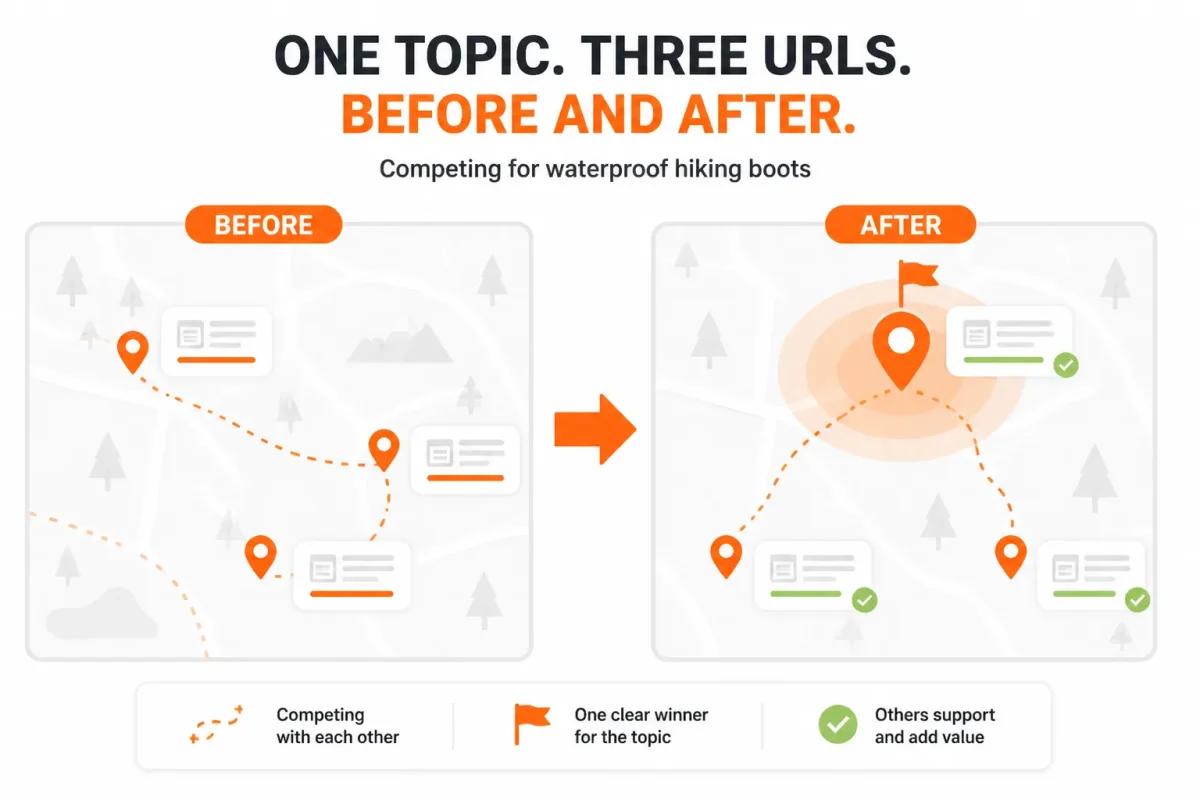
The three pages that appear to target one query
For example, you might have these three URLs in your Shopify store:
- Collection: “Women’s Waterproof Hiking Boots” displays multiple boots for shoppers who want to browse.
- Product: “Summit Ridge Waterproof Hiking Boot” sells one exact model with price, variants, reviews, and a purchase button.
- Buying guide: “How to Choose Women’s Waterproof Hiking Boots” explains fit, waterproof materials, traction, and weather use.
If you repeat the same category copy, title wording, and calls to action on all three pages, you send Google mixed signals. You may divide relevance between the collection and guide, while your product page fails to win the shopper ready to buy.
An example of cannibalization
Your buying guide competes with the collection when it ranks for “women’s waterproof hiking boots” while mainly repeating the collection and product descriptions. Google may select the guide instead of the collection or product because you have made the URLs appear to satisfy the same expectation.
Weak example: “Women’s Waterproof Hiking Boots | TrailForge” appears as the title for every page, with “Shop women’s waterproof hiking boots” as each call to action.
Strong example: “Women’s Waterproof Hiking Boots for Every Trail | TrailForge” supports browsing, while “Summit Ridge Waterproof Hiking Boot | TrailForge” supports a specific purchase.
The signals that reveal genuine cannibalization
You have stronger evidence of cannibalization when two URLs alternate for the same query, receive similar search impressions, and offer the same next step. Shared wording alone isn't enough. Page purpose matters more.
Check whether you link from the guide to the collection for browsing and to the Summit Ridge product for a specific recommendation. Your headings, meta tags, structured data, and copy should reinforce that path, not try to decide page ownership by themselves.
A keyword cannibalization example
You have a keyword cannibalization problem when your collection and buying guide both promise a shopper the same list of waterproof boots. Create a cleaner structure by assigning category browsing to the collection, product purchase to the product page, and selection advice to the guide.
| situation | better move | why |
|---|---|---|
| You target “women’s waterproof hiking boots” on your collection, product, and buying guide with similar copy | Separate category browsing, exact-product purchase, and buying advice | Each URL receives a distinct purpose and searcher expectation |
| Your collection ranks while your product page has stronger conversion potential | Make the collection a browse page and link prominently to the relevant product | The category captures discovery while the product receives qualified commercial traffic |
| Your buying guide repeats product descriptions and collection copy | Rewrite it around fit, materials, weather, and selection criteria | Informational value differentiates the article from transactional pages |
| You give two URLs the same title, CTA, and user expectation | Compare performance and consider merging the stronger material into one URL | Near-identical purpose is stronger evidence of cannibalization than shared wording alone |
The before-and-after intent map
Weak structure: you link your guide to itself, your collection to generic blog content, and your product appears only through scattered navigation.
Strong structure: your guide explains selection criteria, links to the collection for browsing, and sends readers to the Summit Ridge product when its features match their needs. The collection then links to that product with clear category context.
If two URLs would deserve the same title, call to action, and searcher expectation, investigate consolidation. Use your keyword tracking and Google Search Console data to confirm the pattern, then let your Shopify page roles decide the fix.
How to Fix Cannibalization in Shopify SEO Without Deleting the Wrong Page
You fix keyword cannibalization by proving which URLs deserve the search intent before changing redirects, canonicals, or copy. Compare each competing Shopify product, collection, and blog URL by intent, rankings, clicks, conversions, backlinks, content depth, and Google Search Console queries.
Competitor research helps you see which page type wins for the query, but it does not decide your store’s structure alone. Your best fix preserves useful customer paths and revenue, not merely a tidy URL count.
When to merge two Shopify pages
Merge two Shopify pages when they cover substantially the same topic and one URL is clearly stronger. If a thin running-shoe collection and an overlapping buying guide promise the same answer, move the useful guide content into the stronger collection or blog URL, then redirect the retired page.
Weak version: “Running Shoes Guide” and “Best Running Shoes” repeat the same products, advice, and call to action.
Running shoe collection: Keep product browsing on the collection, move selection advice into a focused guide, and give each URL a distinct purpose.
| situation | better move | why |
|---|---|---|
| Two pages cover substantially the same topic and one URL is clearly stronger | Merge the useful content into the stronger URL | One comprehensive page can consolidate relevance, links, and user signals |
| Two products serve different audiences or have meaningful distinct attributes | Differentiate targeting, copy, structured data, and internal links | Separate commercial needs justify separate pages |
| A product, collection, or blog URL is permanently retired | Redirect it to the closest relevant successor after preserving useful value | A relevant redirect prevents a dead end while retiring the obsolete URL |
| A blog guide and product page serve informational and transactional intent | Leave both pages and connect them with purposeful internal links | Different intents are complementary rather than cannibalizing |
When to retarget or differentiate a page
Retarget pages when your products, audiences, or buying stages are genuinely different. A Summit Ridge trail shoe can target technical terrain, while a daily trainer collection targets broad road-running needs. Change the copy, meta tags, structured data, and internal links so each page earns its own expectation.
Weak version: “Summit Ridge Running Shoe” uses the same title, description, features, and keyword focus as the “Trail Running Shoes” collection.
Summit Ridge trail shoe: Target “trail running shoes for rocky terrain,” describe traction and protection, and link to the trail collection.
Practices that work
- Distinct intent: Give each page a clear searcher and buying stage.
- Useful differentiation: Add genuine product attributes rather than swapping keywords.
- Purposeful linking: Send readers from guidance to browsing, then from browsing to the right product.
Practices that fail
- Keyword swapping: Changing one phrase rarely creates a different page purpose.
- Forced separation: Near-identical products still compete when their content and audience are identical.
- Blind canonicalization: A canonical can remove a page from preferred search visibility without solving unclear ownership.
When a redirect or deletion is justified
Redirect a Shopify URL only after you preserve useful value and confirm that the page is permanently retired. Send an outdated product, collection, or blog URL to its closest relevant successor, not to the homepage. A relevant redirect can retire an obsolete path without creating a dead end; a deleted URL with no successor may instead create a soft 404.
How to validate the preferred URL in Search Console
Validate your decision in Google Search Console by comparing queries, clicks, impressions, rankings, and conversions for the competing URLs before and after the change. wRanks can combine keyword tracking and Search Console evidence with meta-tag and structured-data updates, although its automation still depends on accurate page roles and clean Shopify data.
Where the Simple Definition Stops: AI Search, Google Ads, and Keyword Density
A larger Shopify catalog makes the simple definition less reliable. You may have product variants, branded searches, paid campaigns, and AI-focused content where several URLs deserve visibility for different reasons.
Your goal is not to force one URL or one phrase everywhere. You need clear page purpose, clean campaign structure, and copy that helps Google and AI platforms retrieve the right answer.
Keyword cannibalization in Google Ads
Keyword cannibalization in Google Ads describes internal competition between your campaigns, ad groups, match types, bids, or landing pages, not Google choosing between your organic URLs. You may split the same search across campaigns and then struggle to explain which setup caused the click or conversion.
For example, a weak setup sends “women’s waterproof hiking boots” from both a brand campaign and a generic campaign to different collection pages. Strong: Send the branded version to the brand collection, the generic version to the hiking-boot collection, and compare each campaign against its intended landing page.
Why keyword density is not a cannibalization diagnosis
Keyword density measures repetition. Cannibalization concerns page purpose and search-result competition. You do not fix overlapping Shopify pages by forcing the same phrase into every title, heading, product description, and image alt text.
Keyword stuffing examples that create a different problem
A weak product description might say, “Blue running shoes are blue running shoes for blue running shoe runners.” Strong: “The PaceFlex 2 uses a breathable mesh upper and cushioned midsole for daily road runs.” The second version gives you useful product information without mechanical repetition.
The same problem appears in a resume: “SEO manager with SEO strategy, SEO content, and SEO reporting experience.” Strong: “SEO manager experienced in content planning, technical audits, and organic performance reporting.” Neither example diagnoses cannibalization. Both reveal writing that needs a human purpose.
Practices that work
- Distinct intent: Keep pages when each answers a different need, such as buying, troubleshooting, or finding a store.
- Clear retrieval: Give AI platforms direct headings, useful product facts, and structured data that identify each page’s role.
- Measured campaigns: Separate paid landing pages when different audiences or offers justify them.
Practices that fail
- Near-duplicates: Publishing several pages with almost identical copy makes page ownership unclear for you and search systems.
- Forced repetition: Adding a target phrase repeatedly does not clarify which URL deserves the query.
- Blind consolidation: Removing a branded support page or variant page can erase a useful result your customers expect.
When multiple branded or variant pages should remain
Several branded results can be healthy when you offer a product page, support page, and store-location page for distinct needs. Variant pages may also remain when size, compatibility, or availability changes the buying decision. Differentiate their titles, content, structured data, and internal links rather than multiplying near-duplicates for AI search. Strategic differentiation beats forced keyword repetition. A resource such as the vaporizer glass adapter compatibility checklist illustrates how specific compatibility information can justify a distinct page purpose.
Five Cannibalization Mistakes Shopify Merchants Make
Shared keywords aren't automatically a Shopify SEO problem. You need to compare search intent, page purpose, and the conversion path before changing a URL.
Use this checklist when your pages appear to compete. Each fix gives you a clearer decision, not another round of guesswork.
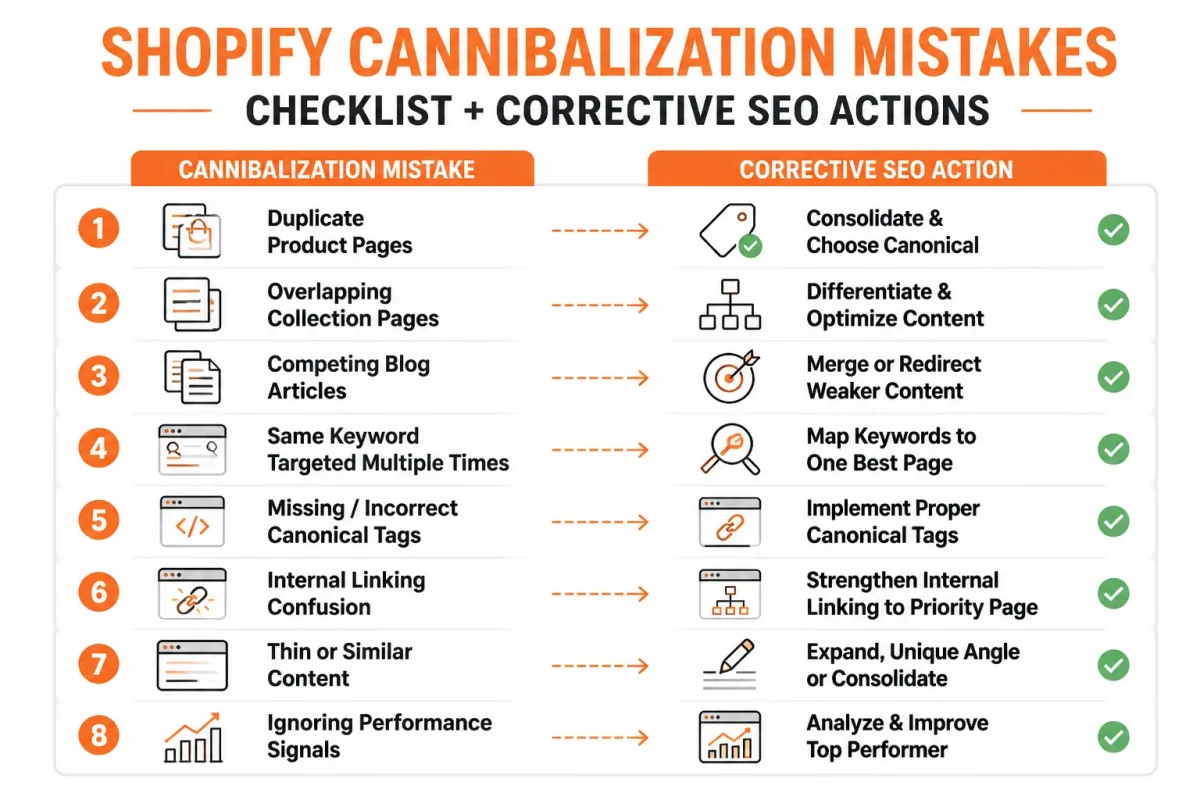
Mistake: treating every shared keyword as cannibalization
- Check intent first: If your collection serves browsing and your product page serves buying, shared wording may be appropriate. Compare keyword tracking, conversions, and the questions each page answers before changing either URL.
Mistake: redirecting before checking intent and conversions
- Review evidence first: A redirect can remove the page earning useful clicks for a different purpose. Use Google Search Console data, rankings, conversion paths, and a content review before choosing a preferred URL. wRanks can bring keyword tracking and Search Console insights into the same workflow, but you still decide which page deserves the searcher.
Mistake: changing titles instead of changing page purpose
- Differentiate the job: Rewriting two titles won't fix two pages that answer the same question. Assign one URL to collection browsing and another to product specifications, then update the meta tags to match. A weak example is “Running Shoes | TrailPeak” on both pages. Strong example: “Women’s Trail Running Shoes | TrailPeak” for the collection and “SummitFlex 2 Women’s Trail Shoes | TrailPeak” for the product.
The guide to Shopify meta titles fits this same workflow, especially when each URL needs a distinct purpose and title.
Mistake: using keyword stuffing as the fix
- Replace repetition with evidence: Repeating “women’s trail running shoes” across every paragraph doesn't clarify the page. Add fit details, terrain guidance, product attributes, useful internal links, and image alt text instead. wRanks can help optimize those elements, while your product information gives them meaning.
Mistake: ignoring structured data and internal links
- Connect the preferred page: If your collection, product, and blog all link to one another equally, your site gives weak ownership signals. Use differentiated structured data, focused internal links, and distinct meta tags so each URL has a clear role. wRanks supports these checks, though it cannot replace a review of your catalog. Monitor the preferred URL after every material change.
Plain-English Answers About Shopify Cannibalization and Similar Terms
SEO terminology can make a simple business problem sound technical. The plain meaning of keyword cannibalization is internal competition between pages that serve a similar search need.
Another word for cannibalization
Another word for cannibalization is self-competition. You may also hear overlap, internal competition, or competing claims used in ordinary business language. None of these terms proves an SEO problem by itself. Compare your pages' search intent, purpose, and outcomes before deciding whether one URL is weakening another.
Cannibalism in simple words
Cannibalism means one part consumes another of its own kind. In SEO, the word is a metaphor: one page appears to take visibility, clicks, or relevance from another page on your Shopify store. You may see this when a product page, collection, and blog post all try to answer the same customer need.
Another word for cannibalization in business
In business, cannibalization can mean internal competition. Your products, teams, campaigns, or sales channels may draw from the same demand or budget instead of creating additional results. For your Shopify store, that might mean two collections attracting the same shoppers. The term describes the overlap, not the final diagnosis.
Words related to synonyms
Similar words to synonyms include related terms, equivalent words, near-synonyms, and alternatives. These words can share much of the same meaning, but they are not always interchangeable in search strategy. Treat “overlap” and “cannibalization” as related descriptions, then compare intent, page purpose, and outcomes.
FAQ
How to fix cannibalization in SEO
Start by grouping URLs that rank for the same queries, then compare their search intent, clicks, conversions, and content quality. Choose the page that best serves the query and give it clear internal links, focused meta tags, and supporting content. Differentiate, merge, redirect, or retain the other URLs based on their roles. Check the result in Google Search Console.
What is an example of cannibalization
A Shopify store might have a collection page targeting “men's running shoes” and a blog post targeting the same phrase. If both pages compete for the query, Google may switch between them or rank the less useful page. The collection should own the buying query, while the blog post can target running-shoe advice and link to the collection.
What are the four types of keywords
The four common keyword types are informational, navigational, commercial, and transactional. Informational searches seek answers, navigational searches look for a specific site or brand, commercial searches compare options, and transactional searches signal an intention to act. Matching each Shopify URL to one primary intent makes page ownership clearer and reduces unnecessary overlap.
What does keyword cannibalization mean
Keyword cannibalization happens when multiple pages on one site target the same keyword or satisfy the same search intent. Instead of helping the store earn more visibility, those pages can split clicks, links, and ranking signals. On Shopify, the overlap might involve a collection, product page, and blog post competing for one commercial query.
A Five-Step Shopify Page-Ownership Plan
You don't need to audit your entire Shopify store before making progress. Start with one collection or product cluster, then use evidence to decide which URL deserves the customer and which pages need a different job.
Open that cluster in wRanks, pair keyword tracking with Google Search Console data, and make one ownership decision first. Your store will gain a repeatable process, not another unfinished spreadsheet.
1. Map one keyword to every relevant URL
Choose one Shopify collection or product cluster and record each relevant URL, its primary keyword, and its intended shopper. Identify the page that currently receives visibility and the page that should receive the customer.
- Start with one cluster: Use wRanks to review tracked keywords and Search Console queries for a single collection, product, and related blog post.
- URL list: Every relevant Shopify URL appears in one working record.
- Primary intent: Each URL has one clear purpose, such as browsing, buying, or learning.
- Preferred page: You have named the URL that best matches the searcher and sales goal.
2. Classify the overlap by intent
Group URLs only when they attract similar queries and serve the same search need. Separate a buying guide from a product page when the content answers different questions.
- Compare purpose: Mark each group as genuine competition, useful support, or unrelated overlap.
3. Choose the correct page action
Use rankings, clicks, conversions, and query data from wRanks alongside Google Search Console. Then choose whether to merge, differentiate, redirect, or retain each URL.
- Make one evidence-led choice: Keep the strongest page when intent matches, differentiate useful pages, merge duplicates, or redirect a page with no separate role.
4. Update content and internal signals
After ownership is clear, align meta tags, structured data, internal links, and image alt text with each page's role. For example, a weak meta description says, “Shop running shoes online.” A stronger version says, “Shop cushioned men's running shoes with free U.S. shipping at Northstar Gear.”
- Support the decision: Give the preferred URL the clearest title, links, schema, and product imagery signals.
5. Monitor the preferred URL
Track the chosen URL after implementation, including its queries, clicks, rankings, and downstream sales. Confirm that visibility moves toward the page built to convert.
- Review one page group: Check the preferred URL regularly in wRanks and Google Search Console before expanding the process to another cluster.
If you want a faster way to manage this workflow, wRanks helps Shopify store owners optimize products, collections, pages, and blogs with AI-powered SEO, keyword tracking, Google Search Console insights, meta tags, structured data, and image alt text. The Shopify SEO blog explains the supporting setup.

Content marketing expert and Shopify ecosystem authority. Priya has helped 200+ stores grow organic traffic through strategic blog content and keyword targeting.