AI Article Generator for Shopify Store: A 2026 Guide
You know the pattern. Your Shopify store is live, the products are solid, and you keep hearing that you need blog content, buying guides, comparison pages, and SEO landing pages if you want organic traffic to grow. Then real life takes over. Orders need attention, inventory needs fixing, ad costs need watching, and the blog stays empty for another month.
That gap is where most store owners get stuck. They don't lack ideas. They lack a system that turns expertise into publishable content without eating the whole week.
An AI article generator for shopify store can help, but only if you treat it like a production tool, not a magic button. Used badly, it creates bland filler. Used well, it helps you publish useful content faster, keep your catalog pages supported with topical content, and give shoppers the kind of answers that reduce hesitation before purchase.
Table of Contents
- The Shopify Owner's Content Dilemma
- What Is an AI Article Generator for Shopify
- How AI Content Drives Real Ecommerce Growth
- Your Framework for High-Ranking AI Articles
- Common Mistakes That Make AI Content Fail
- AI Is Your New Content Co-Pilot Not Autopilot
The Shopify Owner's Content Dilemma
A lot of merchants know exactly what they should publish. A mattress store needs sleep guides. A skincare brand needs routine explainers. A coffee store needs brew comparisons and gift guides. The problem isn't strategy on paper. The problem is getting good content out consistently when the owner is already doing five jobs.
I see this most often with stores that have strong products but thin search presence. Their product pages can only do so much. A collection page might target a broad term, but shoppers also search for things like how to choose, what to compare, which option fits a use case, and whether one material or style is better than another. Those searches are where articles earn their keep.
The usual response is to try one of two extremes. Either the store writes nothing because content feels too slow, or it publishes generic AI text that says a lot without saying anything useful. Neither works for long. Search engines and shoppers both notice when an article reads like it was assembled from recycled phrases.
Good ecommerce content doesn't just attract visits. It helps a buyer move from uncertainty to action.
The hard part is volume with quality. You might need product education posts, seasonal guides, comparison articles, care instructions, and FAQ-driven posts across multiple collections. That's a real workload. It's also why AI has become appealing to merchants who don't have an in-house editorial team.
What changed is that AI content on Shopify isn't an edge case anymore. It's part of the operating environment. Merchants now expect drafting help inside the same workflow where they manage products, pages, and blog content. That lowers the barrier to publishing, but it also raises a new question: how do you use the speed without publishing junk?
A useful answer starts with understanding what these tools are good at, and where they still need a human hand.
What Is an AI Article Generator for Shopify
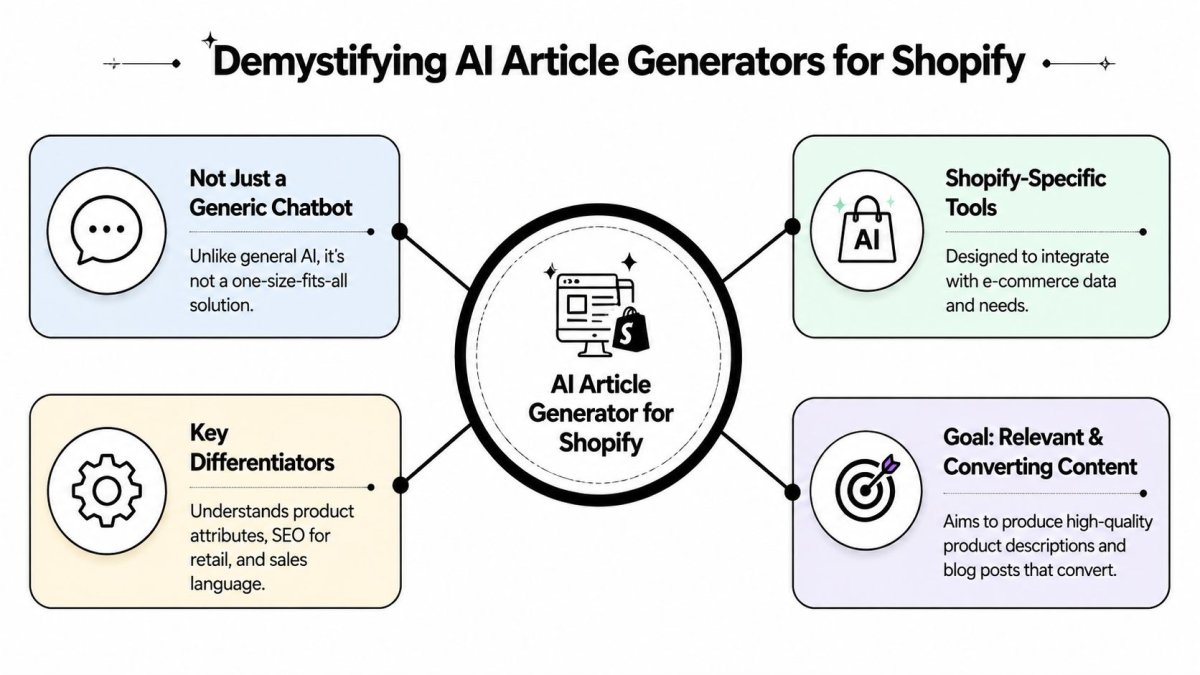
An AI article generator for shopify store is a writing tool that helps merchants draft blog posts and related content inside a Shopify-focused workflow. The useful versions do more than generate paragraphs. They fit into the way a store already manages products, collections, pages, and publishing.
For a Shopify owner, that matters because article production usually breaks down in two places. Ideation slows down, and drafting takes longer than expected. AI shortens both steps. It can turn a product theme, customer question, or rough outline into a workable first draft in minutes.
What the tool actually does
On Shopify, AI is most useful for production tasks that repeat across the store. It can:
- draft article outlines from a target topic
- expand bullet points into readable sections
- rewrite copy for a different tone or buyer awareness level
- generate title options and meta descriptions
- turn product notes, FAQs, and support themes into article material
That speed is real. So is the catch.
The draft is only as good as the input and review process behind it. If the prompt is vague, the article usually comes back vague. If no one checks accuracy, brand fit, or search intent, the result often sounds polished while saying very little. I see this a lot with stores that publish fast and then wonder why traffic never turns into sales.
AI handles the first draft well. It does not automatically know which objections block a sale, which product details cause returns, or which comparisons matter to your buyer. The merchant still has to supply that judgment.
Why Shopify-specific tools matter
A general AI writer can produce text. A Shopify-oriented tool is easier to use in the day-to-day work of running a store. It sits closer to your catalog and publishing flow, which cuts down on copying, pasting, and context switching.
That matters more than it sounds. If the tool can pull from product information, collection structure, and existing store content, the draft starts from material that is already relevant to the business. You still need to edit it, but you spend less time rebuilding the article from scratch.
Some merchants will do fine with a general writing tool, especially if they already have a strong content process. Others benefit from tools built around ecommerce tasks. If you are comparing both categories, this list of best AI content creation tools is a useful starting point for sorting general-purpose writers from Shopify-first options.
The practical takeaway is simple. An AI article generator for Shopify is not a ranking button or a replacement for content strategy. It is a production tool. Used well, it helps stores publish faster without lowering the standard. Used poorly, it creates a pile of generic articles that add very little for search visibility or conversion.
How AI Content Drives Real Ecommerce Growth
Store owners don't need more content for content's sake. They need content that supports discovery, reduces confusion, and helps product pages convert. That's where AI becomes commercially useful.
Content fills the gaps product pages miss
Product pages usually answer “what is this?” Articles answer the harder questions. Which option is right for a beginner? What's the difference between two materials? How should someone use, clean, size, store, or compare the product? Those are buying questions, not just informational ones.
When a merchant publishes useful guides around those questions, three things usually happen:
- Search coverage improves: the store can target more specific searches tied to real purchase intent.
- Support friction drops: shoppers get answers before they email or abandon cart.
- Trust gets built earlier: buyers arrive with more context and less hesitation.
That matters even more for considered purchases. If someone is choosing between product types, ingredients, or technical features, a useful article can do the pre-sale education that a short description can't.
Practical rule: If a topic regularly comes up in chat, email, or pre-purchase calls, it probably deserves an article.
Scale changes the economics
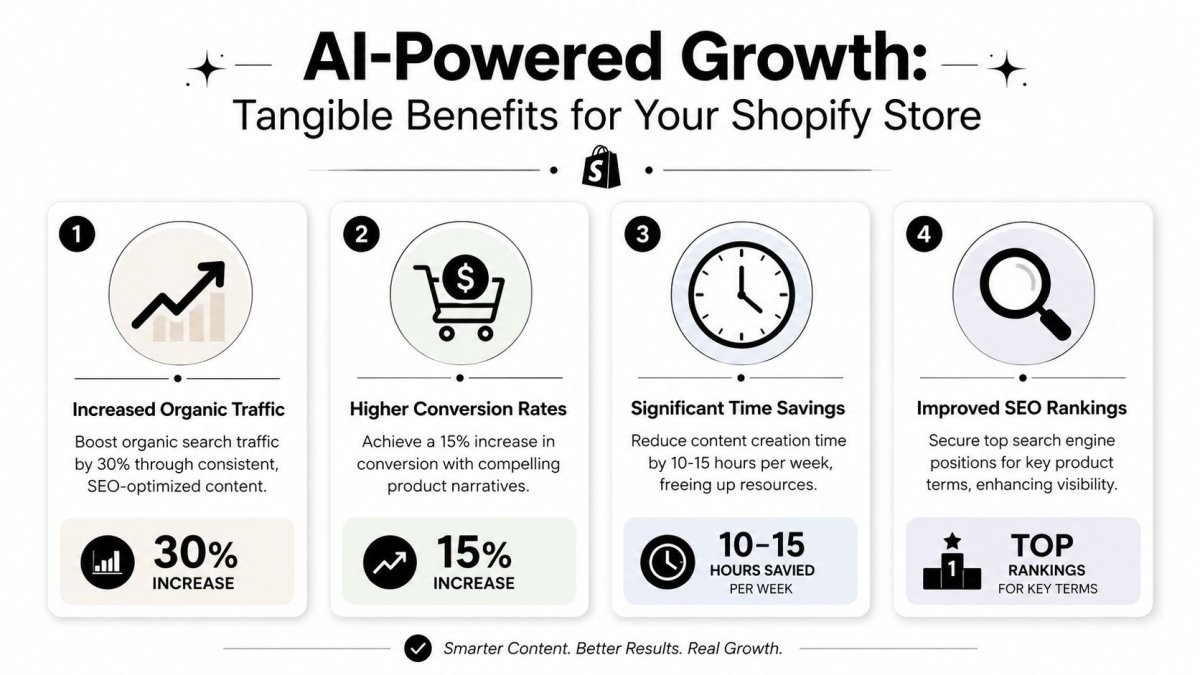
The bigger operational win is scale. The Shopify App Store reflects a shift toward bulk, repeatable publishing workflows. As shown in Shopify App Store listings for AI content tools, apps now support AI descriptions and SEO content for products, collections, and blogs, including bulk generation for multiple products at once. That changes the bottleneck. Writing is no longer the slowest part. Review and optimization are.
For high-SKU stores, that's huge. A catalog with many products doesn't just need polished descriptions. It needs supporting collection copy, comparison content, FAQs, and blog articles that keep the site from feeling thin. AI makes that workload manageable if the team sets standards for what gets published.
There's also a channel effect. A strong article often doesn't stay on the blog. It turns into email copy, product page FAQs, social posts, scripts, and sales enablement content. If you're building an integrated publishing plan, this guide to social media strategy for online stores is useful because it helps connect on-site content with off-site promotion.
Here's the practical takeaway. AI doesn't create growth by being fast. It creates growth when speed lets you cover more relevant topics, refresh content more often, and support commercial pages with stronger informational content.
Your Framework for High-Ranking AI Articles
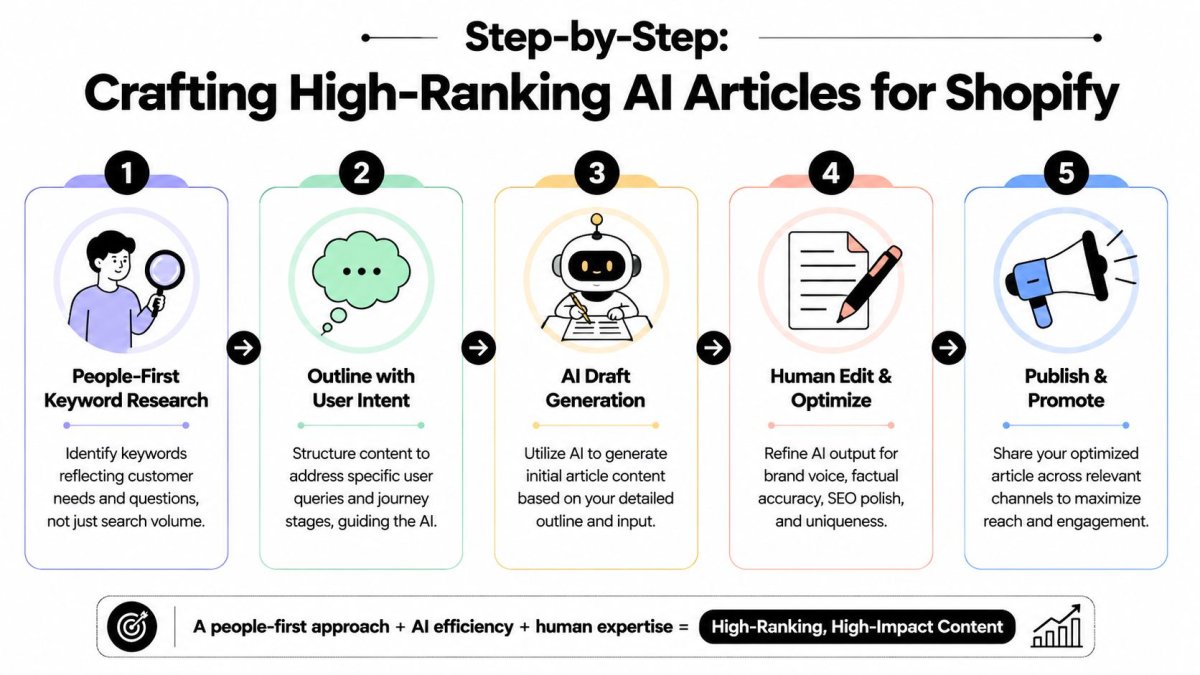
Most AI content fails because merchants start with the tool instead of the workflow. The workflow should come first. The tool just speeds up parts of it.
Start with questions buyers actually ask
Don't begin with “write me a blog post about protein powder” or “create an SEO article about wallets.” That prompt is too broad, so the output becomes broad too.
Start with buyer intent. Pull questions from:
- Support conversations: repeated objections, sizing confusion, care instructions, compatibility issues
- Product reviews: the words customers use when they explain why they bought
- Collection gaps: topics your category pages hint at but don't fully answer
- Comparison moments: when shoppers choose between variants, materials, bundles, or use cases
A good article topic for Shopify has a commercial shadow behind it. “How to choose the right yoga mat thickness” is stronger than “Benefits of yoga mats” because it lines up with a product decision.
A simple planning table helps.
| Topic type | Weak angle | Strong angle |
|---|---|---|
| Buying guide | Best products | How to choose based on use case |
| Comparison | Product A vs Product B | Which option fits which buyer |
| Education | About the material | How the material affects comfort, care, or durability |
| FAQ article | Generic brand questions | Questions that block add-to-cart decisions |
Build the draft like an editor not a prompt gambler
Once the topic is clear, create the outline yourself. AI is much better when it receives structure. Give it the title direction, target customer, article purpose, product context, and sections that must be covered.
For example, a solid prompt brief includes:
- The reader: beginner, enthusiast, gift buyer, repeat buyer
- The store context: product line, price positioning, differentiators
- The must-cover points: materials, sizing, care, compatibility, shipping expectations, common mistakes
- The tone: straightforward, premium, technical, friendly
- The conversion role: educate, compare, reassure, pre-qualify
This is also where you should set guardrails. Many guides reduce AI to a productivity shortcut, but the harder question is quality control. As noted in this Shopify-oriented guide on AI tools and content quality, the main issue isn't whether AI can write a post. It's what level of AI assistance is safe and effective, especially when you want content that avoids low-value sameness and includes original store knowledge.
A helpful walkthrough on workflow is below.
AI should produce the clay. Your team still has to sculpt the final piece.
Edit for evidence specificity and store reality
This is the part that makes the difference between publishable content and disposable filler.
When the AI draft is ready, add what the model can't invent safely:
- Real product specifics: materials, dimensions, compatibility notes, care instructions, warranty terms
- Store voice: how your brand sounds on product pages, email, and customer support
- Observed buyer concerns: what people ask before buying and what causes returns
- Commercial linking: relevant products, collections, bundles, and supporting guides
Then tighten the SEO basics. Write a better title if needed. Add a meta description. Use internal links where they help the reader. Make the headings cleaner. Cut repetition. Replace empty claims with concrete product detail.
A reliable review pass usually asks these questions:
- Does this article answer a real buyer question?
- Could a competitor publish almost the same piece with different product names?
- Does the article include details that only this store could provide?
- Is every recommendation aligned with what the store sells?
If the answer to the second question is yes, the article still isn't ready.
Common Mistakes That Make AI Content Fail
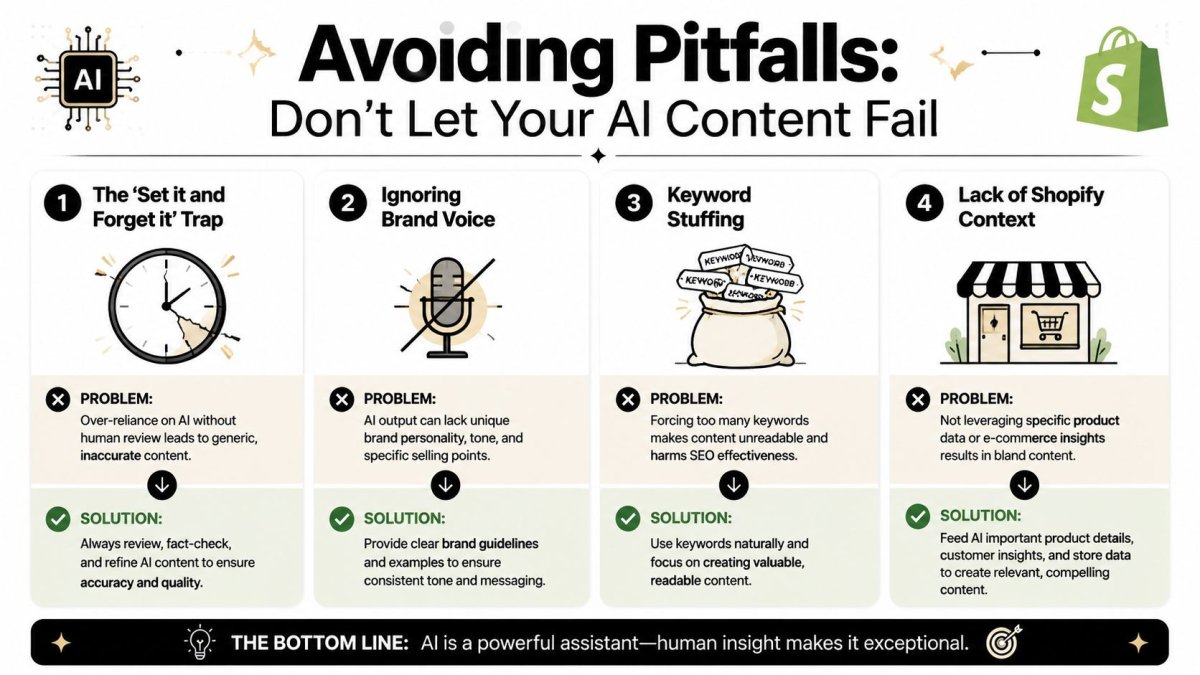
A merchant publishes ten AI-written posts in a week, then wonders why traffic stays flat and sales do not move. The problem usually is not the model. The problem is the process around it.
Publishing raw output
Raw AI drafts are risky because they sound finished before they are ready. Clean grammar gives merchants a false sense of confidence, especially on buying guides, comparison posts, and product education content.
As noted earlier, Shopify warns merchants to review AI-generated copy carefully. That matters for regulated products, but it also matters for everyday catalog content. A draft can state the wrong material, suggest the wrong use case, or gloss over a limitation that leads to returns.
The fix is simple, but it takes discipline. Check every factual claim, every product mention, and every recommendation against your catalog and support knowledge before you publish.
Writing without store context
Generic prompts create generic articles. If the input could apply to any candle shop, apparel store, or skincare brand, the output usually will too.
That is where AI content starts to fail with both shoppers and search engines. Google does not need another vague post about "benefits" and "top tips." Your customer does not either. They need help choosing between your options, understanding your product constraints, and avoiding a bad purchase.
Use the prompt to give the model a job tied to your store:
| Weak input | Better input |
|---|---|
| Write a blog about leather wallets | Write a gift guide that helps shoppers choose between our slim, bifold, and travel wallets |
| Explain benefits of candles | Explain how to choose candle size and scent strength for small rooms versus open-plan spaces |
| Create a skincare article | Draft a routine using our cleanser, serum, and moisturizer for shoppers with sensitive skin |
The best test is blunt. Remove your store name and product names from the draft. If the article still reads like something any competitor could publish, it needs more catalog knowledge, more buyer context, or both.
Stores win with relevant detail, not word count.
Forgetting SEO fundamentals
AI can draft around a keyword. It cannot decide whether the topic deserves a page, whether the search intent matches your offer, or whether the article supports revenue.
That is why many AI posts look optimized on the surface and still go nowhere. They have headings, repeated phrases, and a decent intro, but they miss the basics that make content rank and convert.
The common breakdowns are:
- Keyword stuffing: the target phrase appears so often that the copy gets clumsy and harder to trust
- Weak search intent match: the article targets an informational query but keeps pushing products before answering the question
- Thin support structure: there are no useful paths to collections, products, or related resources
- Low differentiation: the article says what every other store says, with no product-specific insight or merchant perspective
- No upkeep: the post stays live even after products change, inventory shifts, or customer questions evolve
A useful article should earn its place in the store. It should target a real query, answer it clearly, and connect naturally to products that fit the reader's next step. If it cannot do those three jobs, publishing more AI content will not fix the underlying problem.
AI Is Your New Content Co-Pilot Not Autopilot
The best way to use an AI article generator for shopify store is to let it handle the heavy lifting you shouldn't be spending hours on anyway. Drafting, restructuring, rewriting, expanding rough notes, and turning product data into usable first versions. That's where it shines.
What it shouldn't own is judgment. It shouldn't decide what your customers care about most. It shouldn't invent product truth. It shouldn't replace your brand voice, your merchandising priorities, or your standards for what deserves to rank.
That's why the co-pilot idea fits. A co-pilot reduces workload, keeps the process moving, and helps you cover more ground. You still fly the plane.
If you approach AI that way, content becomes more manageable. You can publish more consistently, support your product and collection pages with better informational content, and avoid the trap of pumping out generic articles that do nothing for traffic or sales.
Start small. Pick one collection that needs better support. Build three article topics from real customer questions. Use AI for the first draft. Then edit hard, add your product knowledge, and publish only what you'd be comfortable sending directly to a customer who asked for advice.
If you want a faster way to do that inside Shopify, wRanks gives merchants one place to create AI-assisted blog content, improve on-page SEO, audit technical issues, add schema, track rankings, and tighten the link between content production and store optimization. It's built specifically for Shopify, which makes it a practical next step if you want your content workflow and SEO workflow in the same app.

About David Chen
Technical SEO engineer focused on structured data, indexing optimization, and Core Web Vitals. David turns complex technical requirements into actionable Shopify solutions.