Why AI Search Ignores Product Pages
Discover why AI search often overlooks product pages despite good Google rankings and how clear evidence boosts AI visibility for Shopify stores.
You check a Shopify product page during the morning sales review. It’s indexed, appears in Google, and may even rank for its main query. Then you ask an AI tool to recommend that type of product, and a competitor gets the mention instead. Your product is visible, yet absent when the buying conversation matters. That is why AI search ignores product pages that seem to perform well in traditional search.
Most Shopify stores don’t have a ranking problem. They have an evidence and interpretation problem. The system may not confidently understand what your product is, which shopper it suits, how it differs, or whether its claims deserve trust. That’s not an automatic penalty or proof that your store is broken.
The gap usually sits across four layers: buyer context, entity clarity, machine-readable commercial facts, and external trust. Audit one Shopify product page across those layers, then improve the evidence available to search and answer systems without assuming one schema change will fix visibility.
AI Search Visibility Is a Separate Job From Earning a Google Ranking
Your Shopify product can rank in Google and still lose the recommendation moment. When a shopper asks an AI platform which insulated bottle suits a commuter, the answer may name a competitor whose page offers clearer evidence, even if your product holds the stronger traditional ranking.
That distinction changes the job. You still need indexing and organic visibility, but you also need content that an AI system can interpret, compare, and trust. wRanks can help optimize your product content, meta tags, structured data, and keyword tracking, but no platform can force an AI system to cite one store.
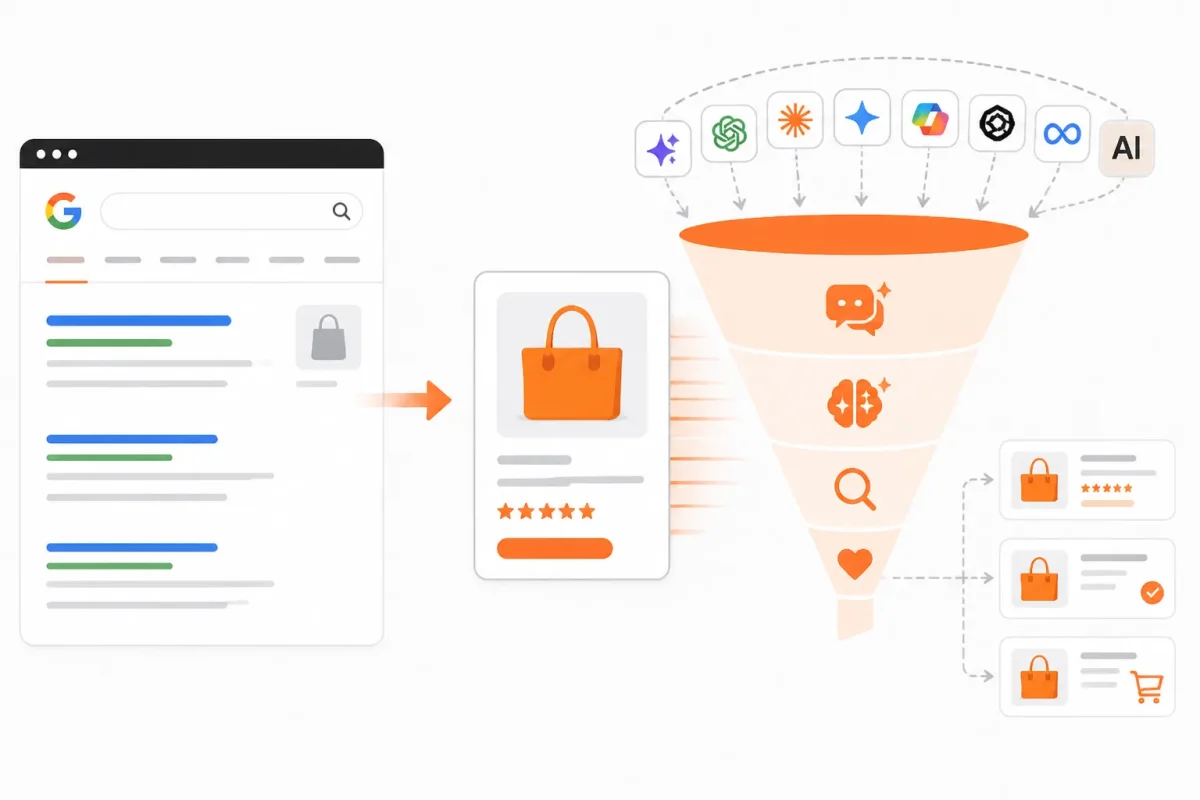
Why AI Search Does Not Work
AI search evaluates sources for an answer rather than simply ordering pages for a query. You can earn a conventional ranking with relevant content and authority, then miss the answer because your product’s use case, attributes, or proof remain unclear.
BrightEdge found that only 16.7% of sources cited in Google’s AI Overviews also ranked in the organic top 10. That gap shows why your ranking report cannot serve as a complete AI visibility audit.
BrightEdge reports that only 16.7% of sources cited in AI Overviews also rank in the organic top 10.
SEO After AI Search
SEO is not dead. The evaluation task has expanded. You still need crawlable pages, useful copy, and relevant keywords, while AI visibility adds clearer entities, machine-readable commercial facts, and independent trust signals.
Google’s AI Overviews appeared on 48% of the queries BrightEdge tracked, according to BrightEdge. As more recommendation-stage searches receive generated answers, your store can lose consideration traffic even when its product pages continue earning organic impressions.
The 30% Rule for AI
There is no universal 30% rule for AI. The often-mentioned figure describes an earlier estimate of AI Overview presence, not a required citation rate, ranking threshold, or optimization target for your Shopify store.
Use a stricter operating rule instead: assess your product page content, machine-readable facts, and independent trust together. Your page should explain who the product suits, structured data should confirm what it is and what it costs, and outside evidence should support why shoppers can trust it.
Practical rule: Treat every product as an evidence chain across page content, machine-readable facts, and independent trust signals, not as a ranking position alone.
The audit needs four layers, not one report. Examine buyer context, entity clarity, commercial data, and external trust to find which missing evidence keeps AI search from understanding your product.
Four Evidence Layers Determine Whether a Product Is Understood
Your Shopify product can contain the right ingredients and still present them in ways AI systems cannot connect. A useful diagnosis separates a thin page, an unclear product entity, a data-delivery problem, and a credibility gap.
Shopify Community explains that you need complete machine-readable information and credible external signals, not indexing alone, to build AI visibility. Its guidance also says you should answer buyer questions about materials, fit, use cases, variants, shipping, returns, reviews, and availability in plain text.
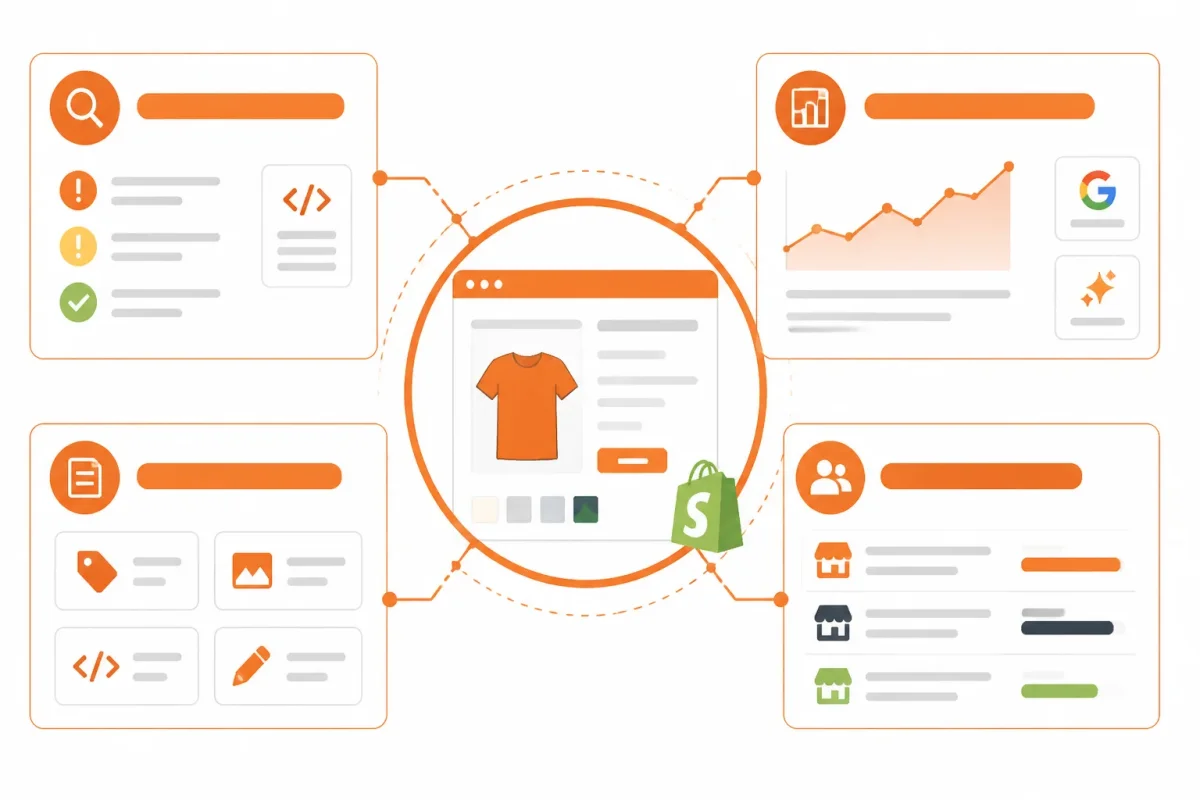
The Search Problem in AI
Your search problem is interpretation. If your running jacket does not clearly fit cold-weather runners, an AI system has weak evidence for matching it to that request.
The Answer Layer: Resolving a Buyer’s Situation
Your page should connect the product to a person, condition, and outcome. “Premium performance outerwear” is vague. “Wind-resistant running jacket for cold, wet morning runs” gives AI a usable answer.
Before: “Premium performance outerwear for active lifestyles.”
After: “A lightweight running jacket for commuters and runners training in cold, rainy weather.”
The Entity Layer: Identifying the Product and Its Relationships
Your brand, product name, category, material, fit, sizes, colors, and related products should agree across the page. If you call the jacket “StormShell” in one place and “WeatherFlex Pullover” elsewhere, you create uncertainty about what the product actually is.
The Data Layer: Consistent Prices, Availability, and Variants
Your visible Shopify offer and machine-readable data must show the same price, currency, stock status, and variant details. If your page shows a $129 jacket in stock but a selected size is unavailable, AI systems have less reason to repeat that offer.
The Trust Layer: Evidence Beyond the Merchant’s Claims
Your reviews, independent mentions, retailer references, and relevant community discussions provide evidence outside your store. wRanks can help you with product optimization, structured data, keyword tracking, and Search Console insights, but it cannot create genuine independent coverage for your brand.
| Situation | Better move | Why |
|---|---|---|
| Your running jacket says "premium performance outerwear" but does not identify weather, activity, or buyer. | State the use case, intended conditions, audience, and practical outcome in visible page content. | You give answer systems the customer context they need to match your product to a specific request. |
| Your product name, brand, material, category, and variant relationships are inconsistent across the page. | Use one unambiguous product identity and connect sizes, colors, materials, and related products consistently. | You reduce ambiguity when systems assemble your product entity and its relationships. |
| Your price, currency, availability, or variant information is missing or conflicts with the live offer. | Keep machine-readable commercial facts aligned with your visible Shopify offer. | You give AI systems facts they can verify across your page and data. |
| Your store has on-site claims but no independent reviews or relevant third-party mentions. | Build credible external evidence through genuine customer feedback and relevant independent coverage. | You reduce uncertainty during recommendation and comparison by providing outside signals. |
When AI Websites Return Nothing
Usually, no universal outage exists. Your product may be missing one evidence layer, so the AI platform cannot confidently interpret, verify, or recommend it. Use the table to find your first broken link instead of adding schema or reviews without diagnosing the gap.
How a Shopify Product Becomes Eligible for an AI Recommendation
Your product becomes a candidate when an AI system can connect a shopper’s need to clear, consistent evidence on your Shopify store. A product page may exist, yet still fail if its title, facts, availability, and trust signals do not describe one coherent entity.
The mechanism is simple: interpret the prompt, find possible products, check their relationships, then select evidence that can support a recommendation.
From a Shopper Prompt to a Candidate Product
You might sell a jacket titled “All-Weather Jacket | Black,” followed by disconnected bullets about nylon, zippers, and pockets.
Waterproof Running Jacket for Cold, Wet Weather: This page connects a recycled nylon shell, available sizes, a $129 price, current inventory, running fit, shipping terms, returns, and relevant customer feedback to one product.
Why Entity Clarity Matters More Than Repeating the Head Term
You help AI systems identify the product by explaining who needs it, where it works, what it is made from, how it fits, and what it costs. Repeating “running jacket” cannot replace those relationships.
A recommendation requires connected evidence, not just a page that exists.
This evidence principle means your product must answer the shopper’s need and verify the answer across visible page content and supporting data.
How Page Evidence, Feeds, and Trust Signals Reinforce One Another
You give AI stronger grounds for selection when your product page, feed data, inventory, price, and structured data agree. Independent reviews, clear returns, and genuine customer experiences then reduce uncertainty about the purchase.
When an AI Tool Doesn’t Reply
Your AI tool may be responding normally while finding no product it can confidently recommend. Check whether your product facts, availability, fit, and trust signals form a complete evidence chain.
Fixing a Nonresponsive AI Tool
First, separate a platform failure from product invisibility. Test another prompt, then audit the product’s content and data rather than adding more keywords blindly.
What wRanks Can Reveal Across a Shopify Product
You can use wRanks to audit product content, structured data, image alt text, keyword patterns, and Google Search Console signals together. That view helps expose mismatched facts, weak intent coverage, or search visibility problems before you rewrite the page.
Run one before-and-after audit prompt: “Which product fits cold, wet running, and why?” Your stronger page should make every part of the answer verifiable.
The Fixes That Fail When You Treat One Signal as the Whole Answer
Your product may have markup, indexing, and polished copy, yet still fail to appear in an AI recommendation. You see the symptom as silence, but the cause is often a broken evidence chain.
Each fix below starts with what you see, explains why the usual response fails, and gives you a better next move. One signal rarely proves product eligibility.
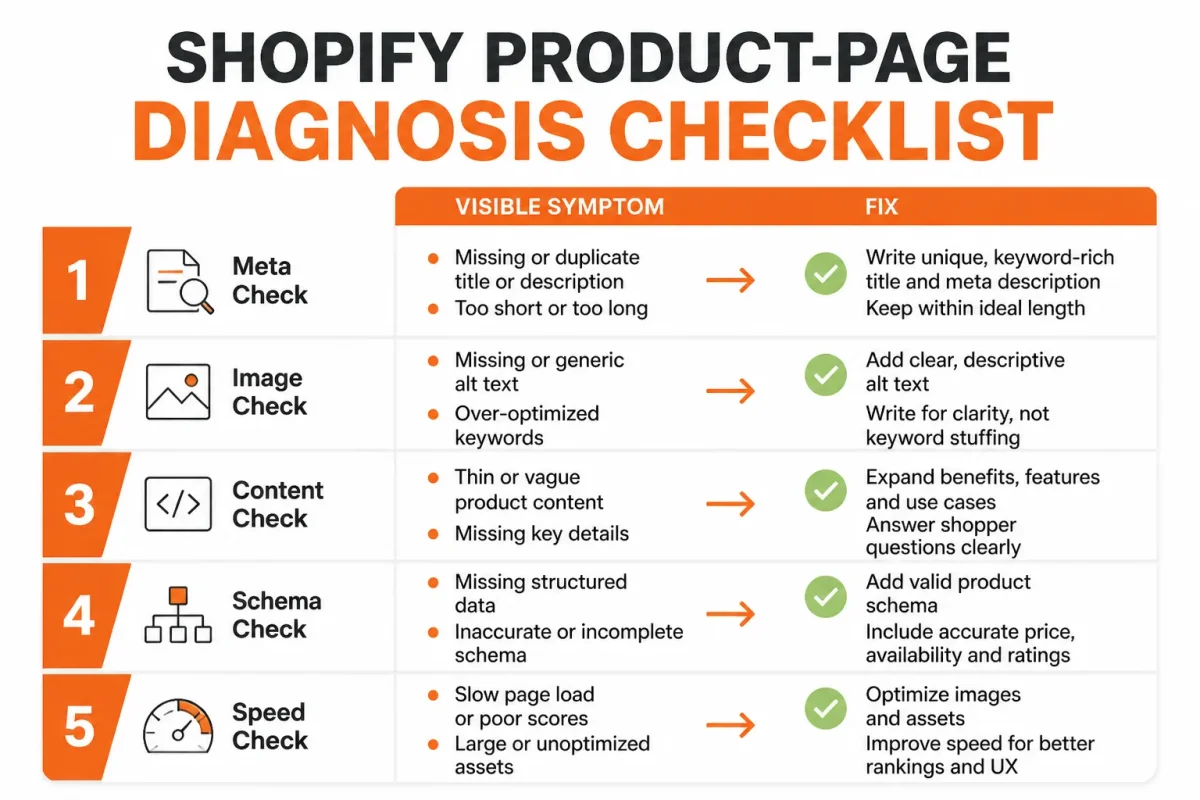
Mistake: Treating Indexing as Recommendation Eligibility
An indexed Shopify page is available to search systems, not automatically eligible for every AI surface. If your page answers only “what is this?” and not “who needs it, where, and why?”, adding more markup will not repair the missing buyer context.
Mistake: Adding Machine Data That Disagrees With the Visible Page
Conflicting facts weaken your product’s identity. You may show “water-resistant” in the description while structured data claims waterproof protection, leaving AI systems unsure which statement represents the product.
Weak example: “TrailShell Jacket, waterproof.” Strong example: “TrailShell Jacket, IPX6-rated protection for wet-weather running.” Compare the live page with structured data, variants, price, availability, and product claims before publishing.
Mistake: Asking AI to Infer the Product’s Audience and Use Case
AI is not required to connect isolated claims about a brand, category, use case, and variant. Expand one priority product with explicit relationships, such as “women’s insulated bottle for winter hiking,” then support that wording across visible content and relevant data.
When AI Doesn’t Mention Your Product
Usually, the cause is uncertain visibility rather than a broken platform. Recheck the same prompt across different times and related prompts before changing your whole catalog. wRanks can monitor query-level visibility and Search Console signals, although no platform can force an AI system to mention a product.
Checking for an AI Service Problem
A temporary absence may reflect changing retrieval, prompt wording, or incomplete store evidence. Check coverage and queries in this guide to adding Google Search Console code to Shopify, then inspect your live page before blaming an outage.
- Inspect the page: Confirm your buyer, use case, variants, and claims are obvious.
- Compare facts: Align visible content with structured data and availability.
- Expand one product: Build connected evidence before editing the catalog.
- Check coverage: Review Search Console indexing and query signals.
- Monitor visibility: Use wRanks prompts and keyword tracking instead of guessing.
FAQ
Why AI search does not work
AI search can fail when a product page leaves key facts unclear, contradicts its structured data, or lacks independent evidence. The system may understand the words on the page but still lack enough consistent signals to recommend the product. A page also may not appear when the prompt is too broad, the product is poorly connected to its category, or stronger sources answer the same need.
Is SEO dead now with AI
SEO isn't dead, but the work has widened. You still need useful copy, descriptive meta tags, crawlable pages, and clear internal links. AI platforms also look for evidence that supports the product's claims, including reviews, policies, product data, and mentions from relevant sources. A page that serves shoppers well gives search systems more reliable material to interpret.
What is the search problem in AI
The search problem in AI is a mismatch between a user's question and the evidence available to answer it. Product pages often describe features without making the buyer, use case, price, availability, or fit easy to verify. When those details conflict across the page, feed, reviews, and other sources, an AI system has less reason to select the product.
What is the 30% rule for AI
The 30% rule for AI is a practical testing guideline, not a published ranking law. Treat any claimed visibility lift or answer change as a signal worth checking, not proof that one edit caused the result. Recheck the same prompts across several dates, compare products and queries, and keep changes that improve both the buyer's experience and the supporting evidence.
Start with One Product and Build the Evidence Chain in Order
Your next move shouldn’t be a full-catalog rewrite. Choose one Shopify product that matters commercially, then test whether its buyer, facts, and trust signals form one clear story for shoppers and AI platforms.
You need a repeatable pattern, not guaranteed inclusion in every answer. Start narrowly, fix the largest break, and let one coherent product page guide related products and collections.
Select the Product with the Clearest Commercial Opportunity
- Choose one product: Pick a product with meaningful sales potential, a clear target buyer, and a known visibility gap. Record the exact AI prompts where you don’t appear, along with the competitor that does.
Audit Its Four Evidence Layers
- Check the page context: Confirm that your use case, audience, material, fit, compatibility, and related category are obvious. Then check how the product connects to your collection, brand, and supporting content.
Correct the Largest Inconsistency First
- Match the live offer: Verify that price, currency, variants, availability, shipping details, and other structured facts agree with what shoppers see. Next, strengthen genuine reviews, clear policies, and relevant independent mentions. Fix the contradiction that could make your product appear unreliable.
Track the Same Prompts and Search Signals
- Monitor comparable evidence: Recheck the same prompts instead of relying on one response. Use Google Search Console signals and wRanks keyword tracking to compare changes by query and product over time.
Roll the Pattern Out Only After the First Page Is Coherent
- Copy the process, not assumptions: Once the first audit is complete, apply its evidence pattern to related products and collections. wRanks brings content optimization, structured data, image alt text, keyword tracking, and Search Console insights into one workflow, though no platform can control every AI answer.
If you want a faster way to audit and optimize Shopify product visibility, wRanks brings AI-powered content optimization, structured data, image alt text, keyword tracking, and Search Console insights together for Shopify store owners. Its Shopify SEO resources support a practical one-product-first workflow.

AI & GEO specialist helping brands maximize visibility across AI platforms like ChatGPT, Gemini, and Claude. James pioneers generative engine optimization techniques for e-commerce.