What Is Search Impression Share? A Shopify SEO Guide
What is search impression share measures your paid visibility in Google Ads auctions, helping Shopify stores optimize ad spend and organic SEO strategies.
You’ve improved a Shopify product page, checked the title, and refreshed the description. Yet by the afternoon, its visibility still feels inconsistent. If you’re asking what is search impression share, you may be trying to work out whether the page is losing rankings, missing paid ad auctions, or serving a product with limited demand.
Most Shopify stores don’t have a traffic problem. They have a visibility-diagnosis problem. Google Ads Search Impression Share measures your paid visibility in auctions, while Google Search Console impressions show when your pages appeared in organic results. The signals are related, but they aren't interchangeable metrics.
You can use the distinction to assess a product, collection, or blog page, compare its query evidence, and choose an optimization before changing bids or budgets. That separates a paid visibility gap from an organic page opportunity, so your next Shopify SEO decision rests on evidence rather than guesswork.
What Search Impression Share Changes for a Shopify Marketing Budget
A low search impression share can mean your Shopify campaign misses eligible searches because of budget, bids, ad rank, or targeting. You may have a strong product page and a profitable offer, yet your ads still fail to appear when shoppers search.
A high share doesn't automatically mean better performance. You might already reach most available searches while paying more for the same audience, so return on ad spend, conversion value, and contribution margin matter more than a perfect percentage. The same discipline applies to financial services tools like Car Loan Finder, where comparing total borrowing costs matters more than choosing the most visible offer.
What a good impression volume looks like
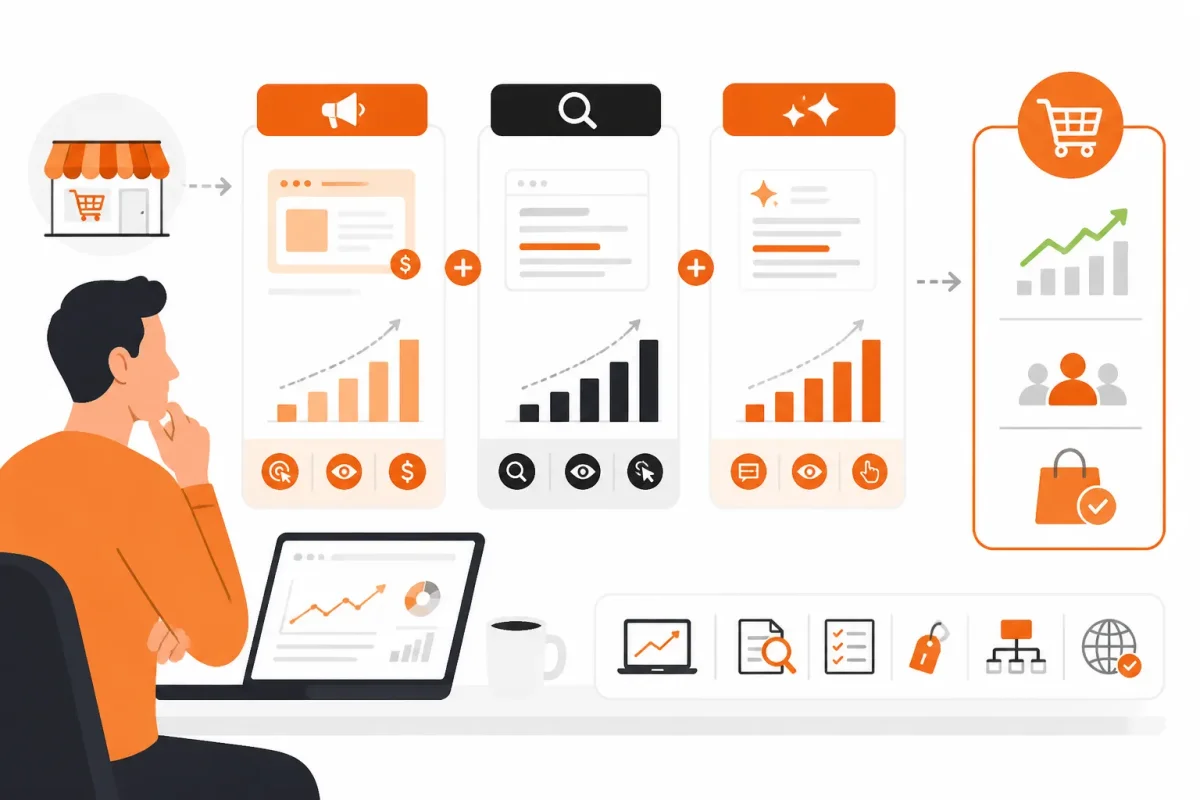
A useful impression volume reveals whether you reach valuable searches without making visibility the goal itself. Review impressions beside clicks, orders, revenue, and margin for each product or collection campaign. A branded collection may deserve protection, while an expensive non-branded keyword may need an organic page instead of a larger bid.
A practical Google Ads search impression share benchmark
A reasonable Google Ads search impression share is about 95% for branded terms, around 80% for lower-competition non-branded terms, and near 60% for highly competitive terms. Treat these as directional starting points, not targets that justify unlimited spending.
Some legal keywords cost more than $1,000 per click, according to HubSpot.
That cost shows why maximum visibility can damage your Shopify budget. You may protect branded product searches, test profitable non-branded terms, and improve organic pages when paid expansion becomes too expensive.
A profitable search impression share target
A good search impression share is the level that produces profitable growth for your store, not the highest percentage available. Combine Google Ads data with page-level evidence from Google Search Console to decide whether a product, collection, or blog deserves paid investment or SEO work.
Practical rule: Set the share target by profitable return, then prioritize the Shopify pages and keywords that still show valuable missed demand.
wRanks helps connect keyword tracking, Search Console insights, and page optimization, although its recommendations still depend on accurate conversion and margin data. This e-commerce SEO checklist for Shopify stores fits the workflow when you turn page-level findings into technical and content priorities.
The Four Visibility Metrics Behind Search Impression Share
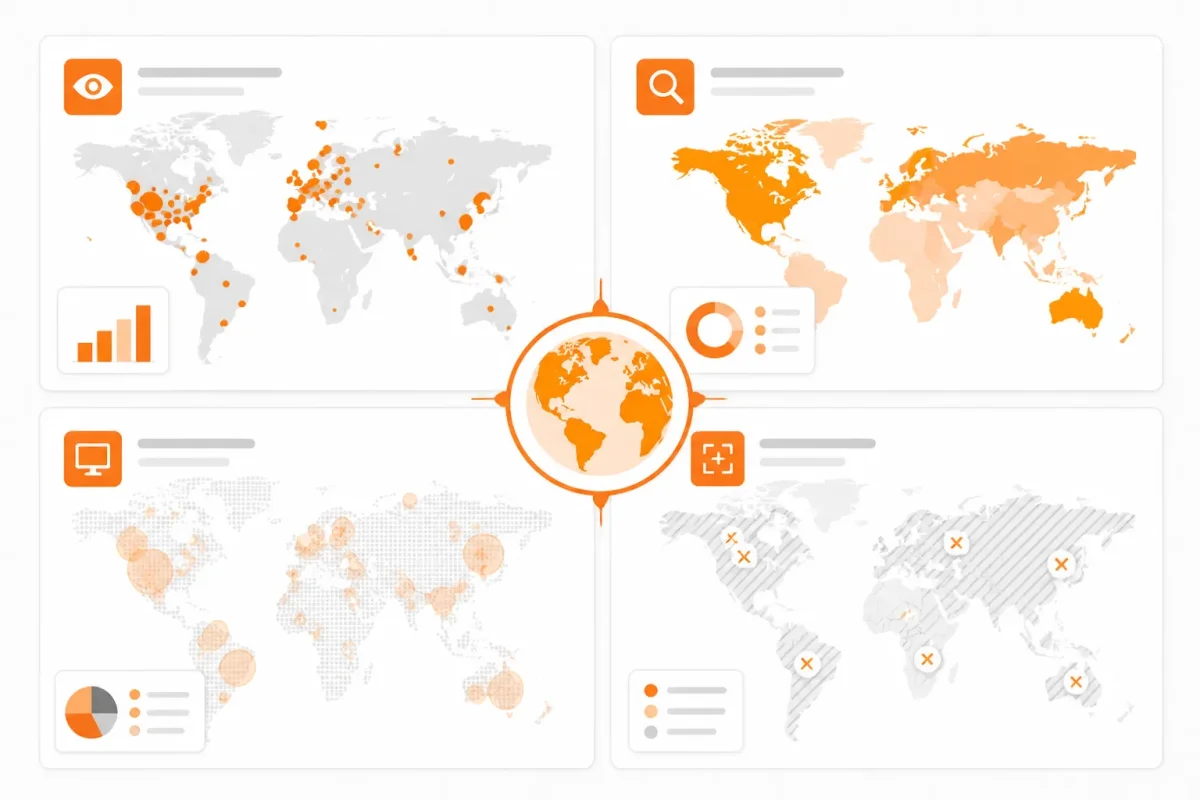
An impression is one opportunity for someone to see your ad or organic result. For your Shopify campaign, that distinction matters because paid Google Ads visibility and organic Search Console visibility come from different systems.
Start with the placement, then identify why visibility is missing. That keeps you from judging your product campaigns, collection pages, and organic queries by the wrong metric. If you’re still building your store’s search foundation, review this Shopify SEO guide before comparing paid and organic visibility. A placeholder such as Example Domain can also help illustrate the difference between a destination URL and the visibility metric attached to it.
What an impression means in simple terms
An impression means your ad was shown to a potential customer. WordStream defines a qualifying impression as at least 50% of the ad being visible for at least one second, according to its January 7, 2026 guidance.
For your Shopify store, one ad display is one impression. Search Impression Share then compares the Search impressions you received with the impressions your ad was eligible to receive.
A clearer word for impression
A clearer word is display. Read “impression” as “an eligible ad display,” not as a click, visit, sale, or organic ranking.
Weak setting: You set Target Impression Share to 90% without a cost limit for “women’s running shoes.”
Strong setting: You set Target Impression Share to 65% with a $4 maximum bid and a profitable “women’s running shoes” campaign.
An impression example
Imagine your blue running-shoe ad appearing above or among Google Search results for “women’s running shoes.” Search Impression Share measures that paid Search visibility. Display Impression Share applies instead to banner placements across websites and apps.
Target Impression Share is an automated bidding goal for a chosen Search position. Lost Impression Share shows the eligible visibility your campaign missed because of limits such as budget or ad rank. WordStream reports that these impression share metrics are available for standard Search, Shopping, and Display campaigns.
Impression in one word
In one word, impression means display. Search Console uses the same word differently for your organic results, so analyze those impressions by Shopify page and query rather than by paid auction share.
| situation | better move | why |
|---|---|---|
| Your Shopify product campaign is missing eligible Google Search ad impressions | Check Search Impression Share and the lost-budget or lost-rank reason | This is a paid Search auction problem, not an organic ranking report |
| You’re evaluating a banner campaign across websites and apps | Use Display Impression Share | Display placements have a different eligible inventory pool from Search |
| You want ads near the top of Google results | Review Target Impression Share settings and profitability | The target controls a desired position, but higher visibility can cost more |
| Your campaign receives fewer impressions because its budget or ad rank limits auctions | Use Lost Impression Share to identify the limiting factor | The cause determines whether you should adjust budget, bids, relevance, or landing-page quality |
| Your Shopify collection appears for queries but earns few organic clicks | Inspect Google Search Console impressions, clicks, and queries | Search Console measures your organic visibility and page-level opportunity rather than paid share |
How Google Ads Calculates Search Impression Share and Where Shopify Fits
Search Impression Share equals impressions received divided by total eligible impressions, multiplied by 100. Your Shopify ad can appear for a keyword yet still miss many eligible auctions, so the percentage shows how much available visibility your campaign captured.
Google defines impression share as the percentage of impressions your ads receive against the total impressions they could receive, according to Google Ads documentation. The figure is the percentage of eligible impressions received, and your Shopify targeting, budget, bids, ad quality, and ad rank all affect eligibility and delivery.
How much impression share can a campaign capture
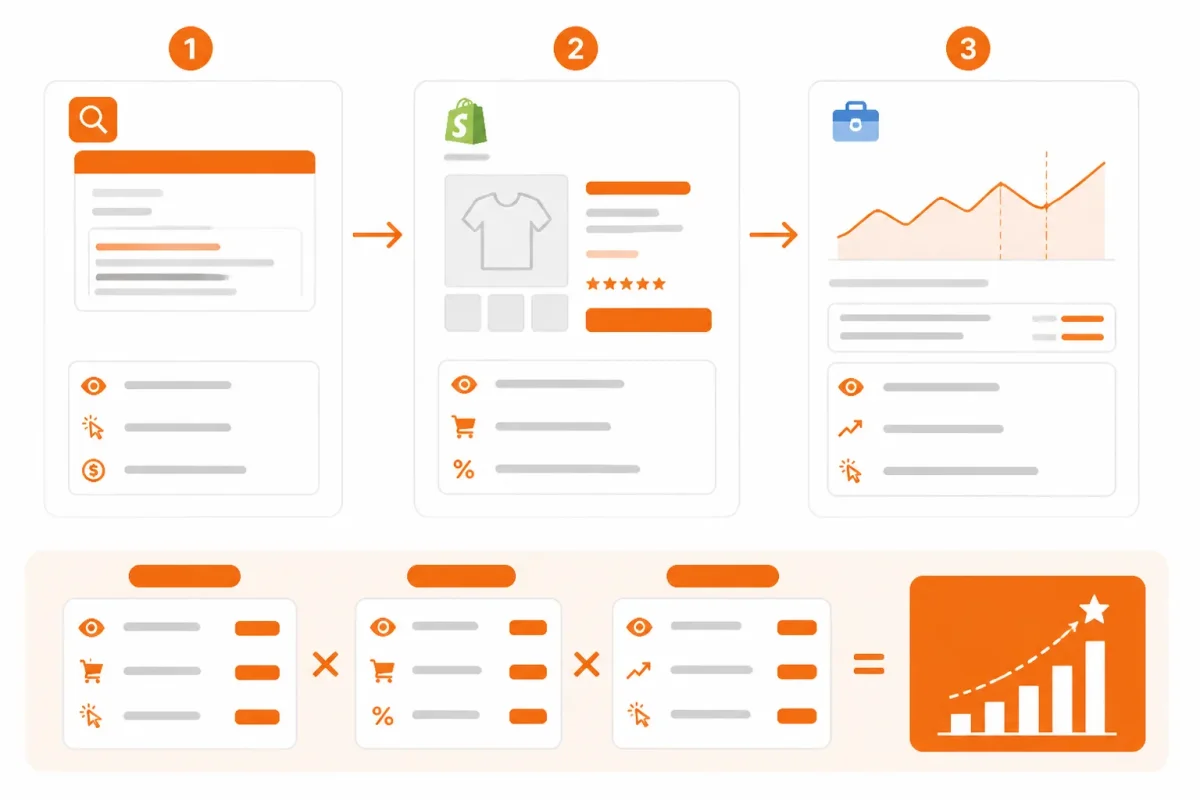
Divide impressions received by total eligible impressions, then multiply by 100. If a Shopify collection ad appears 800 times from 1,000 eligible opportunities, its Search Impression Share is 800 ÷ 1,000 × 100 = 80%.
Those 1,000 opportunities aren't every search containing your keyword. Google filters eligibility by location, language, device, schedule, keyword or audience targeting, budget, bids, ad quality, and ad rank. A campaign targeting shoppers in Texas during business hours has a different eligible pool from one targeting the entire United States all day.
What counts as a search impression
A search impression means your ad was shown in an eligible Google search auction. For your Shopify store, the impression belongs to the campaign and ad, not automatically to the product or collection page you want to improve.
Use the final URL and campaign structure to connect that paid result to a Shopify page. If a collection campaign points to “Women’s Waterproof Hiking Boots,” review that collection in Google Search Console separately. Paid impressions describe ad delivery; organic impressions describe how often Google showed your page in unpaid results. A neutral placeholder such as Example Domain demonstrates why the destination itself should be analyzed separately from the visibility data.
What does search impression share tell you
Impression share tells you how much paid visibility your campaign captured, while Search Console tells you which Shopify pages and queries earned organic visibility. Compare them, but don't merge them into one performance figure.
Start with a Search Console query that has impressions but weak clicks. Filter Performance data by the Shopify page and query, then compare the visible title and snippet with the page itself. Test one focused improvement, such as a meta tag rewrite, structured data enhancement, image alt text update, or useful on-page content.
Before: “Hiking Boots | Summit Trail.”
After: “Women’s Waterproof Hiking Boots for Rocky Trails | Summit Trail.”
wRanks can help automate these Shopify SEO tasks while tracking keywords and connecting Google Search Console insights. It also supports product, collection, page, and blog optimization for search engines and AI platforms, though your team still needs to review whether each change matches the page and query.
| situation | better_move |
|---|---|
| A product ad received 800 impressions from 1,000 eligible opportunities | Calculate 800 ÷ 1,000 × 100 = 80% Search Impression Share |
| A campaign has low share and a high lost-impression-share budget value | Review budget and conversion value before increasing spend |
| A campaign has low share and a high lost-impression-share rank value | Improve bid strategy, ad relevance, landing-page experience, or product-page alignment |
| A collection page has organic impressions but few clicks in Search Console | Test the title, meta description, content relevance, structured data, or image alt text |
The Search Impression Share Mistakes That Mislead Shopify Merchants
You can read a low Search Impression Share as a ranking problem when it only describes eligible Google Ads opportunities. That mistake sends you toward the wrong Shopify product page, budget decision, or metric.
Your account contains better evidence than general advice. Check the campaign data, then verify the related page in Google Search Console before changing bids, content, or meta tags.
Search impression share in Google Ads
Search Impression Share in Google Ads measures how often your ad appeared among eligible paid searches, not how often your organic Shopify page ranked. Use Google Search Console for organic impressions, clicks, queries, and pages.
- Separate channels: Read Google Ads for paid visibility and Search Console for organic visibility.
- Find the loss: Inspect the lost-impression-share column for budget or rank before changing the page.
- Verify the URL: Match the campaign with the relevant Shopify product or collection page in Search Console.
A search impression share example
A Shopify campaign for an insulated bottle can show a strong share for branded searches while missing non-branded searches because of budget or ad rank. That doesn't prove the product page has weak organic rankings, and it doesn't prove the campaign deserves more spend.
Chasing complete visibility can also reduce return. Check conversion rate, margin, customer value, and profit before pursuing a higher share.
Search impression share discussions on Reddit
Search impression share discussions on Reddit can suggest useful hypotheses, but they can't replace your campaign-level evidence. Each account has different budgets, ad rank, targeting, query mix, and Shopify landing pages.
- Segment queries: Separate branded and non-branded searches before applying any benchmark.
- Distinguish actions: Treat an impression as visibility, not proof of attention, visits, or sales.
- Check the page: Confirm the associated product or collection URL in Search Console.
- Choose the fix: Change bids, content, or metadata only after identifying the relevant lost-share cause.
Once the diagnosis is clear, wRanks can organize keyword tracking and page optimization across your Shopify store. Its AI-powered SEO tools help you act on evidence, though they can't replace account-level judgment.
FAQ
What does search impression mean
A search impression means your result or ad was shown in response to a search. In organic search, Google Search Console records an impression when a link to your page appears on the results page. An impression doesn't mean someone clicked, read the page, or visited your Shopify store.
What is a good number of impressions
There isn't one good impression count for every page. A useful number depends on the query's demand, your audience, the page type, and the date range. Compare impressions with clicks, click-through rate, conversions, and position. A rising count is useful only when it brings relevant searches and supports a clear business goal.
How do I calculate impression share
Calculate impression share by dividing impressions received by total eligible impressions, then multiplying by 100. Google Ads reports this figure for eligible paid auctions. Organic search doesn't provide the same total opportunity number, so Google Search Console impressions alone can't produce an organic impression-share percentage.
What does impression share mean
Impression share is the percentage of eligible opportunities in which your ad appeared. For example, a 60% share means the ad showed in 60% of the auctions where it was eligible to appear. Google Ads can also show whether missed visibility relates mainly to budget, ad rank, or another eligibility issue.
What is a good search impression share in Google Ads
A good search impression share in Google Ads depends on the campaign's purpose, competition, budget, and conversion value. A high share isn't automatically profitable, and a lower share may be sensible for expensive terms. Review impression share beside cost, conversions, return on ad spend, and the reason for lost visibility.
A Five-Step Visibility Check to Start With One Shopify Page
You don't need to inspect your entire Shopify catalog before making a useful decision. Start with one product or collection page that matters to revenue, then trace its query through Google Ads, Google Search Console, and the page itself.
The aim isn't maximum impression share. Start with a clean baseline that shows where visibility is being lost and which page change deserves attention.
Choose one page and one query
- Choose: Select one revenue-relevant product or collection page, not your whole catalog.
- Define: Write down its target query and mark it as branded or non-branded. Record the current URL before changing anything.
Separate paid share from organic impressions
- Inspect paid visibility: If Google Ads supports the query, check Search Impression Share and the relevant lost-budget or lost-rank reason. Don't respond with a blanket bid increase.
- Compare organic evidence: Open that page's Google Search Console Performance report. Compare impressions, clicks, queries, and dates for the same page and search intent.
- Paid check: Search Impression Share and its lost-share reason are recorded when paid data exists.
- Organic check: Search Console data is filtered to the chosen page.
- Query check: Branded and non-branded searches are separated.
Prioritize one measurable page improvement
- Improve and recheck: Choose one change, such as a clearer meta tag, stronger content alignment, structured data, image alt text, or an internally supported keyword. Then recheck the same evidence after an appropriate interval.
Weak title: “Blue Running Shoes | Store.”
Strong title: “Men’s Blue Trail Running Shoes for Rocky Terrain | Summit Run.”
wRanks can streamline the Shopify optimization and keyword-monitoring workflow. Start with the page’s Search Console report, record its current evidence, and only then make the first change.
If you want a faster way to optimize Shopify products, collections, and blogs, wRanks provides AI-powered meta tag optimization, structured data, image alt text, and keyword tracking for Shopify stores. The Shopify SEO blog guides cover related workflows for improving search visibility and AI platform readiness.

Technical SEO engineer focused on structured data, indexing optimization, and Core Web Vitals. David turns complex technical requirements into actionable Shopify solutions.