SaaS SEO Consultant vs Agency vs Software
Compare a SaaS SEO consultant, agency, and scalable software to choose the right Shopify SEO model for your team and growth stage.

Choose the SEO model that matches your Shopify growth bottleneck
A Shopify team may have a strategy gap, a production-capacity gap, or a catalog-execution gap. A SaaS SEO consultant, an agency, and optimization software address those problems differently, so they aren't interchangeable labels. The right choice depends on product and collection volume, internal implementation capacity, measurement maturity, and the need to appear in Google and AI search.
When a business doesn't know how organic acquisition should connect with the funnel, a consultant is usually the strongest fit. A SaaS SEO consultant can align search demand with product-led or sales-led stages, determine which collections deserve priority, and clarify whether the problem is keyword targeting, content, technical SEO, or conversion flow. That diagnosis matters when the store has traffic but weak revenue attribution, or when teams are publishing without a clear acquisition plan.
An agency adds people and specialist coverage. It can bring together technical SEO, content strategy, international SEO, programmatic SEO, and complex funnel expertise for a larger Shopify operation. This model suits a team with a substantial roadmap but limited capacity to implement redirects, improve templates, build content, review structured data, or coordinate work across markets. The tradeoff is less direct control over day-to-day execution and a higher ongoing cost than a single specialist or software platform.
Software fits a different constraint: repeated optimization across many Shopify assets. A catalog with hundreds or thousands of products and collections may need consistent improvements to meta tags, structured data, image alt text, internal signals, and content. wRanks provides AI-powered SEO for Shopify, including keyword tracking, Google Search Console integration, and AI-generated content intended for both traditional search and AI platforms. That repeatable workflow can reduce manual editing, but it can't replace human judgment when the store has unclear positioning, unusual architecture, or a complicated international setup.
Measurement should shape the decision as much as output. A team with reliable Search Console data and defined organic revenue goals may be ready for software, while a team that can't connect rankings, clicks, assisted conversions, and product sales may need strategic help first. Visible activity isn't the same as a return. A comprehensive SEO strategy commonly takes 6 to 12 months to produce a significant return on investment, even when implementation begins quickly.
The comparison below applies SaaS SEO principles to Shopify workflows. It focuses on when specialist expertise, agency capacity, or scalable optimization best matches the bottleneck, with wRanks most relevant when repeatable Shopify execution is the limiting factor.
Judge every option on four criteria that affect organic revenue
Consultants, agencies, and software shouldn't be compared by deliverables alone. A useful buying rubric asks four questions: does the option attract the right commercial intent, cover the technical and on-page work, get changes implemented and measured, and produce enough value at a sensible cost and pace?
Competitor research often emphasizes PLG sign-ups, activation, JavaScript expertise, bottom-of-funnel content, and objective audits. For Shopify teams, that framework also has to answer who will optimize hundreds or thousands of products, collections, pages, and blog posts.
Funnel and search-intent fit
The first test is whether the option connects search demand to a commercial outcome. For SaaS, that may mean moving a visitor from a problem-focused query to product discovery, sign-up, activation, or paid adoption rather than stopping at a marketing-qualified lead or demo request. For Shopify, the path usually runs from category or product research to collection views, product consideration, checkout, and revenue.
Evaluation should include bottom-of-funnel content, product and collection targeting, keyword-to-page mapping, and the quality of calls to action. A consultant may diagnose gaps in intent and funnel alignment, an agency may produce the content, and software may help apply consistent optimization across pages.
Technical and on-page coverage
Coverage must extend beyond title tags. It includes JavaScript rendering, site speed, crawlability, indexing, internal linking, schema, metadata, image alt text, and content quality. SaaS research may also examine software-product schema and application performance, while a Shopify review should account for theme behavior, variant URLs, collection templates, and structured data on commerce pages.
This criterion separates a narrow content service from a complete SEO capability. It also rewards an objective audit that challenges internal assumptions and exposes technical blind spots. Store teams can review the scope of that process in the wRanks store audit documentation.
Implementation and measurement
A recommendation has limited value if nobody can put it into production. The Shopify-specific question is direct: who changes hundreds or thousands of assets, and how safely? Assessment should cover implementation ownership, catalog-wide controls, approval workflows, and the ability to optimize products, collections, pages, and blogs without creating inconsistent metadata or schema.
Measurement should connect rankings and clicks with impressions, indexing, organic sessions, product engagement, sign-ups where relevant, and sales. Google Search Console integration and keyword tracking support that chain, but reporting still needs clear commercial goals and a reliable baseline.
Economics, speed, and scalability
Cost comparisons should include consultant fees, agency retainers, software subscriptions, internal review time, and the alternative cost of hiring a senior SEO specialist. Speed also needs careful interpretation. A consultant can deliver findings quickly, and an agency can produce visible activity quickly, but SEO returns commonly take 6 to 12 months to become significant.
Scalability asks whether output increases without matching increases in headcount, meetings, or manual edits. The comparisons below use these four criteria to distinguish specialist judgment, production capacity, and AI-powered SEO software.
A SaaS SEO consultant delivers strategic diagnosis and funnel alignment
A SaaS SEO consultant is most valuable when a Shopify team has plenty of possible SEO work but no clear order of operations. The consultant provides senior judgment across search intent, technical priorities, topical authority, and the path from organic visits to sign-ups, orders, and revenue.
Funnel and search-intent fit
Consultants are well suited to product-led growth SEO because they can connect technical SEO, high-intent content strategy, and product analytics. They can separate informational searches from product, collection, comparison, and purchase intent, then map each group to the right page type and funnel stage.
That judgment matters when a store is publishing traffic-generating articles while product pages remain weak, or when comparison pages attract visitors who never reach checkout. A senior specialist can also assess topical authority, identify programmatic SEO opportunities, and decide whether the next priority is bottom-of-funnel content, category depth, internal linking, or stronger product positioning.
Technical and on-page coverage
An experienced consultant can investigate JavaScript rendering, canonicalization, indexing, schema, site architecture, and the content-SEO interlock. An external review also brings independence. The consultant can challenge assumptions held by the marketing, development, or merchandising teams and produce an objective audit of what is limiting organic performance.
The limitation appears after the diagnosis. One specialist may recommend better meta tags, structured data, and image alt text across 5,000 products, but that doesn't mean the work will be applied consistently. Unless the merchant has an implementation team or an automation layer, the consultant's output can become a backlog rather than a catalog-wide improvement.
Implementation and measurement
Consultants can define measurement plans that connect Google Search Console data and keyword movement with qualified visits, sign-ups, orders, activation, and revenue. They may also guide technical fixes and review results after implementation. Their capacity is finite. A single expert can prioritize templates and workflows, but can't manually maintain every metadata field, schema rule, and alt-text recommendation as the catalog changes.
Economics, speed, and scalability
A consultant can reach an initial diagnosis faster than a full-time hire because there is no equivalent onboarding period. The cited US research benchmark places a senior SEO manager above $110,000 in annual salary before benefits and overhead, though that figure isn't a universal market price.
The tradeoff is limited production capacity and dependence on the merchant's team. A consultant fits when the bottleneck is uncertainty, such as unclear intent, technical priorities, or funnel alignment. When the main need is continuous metadata, structured-data, and image-alt-text execution across a growing Shopify catalog, software such as wRanks can provide the repeatable optimization layer that one senior specialist can't supply alone.
An SEO agency adds production capacity for complex growth programs
An agency suits a Shopify business whose SEO bottleneck involves several workstreams at once. International expansion, an information architecture rebuild, bottom-of-funnel content, difficult technical issues, or a sustained organic growth program can justify a coordinated delivery team rather than isolated senior advice. The tradeoff is operational overhead when the store mainly needs fast, tightly controlled catalog edits.
Funnel and search-intent fit
Agencies bring specialists together around a broader search and revenue plan. One team may map non-branded research terms, comparison pages, product-led content, and conversion paths while another handles editorial production. Agency rankings commonly separate providers by strengths such as enterprise SaaS, high-end content creation, complex SaaS funnels, international SaaS, and scaling content production. Those distinctions matter because an agency built for international programs may be a poor match for a small Shopify store that needs 500 product titles corrected.
This model is especially useful when search intent changes across the funnel. A Shopify business selling software, equipment, or subscription products may need category architecture, use-case pages, comparison content, technical cleanup, and measurement tied to qualified revenue. An agency can assign specialists to each area and keep the work moving under a project manager.
Technical and on-page coverage
Agency services can combine crawl analysis, internal linking, structured data, content briefs, production, international targeting, and technical implementation. That breadth helps when a Shopify redesign affects collections, canonical signals, templates, redirects, and indexation at the same time. It also helps a growing merchant maintain a regular publishing program without asking one consultant to write, audit, brief, and QA every asset.
The limitation appears when the store's need is narrower. A smaller team may want direct control over meta tags, image alt text, collection copy, and product-level changes throughout the week. If every adjustment travels through an account lead, strategist, writer, and developer, a simple catalog fix can take longer than the SEO issue deserves. Not every agency works this way, but the ownership model should make that speed visible before the contract begins.
Implementation and measurement
A capable agency should show who changes Shopify templates, who approves content, who checks structured data, and who reports results. Measurement should connect Google Search Console impressions and clicks with rankings, organic sessions, product engagement, and revenue by landing-page type. For international work, the plan should also define market ownership, localization review, and how hreflang and regional collections will be maintained.
Economics, speed, and scalability
An ongoing agency retainer can make sense when the constraint is coordinated complexity and the business has enough opportunity to keep several specialists busy. It is less efficient when a broad program is wrapped around one narrowly defined store problem. Smaller Shopify teams should ask for a Shopify-specific implementation plan, a named ownership model, expected approval times, and a measurement process before signing. An agency is the right fit when breadth and production capacity matter more than instant catalog control.
Scalable SEO software standardizes Shopify optimization across the catalog
As a Shopify catalog grows, manually improving titles, descriptions, structured data, image alt text, and supporting content becomes slow and inconsistent. Software is strongest when the recurring work spans hundreds or thousands of products, collections, pages, and blogs, and the team needs a repeatable way to improve search visibility without assigning every task to a specialist.
Funnel and search-intent fit
Software can apply optimization rules and recommendations across a store, but it doesn't decide the entire commercial strategy. A SaaS SEO consultant may determine whether a merchant should prioritize high-intent collection pages, comparison content, or post-purchase searches before any catalog work begins. wRanks supports that execution layer by helping Shopify merchants optimize products, collections, pages, and blogs for search engines and AI platforms.
That broader visibility brief matters as search behavior changes. Keyword tracking and Google Search Console insights show which queries and pages deserve attention, while AI-assisted recommendations and AI-generated content can help a team produce or refine supporting material. Human review still matters, especially for claims, product specifications, and brand voice.
Technical and on-page coverage
wRanks brings common Shopify SEO tasks into one workflow. Merchants can work on meta tags, structured data, and image alt text alongside page and blog content, rather than relying on scattered spreadsheets or manual checks. This standardization helps keep new products and existing catalog pages aligned as inventory changes.
Software has clear limits. It isn't a substitute for an agency producing a large international content program, a consultant shaping a bespoke funnel strategy, or an engineer repairing unusual technical architecture, such as a heavily customized theme or complex rendering problem. Those cases require judgment and hands-on intervention beyond supported platform workflows.
Implementation and measurement
The practical advantage is centralized execution. A marketing manager can apply priorities across recurring Shopify tasks, monitor keyword movement, and use Google Search Console data to identify pages that need revision. Coverage becomes easier to maintain because optimization doesn't depend on remembering which product templates, collection groups, or blog posts were handled last.
Economics, speed, and scalability
For a growing catalog, software usually offers more repeatability and lower marginal effort than assigning each page to an agency or consultant. The tradeoff is less bespoke judgment and dependence on the platform's available workflows. wRanks is a strong fit when catalog-level execution is the bottleneck, particularly when a Shopify team needs consistent optimization across many assets. It can also complement specialist strategy when a consultant supplies the diagnosis and software carries that plan across the store.
The side-by-side decision: expertise, capacity, control, and scale
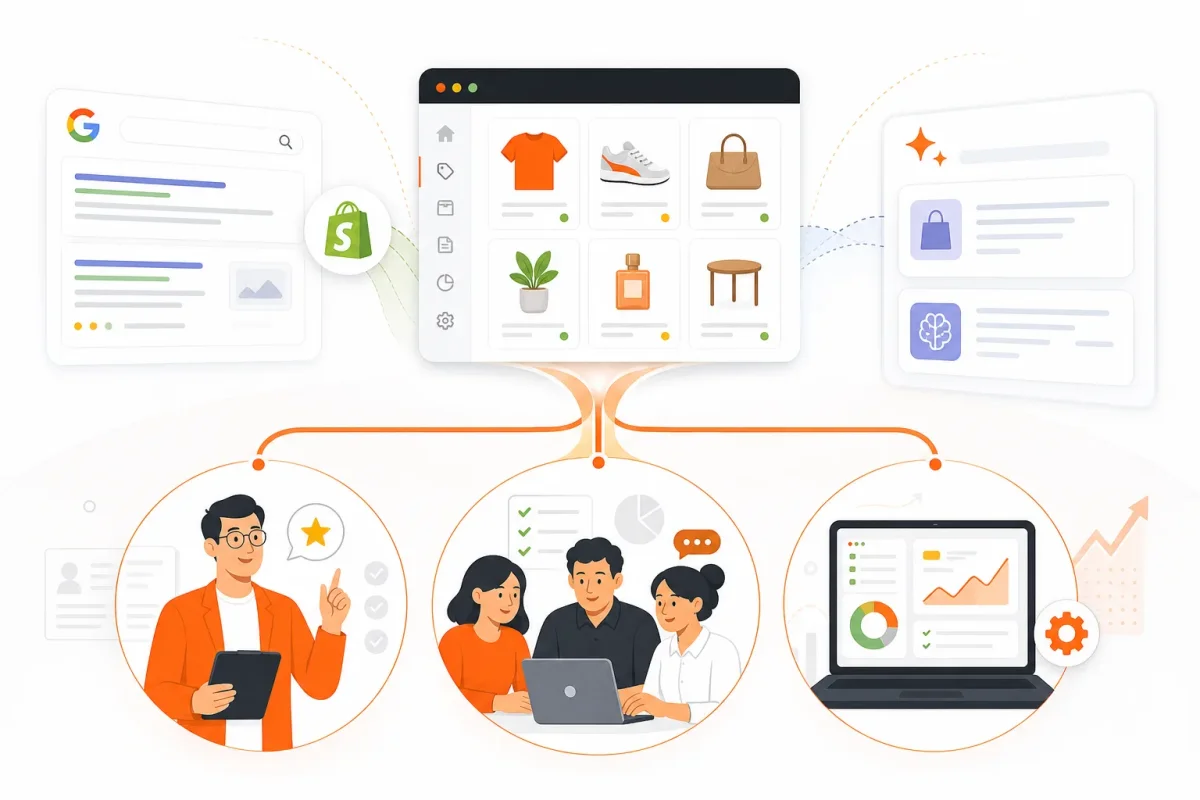
The right choice depends on what the Shopify team needs to improve repeatedly, not which provider lists the most deliverables. Organic search drives over 53% of all trackable B2B website traffic, and approximately 75% of B2B buyers use search engines during vendor research, so the buying decision should protect long-term visibility rather than reward short-term speed.
A significant SEO return commonly takes 6 to 12 months. Consistency, measurement, and fit are more useful buying metrics than a promise of rapid traffic.
Capability and control comparison
| Model | Funnel and search-intent fit | Technical and on-page coverage | Implementation and measurement | Economics, speed, and scalability |
|---|---|---|---|---|
| SaaS SEO consultant | Strong: handles ambiguous intent, topical authority, programmatic opportunities, and funnel alignment. Limited recurring production. | Strong strategically: supplies direction for technical and on-page work, but the internal team must execute or outsource it. | Strong: provides audits, priorities, and a measurement framework. Limited recurring catalog capacity. | Fast diagnosis: senior judgment arrives quickly, but repetitive Shopify edits don't scale through consulting alone. |
| SEO agency | Strong: supports complex funnels, international programs, and broad content plans. Coordination can slow decisions. | Strong: offers specialist technical SEO and content production. A small team may have less direct control. | Conditional: coordinated delivery covers multiple workstreams, with added process and communication overhead. | Scalable capacity: suits large programs, but may be inefficient for a narrow brief or small Shopify store. |
| Scalable SEO software | Conditional: effective for repeatable target-page optimization, with less bespoke funnel judgment. | Strong: standardizes meta tags, structured data, image alt text, and content workflows across Shopify assets. | Strong: centralizes execution through keyword tracking and Google Search Console insights. Unusual technical issues may need specialist help. | Strong for scale: efficient for growing catalogs, but limited for unusual architecture or complex strategy. wRanks is built for this Shopify workflow. |
Cost, time-to-value, and scaling trade-offs
A consultant can create the fastest strategic clarity, while an agency buys production capacity and project management. Software usually delivers the lowest marginal effort as a catalog expands, particularly when wRanks applies repeatable optimization across products, collections, pages, and blogs. None removes the 6-to-12-month evidence window required to judge meaningful organic revenue.
The failure mode to screen for before buying
- Consultant: a clear strategy sits untouched because nobody owns implementation.
- Agency: meetings, approvals, and handoffs consume more time than the Shopify team can spare.
- Software: automated improvements are applied without enough judgment about positioning, intent, or unusual site architecture.
The strongest model is the one that closes the specific bottleneck. Speed matters, but sustained execution and measurable search visibility matter more.
Pick the model that fits your Shopify team and operating constraint
The choice comes down to what is preventing the Shopify team from making consistent search improvements. A SaaS SEO consultant resolves uncertainty, an agency resolves specialist capacity, and wRanks resolves repetitive optimization work across a growing store. Each option addresses a different constraint and carries a different limitation.
Pick a consultant if strategy is the bottleneck
Choose a SaaS SEO consultant when the team can't decide which audiences, keywords, funnel stages, or technical priorities deserve attention first. This is the strongest fit for a store with scattered SEO ideas, weak search intent mapping, unclear category positioning, or a product funnel that attracts traffic without enough qualified buyers.
The consultant should leave the team with a prioritized roadmap, audience and keyword decisions, measurement plans, and clear recommendations for product, collection, page, and blog content. The constraint it resolves is judgment. The limitation is implementation dependence. Internal staff still need to update Shopify assets, coordinate developers, publish content, and maintain the plan. A consultant can clarify the next move, but can't replace an owner who carries it through.
Pick an agency if specialist capacity is the bottleneck
Choose an agency when the program spans coordinated specialists or sustained production. International markets, complex funnels, technical migrations, information architecture changes, digital PR, and a high-volume content operation may require strategists, writers, developers, and analysts working from one plan.
An agency resolves the constraint of limited internal capacity. It can absorb a broad program that would otherwise stall across several departments. The buyer must accept more process, cost, and coordination, including recurring meetings, approvals, onboarding time, and handoffs. An agency is a poor fit when the store needs fast, repeatable changes to thousands of similar Shopify assets but has no appetite for an ongoing service relationship.
Pick wRanks if catalog scale and consistency are the bottlenecks
Choose wRanks when a growing store needs repeatable optimization across products, collections, pages, and blogs. Its AI-powered SEO tools support meta tags, structured data, image alt text, keyword tracking, Google Search Console insights, AI-generated content, and visibility across search engines and AI platforms. The constraint it resolves is execution volume: the team can apply a consistent optimization process without reviewing every asset from scratch.
This model suits e-commerce managers who need standardized improvements across a changing catalog, not a replacement for bespoke strategy. Unusual site architecture, difficult positioning decisions, and major international programs may still require a consultant or agency. Teams assessing the workflow can review the wRanks Quick Start Guide before committing.
SEO is a compounding channel, and meaningful returns commonly take 6 to 12 months. Fit, ownership, and execution quality matter more than promises of instant rankings.
Start with a scoped SEO test before committing to the wrong model
The safest buying decision starts with evidence from the Shopify store, not a provider's logo, service label, or traffic claim. A short, defined test shows whether the main constraint calls for strategic expertise, production capacity, or repeatable optimization before the team commits budget and ownership.
Inventory the assets and gaps
Record the number of products, collections, pages, and blog posts in the Shopify store. Group them by business value, giving priority to products and collections that support strong margins, seasonal demand, or clear purchase intent. The inventory should also flag outdated content, incomplete meta tags, missing image alt text, weak internal linking, and pages that shouldn't compete with one another.
Next, connect Google Search Console and capture a baseline for priority commercial pages. Record current rankings, organic clicks, indexed coverage, impressions, and any indexing exclusions. This creates a practical view of where search demand exists but the store is underperforming, rather than relying on total traffic as a proxy for SEO progress.
Separate strategic work from repeatable tasks
Classify each issue by the kind of decision it requires. Funnel mapping, search intent choices, positioning, content prioritization, and unusual technical remediation need experienced judgment. A consultant may be the right resource for those decisions, while an agency can help when several complex workstreams need to move at once.
Other work can follow a repeatable process across a catalog. Meta tag optimization, structured data, image alt text, keyword tracking, Search Console monitoring, and recurring content workflows may be standardized with AI-powered SEO software such as wRanks. The distinction matters because automating a poor strategy creates more consistent errors, while manually handling routine work can consume the team's available capacity.
Define the pilot and measurement plan
Choose one defined asset group for a short pilot, such as 50 priority products, a collection cluster, or a set of pages supporting one commercial theme. Set the changes, owner, timeline, and baseline before work begins. Measure ranking movement and organic clicks as leading indicators, then track qualified visits, sign-ups where relevant, orders, and revenue to test commercial value.
A pilot can't prove the full value of SEO in a few weeks. Meaningful returns commonly take 6 to 12 months, although technical coverage, impressions, and click trends can provide earlier signals. The decision rule is simple: retain the model that improves the chosen bottleneck without creating an operating burden the Shopify team can't sustain. Teams ready to test repeatable catalog optimization can explore the wRanks blog for practical next steps.

Technical SEO engineer focused on structured data, indexing optimization, and Core Web Vitals. David turns complex technical requirements into actionable Shopify solutions.